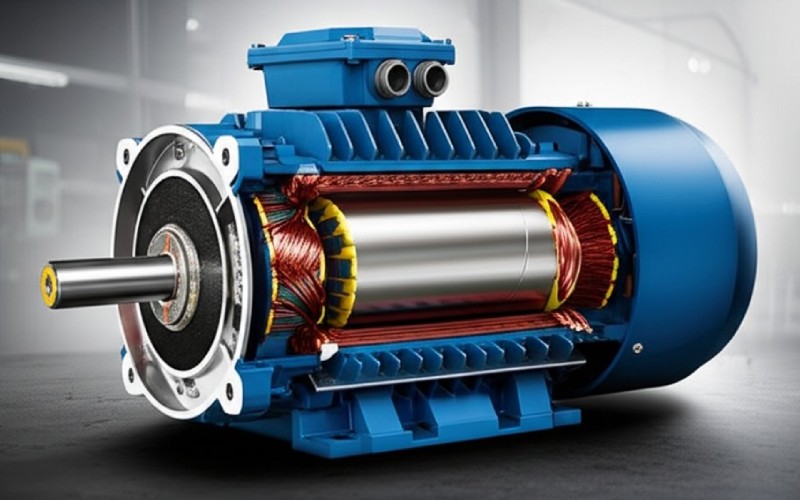
Sino의 라미네이션 스택으로 프로젝트에 힘을 실어주세요!

프로젝트 속도를 높이기 위해 라미네이션 스택에 다음과 같은 세부 정보를 레이블로 지정할 수 있습니다. 허용 오차, 재료, 표면 마감, 산화 단열재가 필요한지 여부, 수량등 다양한 기능을 제공합니다.
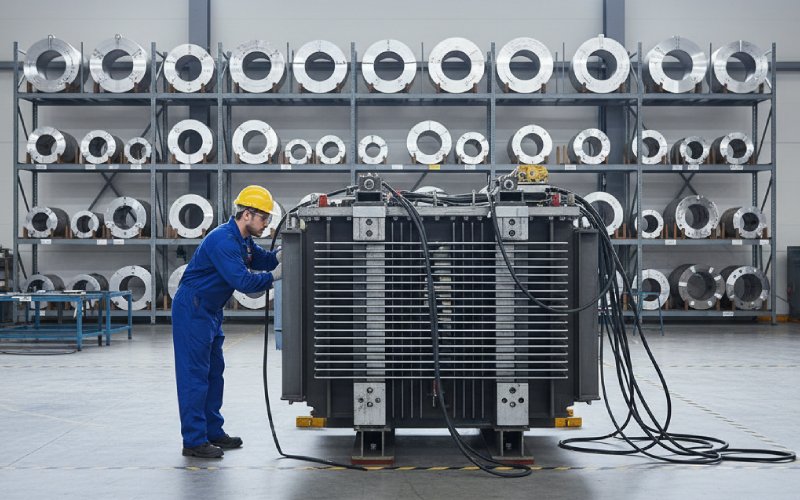
CRGO lamination vs nanocrystalline core: where each wins

What this article is about: CRGO 라미네이션 스택 vs nanocrystalline cores, from a design + purchasing point of view.


1. Quick context: what you already know

You already know the basics:

  • CRGO = grain-oriented silicon steel laminations, high flux density, excellent for 50/60 Hz power transformers.
  • Nanocrystalline = Fe-based ribbon, nanometer grain size, very high permeability, very low loss from low to medium-high frequency.

The data sheets say similar things, in slightly different fonts. The question is how they behave when you build actual cores and lamination stacks, and where each choice really earns its keep.


2. Magnetic numbers side-by-side (realistic, not perfect)

Let’s put typical catalogue values on one page. These are ballpark engineering numbers, not design limits.

Parameter (typical)CRGO lamination stackNanocrystalline tape-wound core
Saturation flux density Bs≈ 1.8–2.0 T≈ 1.2–1.3 T
Relative permeability µr (usable range)≈ 30,000–50,000≈ 80,000–150,000 (tunable up, even higher)
Core loss @ 50 Hz, 1.7 T≈ 0.9–1.6 W/kg (Hi-B at low end)Not usually run that hard at 50 Hz
Core loss @ 20 kHz, 0.1 T>150 W/kg<15 W/kg
Curie temperature≈ 730–750 °C≈ 550–580 °C
전기 저항≈ 40–50 μΩ·cm≈ 100–120 μΩ·cm
Typical stacking / lamination factor~0.96 for good step-lap stacks~0.75–0.80 for wound ribbons
Sweet-spot frequency band50/60 Hz, up to a few hundred HzA few kHz up to tens of kHz (depends on flux)
Geometry in practiceEI, step-lap cores, wound legs, reactorsToroids, cut cores, C-cores, special stacks
Relative material cost per kgLower더 높음
Relative power density potentialLimited by losses at higher fVery strong in medium-frequency range

Data above merges published examples from core vendors and material notes, not just one marketing sheet.

A couple of things jump out:

  • CRGO carries more flux before saturation, which matters for fault current withstand and inrush.
  • Nanocrystalline slashes high-frequency loss by roughly one order of magnitude at the same induction.

Those two facts already hint at where each wins.


3. Where CRGO lamination stacks are still the obvious choice

3.1. Big iron at 50/60 Hz

If you’re doing MV/HV power or distribution transformers at grid frequency, you’re almost certainly on CRGO laminations for the main core:

  • Efficiency in the 98–99% range is reachable with modern Hi-B grades (≤0.9 W/kg @ 1.7 T, 50 Hz, with laser scribing).
  • Stacking factor around 0.96 in good step-lap builds means you’re not wasting window area on air.

For a 1 MVA 50 Hz unit, switching to nanocrystalline for the main legs is usually a non-starter:

  • You’d have to run Bs lower to control loss at 50 Hz, so the core volume goes up.
  • Mechanical structure becomes tricky: tape-wound blocks under heavy clamping and transport loads are not happy unless you redesign everything around them.

So for classic power transformers, CRGO lamination stacks win by a wide margin on cost per kVA, practicality, and ecosystem.

3.2. High flux, short-circuit duty, “abuse mode”

Whenever the spec smells like:

  • high fault current
  • long inrush
  • thermal constraints in oil or resin

…you’ll appreciate having ~1.9–2.0 T saturation instead of ~1.25 T.

Nanocrystalline can deal with high induction in special cases, but the point is simple: if the core lives near the limit during faults, CRGO is usually safer.

3.3. Very large frame sizes and local fabrication

On big cores:

  • You can cut, stack, and re-stack CRGO laminations locally, using well-known jigs.
  • Repair shops know how to re-build them.
  • You can source electrical steel from multiple mills, slit locally, and keep supplier risk under control.

Nanocrystalline cores in those sizes exist (laminated nano stacks, not just toroids), but they’re specialty items with fewer suppliers and tighter process windows.

If your purchasing team wants second and third sources for every strategic part, CRGO stacks keep life simpler.


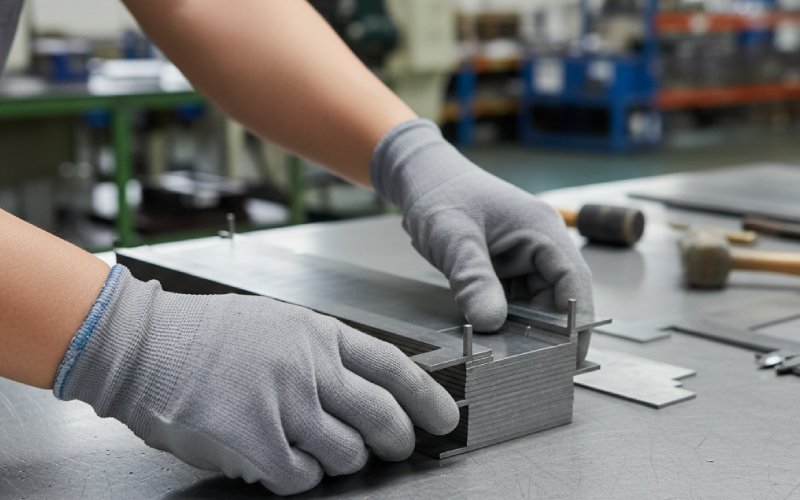
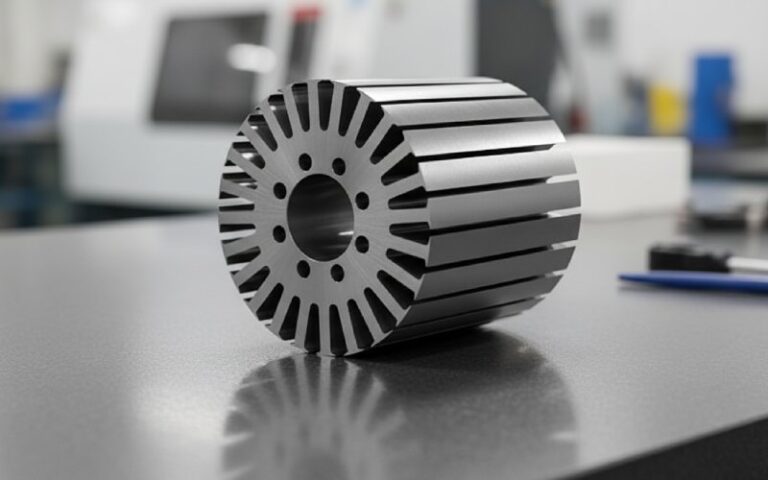
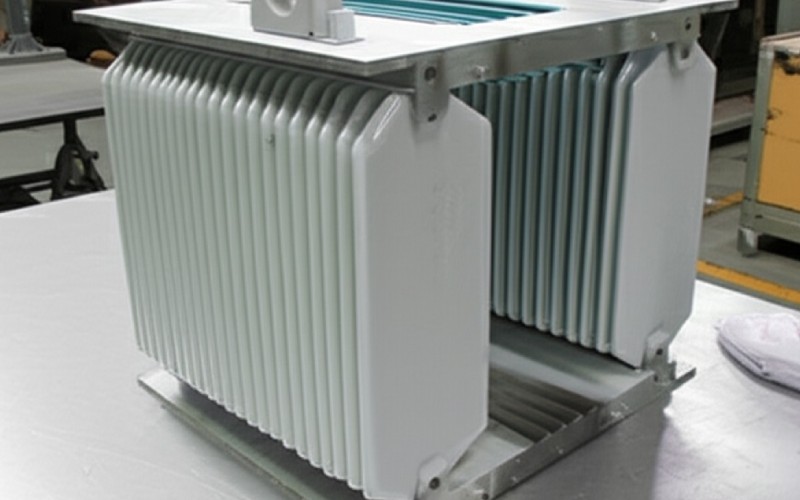
close-up CRGO lamination assembly

4. Where nanocrystalline cores absolutely shine

Now the interesting part. Places where CRGO is technically possible, but not wise.

4.1. Medium-frequency power (a few kHz to tens of kHz)

Think:

  • solid-state transformers
  • EV fast chargers
  • solar and storage inverters
  • medium-frequency link converters

In that band, CRGO core loss explodes. Nanocrystalline stays calm:

  • Typical data: at 20 kHz, 0.1 T, nanocrystalline cores can sit below 15 W/kg vs >150 W/kg for CRGO silicon steel – about a 10× difference.
  • High permeability (up to ~80,000 and beyond) means fewer turns, shorter copper paths, and compact transformers at those frequencies.

So if your fundamental or dominant switching frequency is in the 5–50 kHz region and power isn’t tiny, nanocrystalline is usually the front-runner, not ferrite and not CRGO.

4.2. EMI and common-mode chokes

Common-mode chokes and EMI filters are classic nanocrystalline territory:

  • Very high µr across a broad band → big inductance in a small toroid.
  • Low loss even under HF ripple → cooler filters at the same attenuation.

With CRGO you’d either:

  • burn too much loss at high frequency, or
  • need absurd dimensions to reach the same impedance.

So if your BoM has multiple large ferrite CM chokes, swapping to nanocrystalline tape-wound cores is often the easiest density upgrade.

4.3. Instrument transformers & metering

For current transformers (CTs) and precision instrument transformers:

  • High permeability and low coercivity shrink magnetizing current and improve linearity.
  • Higher resistivity (~100–120 μΩ·cm vs ~45 μΩ·cm for CRGO) helps control eddy currents at higher harmonics.

If the CT sees distorted waveforms – drives, EV chargers, UPS outputs – nanocrystalline cores tend to maintain ratio and phase accuracy where silicon steel starts to wander.

4.4. Harmonic-rich 50/60 Hz systems

Sometimes the fundamental is still 50/60 Hz, but:

  • THD is ugly
  • loads are electronic
  • power factor correction and rectifiers throw high-frequency components into the core

Here, nanocrystalline behaves like “CRGO + filter ferrite in one material”. You get:

  • good flux handling at moderate inductions
  • strong attenuation of HF components due to permeability profile and lower loss

That’s one reason you see nanocrystalline in modern dry-type transformers and special reactors aimed at power electronics.


5. Frequency bands: quick design cheat sheet

Not strict rules. Just a sanity check for early selection:

  • 0–200 Hz, bulk power, MV/HV
    • Main core: CRGO 라미네이션 almost every time.
    • Nanocrystalline only in small auxiliary pieces (CTs, sensors).
  • 200 Hz–2 kHz
    • If induction is low and size is generous: CRGO or amorphous may still fit.
    • If you’re pushing density or seeing strong ripple: nanocrystalline becomes very attractive.
  • 2–50 kHz
    • Power transformers: nanocrystalline vs ferrite; CRGO usually drops out early.
    • EMI: nanocrystalline for compact high-current chokes; ferrite for cheaper, cooler spots.
  • >50 kHz
    • Ferrite still dominates, with some advanced nanocrystalline and powder cores for niche high-power designs.

If your design sits exactly on a boundary, expect iterations, not a single “correct” answer.


6. Cost, availability, and risk – from a buyer’s chair

6.1. Material + processing cost

  • CRGO 라미네이션
    • Low cost per kg, high stacking factor, reasonably low waste with good nesting.
    • Cutting, step-lap punching, and stacking are all mature processes worldwide.
  • Nanocrystalline cores
    • Higher cost per kg, lower stacking factor, more process steps (winding, annealing, coating, potting or casing).
    • But you often use less core volume because of higher µr and because your frequency is higher.

On a part level, nanocrystalline may look expensive. On a system level, once you factor:

  • reduced copper
  • smaller magnetics
  • smaller thermal hardware

…it can land cheaper per kW handled, especially in medium-frequency converters.

6.2. Lead time and second-source strategy

CRGO strip and laminations:

  • Many mills, many slitters.
  • Easier to qualify alternatives, though grades differ.

Nanocrystalline:

  • Fewer alloy producers and core factories.
  • Annealing recipes and coating processes vary from supplier to supplier.

If your project is safety-critical or long-lived, it’s worth designing mechanical envelopes and lamination stack windows that can accept at least two nanocrystalline core geometries, not just one proprietary part.


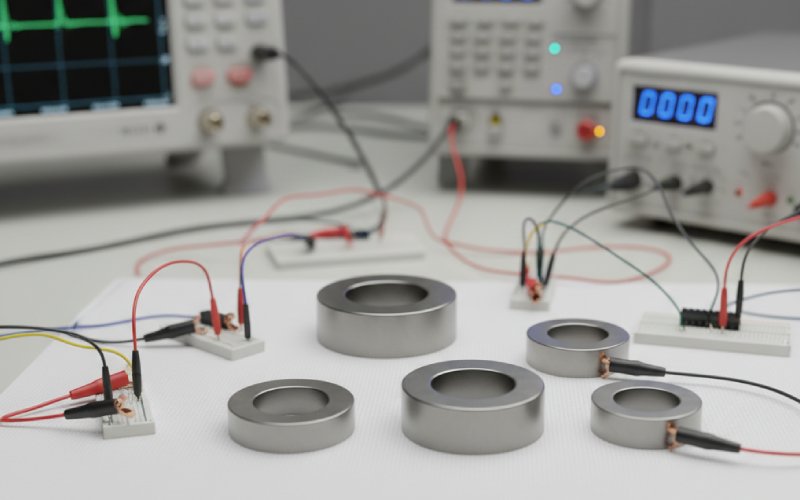
nanocrystalline toroidal cores on bench

7. Mechanical and manufacturing traps to avoid

These aren’t on the data sheet, but they hit yield.

7.1. Over-clamping nanocrystalline cores

Nanocrystalline ribbon is:

  • thin
  • sharp
  • somewhat brittle

Excess clamping or uneven pressure can:

  • increase loss
  • create hot spots
  • even crack the core coating

Design your clamping scheme to treat the wound core as a precision component, not as a stack of heavy laminations.

7.2. Treating CRGO like it has infinite stacking factor

For lamination stacks:

  • Burrs, poor cleaning, and sloppy step-lap alignment can quietly kill your assumed 0.96 stacking factor and efficiency.
  • Small air gaps between packets show up as higher no-load loss and noise.

So if you’re chasing fractional-percent efficiency, core shop process control is as important as material grade.

7.3. Ignoring frequency content of the waveform

Designs sometimes say “50 Hz transformer” when the load is a drive cabinet:

  • DC-bus choppers
  • switching ripple
  • high harmonic content

In that case:

  • Using pure CRGO stacks sized for 50 Hz RMS can give nasty core heating under real waveforms.
  • composite approach (CRGO main legs + nanocrystalline auxiliary cores or filters) often hits a better balance.

8. Practical decision path: CRGO lamination vs nanocrystalline core

You can sanity-check your material choice with a few blunt questions.

  1. Is the main operating frequency ≤ 400 Hz and power above, say, tens of kVA?
    • Yes → Start with CRGO 라미네이션 스택.
    • No → Consider nanocrystalline or ferrite first.
  2. Do you need to endure high inrush or short-circuit currents at high flux?
    • Yes → CRGO has more headroom in Bs.
    • No → Lower Bs of nanocrystalline can be fine; design around it.
  3. Is the core also doing EMI / common-mode filtering or living in a strongly distorted waveform?
    • Yes → Nanocrystalline cores for chokes and aux transformers are usually better.
  4. Is your main constraint volume and weight, not raw material cost?
    • Yes → Nanocrystalline gains value fast as power density matters more than kg price.
  5. Do you have local lamination capacity but limited access to specialty cores?
    • Yes → CRGO laminations may be safer for schedule until supply chain matures.

You can of course mix both: CRGO main lamination stack + nanocrystalline CTs and CM chokes in the same product is already common in modern switchgear and power converters.


9. FAQs: CRGO lamination vs nanocrystalline core

Q1. Can I drop nanocrystalline cores into an existing CRGO transformer design and expect an efficiency upgrade?

Usually no.
Nanocrystalline wants a different 플럭스 밀도, different window utilization, and often different cooling strategy.
Direct one-for-one swaps tend to either saturate the core or under-use the material.
If you want nanocrystalline benefits, treat it as a new magnetic design, not a replacement lamination grade.

Q2. Is there such a thing as “nanocrystalline lamination stacks” like CRGO stacks?

Yes, but they’re not commodity parts.
Researchers and some manufacturers build laminated nanocrystalline cores by stacking treated ribbons or tape-cut tiles, mainly for high-frequency power electronics where standard toroids don’t fit.
For now, though, most commercial nanocrystalline parts you’ll see are:
toroids (solid or cut)
C-코어
special wound shapes
If your business is classic power transformers, you’ll still live mostly in CRGO lamination stacks for a while.

Q3. How do nanocrystalline cores compare to amorphous metal?

At a high level:
Both have much lower loss than CRGO at line frequency. Amorphous can cut core losses by up to ~70% vs conventional silicon steel in many cases.
Nanocrystalline often improves on amorphous at 더 높은 주파수, with higher permeability and lower loss in the tens-of-kHz band.
그래서:
For ultra-efficient 50/60 Hz distribution transformers in big volumes: amorphous and advanced GOES compete.
For medium-frequency magnetics and EMI: nanocrystalline tends to win.

Q4. Is nanocrystalline overkill for low-power SMPS?

Sometimes yes.
For a 20–50 W flyback at 100 kHz:
Ferrite is cheap, easy, and good enough.
Nanocrystalline starts to make more sense as power, current, or DC bias go up, or when size is severely constrained.
For higher-power SMPS (kW-class) with demanding EMI and efficiency targets, nanocrystalline transformers and chokes can be a strong lever.

Q5. What should I tell purchasing when they ask “Why is this core so expensive?”

Three short points usually help:
At the converter level, loss and cooling cost more than steel. Lower core loss can reduce heatsink, fan, or liquid cooling requirements.
Higher permeability means less copper, fewer turns, and sometimes cheaper PCB and assembly.
In many projects, magnetics volume and weight are now system-level constraints (rack space, vehicle packaging), not just line items in the BoM.
If that still doesn’t land, run a simple cost-per-watt-saved comparison between CRGO and nanocrystalline designs. The numbers tend to speak quietly but clearly.

마무리

CRGO lamination stacks aren’t going away. They’re unbeatable for large, low-frequency transformers and anything that lives at high flux under fault conditions.

Nanocrystalline cores aren’t magic either. They just bend the trade-offs in your favor once:

  • frequency rises
  • harmonic content gets ugly
  • or you’re chasing compact, efficient magnetics in power electronics.

If you treat both as tools, not teams, and align them with the right frequency band and duty, your lamination stacks, wound cores, and purchasing decisions will all start to line up much more easily.

사랑을 나누세요
Charlie
Charlie

Cheney는 정밀 제조에 대한 강한 열정을 가진 Sino의 선임 애플리케이션 엔지니어입니다. 그는 기계 공학에 대한 배경 지식을 보유하고 있으며 광범위한 실무 제조 경험을 보유하고 있습니다. Sino에서 Cheney는 라미네이션 스택 제조 공정을 최적화하고 혁신적인 기술을 적용하여 고품질의 라미네이션 스택 제품을 만드는 데 주력하고 있습니다.

신제품 브로셔

아래에 이메일 주소를 입력해 주시면 최신 브로셔를 보내드립니다!

ko_KRKorean

Sino의 라미네이션 스택으로 프로젝트에 힘을 실어주세요!

프로젝트 속도를 높이기 위해 라미네이션 스택에 다음과 같은 세부 정보를 레이블로 지정할 수 있습니다. 허용 오차, 재료, 표면 마감, 산화 단열재가 필요한지 여부, 수량등 다양한 기능을 제공합니다.