Let Sino's Lamination Stacks Empower Your Project!
To speed up your project, you can label Lamination Stacks with details such as tolerance, material, surface finish, whether or not oxidized insulation is required, quantity, and more.
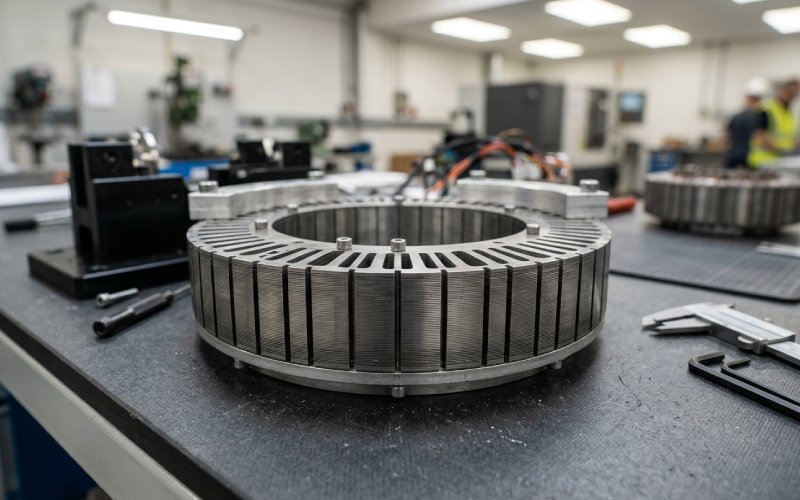
When buyers ask whether axial flux motor laminations are better than radial flux laminations, we usually slow the question down. Not much. Just enough. The real issue is not the motor sketch. It is the lamination stack: how many segment families exist, how the flux crosses the steel, how flat the assembly stays, how the stack is cooled, and how much variation the design can survive before torque ripple and loss start showing up in production parts. Axial flux machines do have a strong case in short-package, high-torque-density layouts, but the lamination problem becomes less forgiving the moment the concept leaves CAD.
From a stack manufacturer’s side, radial flux is still the more natural format for laminated steel. The punch profile is typically repeated and stacked in the axial direction. Tool correction is cleaner. Stack compression is cleaner. Automation is cleaner. Axial flux changes that. In many builds, the electrical steel is no longer a repeated axial stack of one profile; it becomes a set of non-uniform radial segments or teeth-and-back-iron pieces, and even small geometry changes can become difficult to make economically once tooling is released.
Axial flux laminations make sense when the package is driving the project, not just the motor team. Very short axial length. Large usable diameter. High torque at low to medium speed. Direct access to cooling surfaces. Those are real advantages, and they are why axial flux keeps showing up in traction, aerospace-adjacent, and tightly packaged industrial systems. The point is not that axial always wins. The point is that it can move the system boundary in ways radial flux cannot.
There is also a stack-level reason axial designs stay viable: segmentation. A segmented stator can push slot fill factor much higher than a conventional one-piece laminated core when the tooth, winding, and assembly route are designed together. In segmented concentrated-winding builds, copper fill can move into the 75% to 80% range, which is one of the few places where manufacturing and electromagnetic performance point in the same direction at the same time. Not always. But often enough to matter.
And material usage can improve in the right stack architecture. Segmented laminations can reduce punch waste compared with layouts where stator and rotor features are forced out of the same sheet pattern. That does not guarantee lower total cost, because assembly labor, datum control, bonding, and inspection usually get harder. Still, on programs where material nesting is ugly in a one-piece core, segmentation is not just an electromagnetic choice. It is a factory choice.
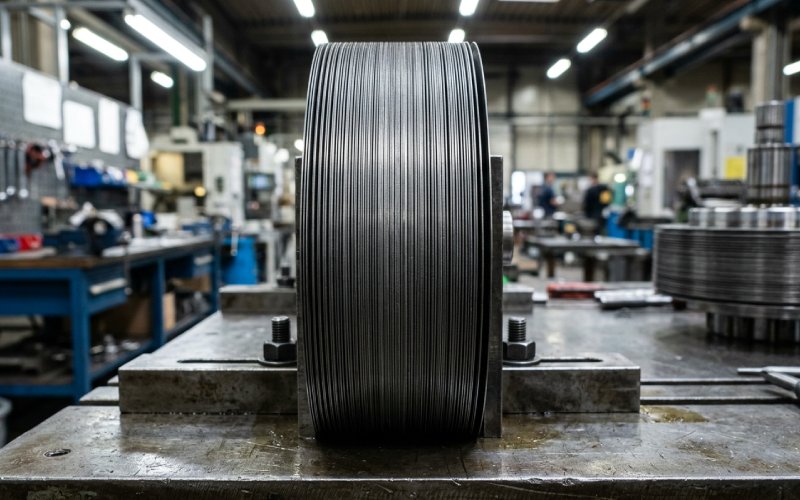
The trouble starts with the flux path and the steel format. Conventional electrical steel likes 2D logic. Axial flux machines often do not. Some topologies push the magnetic circuit into a more three-dimensional path, and that is exactly where laminated stacks become awkward to manufacture. Once the design needs 3D flux behavior, the team usually ends up accepting either segmentation complexity, hybrid core structures, or alternative magnetic materials with weaker magnetic properties than electrical steel. None of those options is free.
The second problem is gap control. Segmented cores bring parasitic gaps. Small ones, yes. Still there. Those gaps can raise cogging, disturb the working harmonic, and reduce torque if the segment-to-segment fit is not consistent. Extra cut edges do not help either. Cut-edge damage degrades local magnetic properties, which pushes loss upward and makes tight process control more important than many early prototypes suggest. This is one reason an axial flux sample can look fine in the lab and then become fussy in batch production.
Then there is slot opening. In radial flux motors, slot-opening tradeoffs are already familiar. In axial flux laminations, the effect becomes more uneven through the stack. Wider slot openings can lower stator core loss, but they also increase eddy losses in the magnets, and both very large and very small openings can hurt torque. More awkwardly, slot opening in segmented axial designs changes the flux density distribution from one lamination slice to another. That makes “just open the slot a little” a poor factory instruction.
For high-volume industrial production, radial flux laminations are still the safer answer most of the time. Better-established tooling logic. Fewer assembly variables. Easier stack referencing. More forgiving automation. More predictable cost-down over time. If the project brief is cost, repeatability, and speed of industrialization, radial flux remains the default for a reason.
There is also a quiet point that gets missed: a lighter or shorter motor concept does not automatically produce the better machine once cooling and efficiency are held to practical limits. In one traction-motor comparison built around common operating targets and cooling assumptions, a comparable radial layout remained preferable unless the axial machine moved into a more aggressive yokeless architecture; even then, the thermal and mounting problems did not disappear, they just moved. That is normal. Packaging gains usually send the engineering burden somewhere else.
Before we quote an axial flux lamination stack, we look at four things first: segment family count, inter-segment gap tolerance, final flatness after bonding or welding, and how the customer wants the core referenced during assembly. Not because those are the only issues. Because they decide whether the rest of the issues are manageable.
If the design needs many unique segment geometries, engineering change cycles slow down. If the segment interfaces do not have a stable datum strategy, gap scatter shows up. If the stack cannot stay flat, axial force, air-gap consistency, and NVH start to drift together. If the thermal path is still being “worked out later,” the lamination design is probably not stable yet. Axial flux programs punish late-stage compromise more than radial ones do.
| Decision point | Axial flux laminations | Radial flux laminations | What this means for the stack supplier |
|---|---|---|---|
| Core geometry | Often segmented, non-uniform, radially assembled | Usually repeated profiles stacked axially | Axial needs tighter datum planning and more assembly control |
| Flux path vs steel format | Can push toward 3D magnetic behavior | Better aligned with conventional laminated steel practice | Radial is naturally easier to industrialize |
| Slot fill potential | Can be very strong in segmented concentrated-winding builds | Strong, but usually less aggressive in comparable one-piece cores | Axial may justify extra stack complexity when copper utilization is critical |
| Parasitic gaps | Higher risk due to segmentation interfaces | Lower in conventional one-piece stacks | Axial needs stricter fit-up and inspection |
| Cut-edge sensitivity | More cut edges in segmented architectures | Fewer edge interruptions in conventional stacks | Axial needs sharper burr and edge-damage control |
| Cooling dependency | Package may allow good cooling access, yet compact stators can still be thermally limiting | More familiar cooling integration | Thermal design must be frozen early in axial projects |
| Design changes after tooling | Often more disruptive | Usually simpler to implement | Radial is more forgiving during late revisions |
| Best-fit use case | Short axial envelope, torque-dense premium systems, modular builds | Cost-focused, volume-focused, mature industrial programs | Choose axial for system packaging value, not for novelty |
The table above is the pattern we see repeatedly in engineering work around segmented cores, slot-fill behavior, stack losses, cooling limits, and comparative axial/radial machine studies.
Sometimes yes. Not by default.
They make sense when the customer is buying a system advantage: shorter axial package, higher torque density at useful diameter, modular stator construction, or a thermal layout that actually benefits from the geometry. In those cases, the added stack complexity can be justified. Sometimes it is the only sensible route.
They do not make sense when the project mainly wants a cheap, repeatable, scalable laminated core with fast tooling iteration and wide process margin. That is still radial flux territory in most B2B production programs. The mistake is forcing an axial answer onto a radial manufacturing problem.
For our factory, the rule is simple enough: if the packaging gain is real, and the segment strategy is disciplined, axial flux laminations can be the right product. If the value case depends on ignoring gap control, cut-edge effects, or thermal limits, the design usually circles back to radial flux after a few rounds. Not because axial is wrong. Because the stack told the truth first.
No. But segmentation shows up often because many axial designs do not fit the repeated-sheet logic used in conventional radial stacks. Once the geometry becomes non-uniform in the radial direction, segmented teeth, segmented back irons, or hybrid core structures become more likely.
They can. The main upside is higher slot fill and easier concentrated-winding assembly, which can support higher torque density. The tradeoff is extra parasitic gaps, more cut edges, and stronger sensitivity to assembly variation.
Not automatically. Material nesting can improve in segmented architectures, but total cost also depends on tool count, assembly time, bonding method, flatness control, and inspection burden. In low-volume premium builds, that can still work. In volume manufacturing, it often does not beat a radial stack on cost.
Inter-segment gap control and final flatness usually sit at the top of the list. Once those drift, the air gap, loss balance, torque ripple, and vibration behavior can drift with them. Slot-opening geometry is also more sensitive than many teams expect.
Stay with radial flux when the program is volume-driven, cost-driven, high-speed, or still changing late in development. Radial laminations are usually easier to tool, easier to automate, and more tolerant of iteration.



 English
  German
  Spanish
  French
  Italian
  Japanese
  Korean
  Dutch
Dutch  Indonesian