Let Sino's Lamination Stacks Empower Your Project!
To speed up your project, you can label Lamination Stacks with details such as tolerance, material, surface finish, whether or not oxidized insulation is required, quantity, and more.
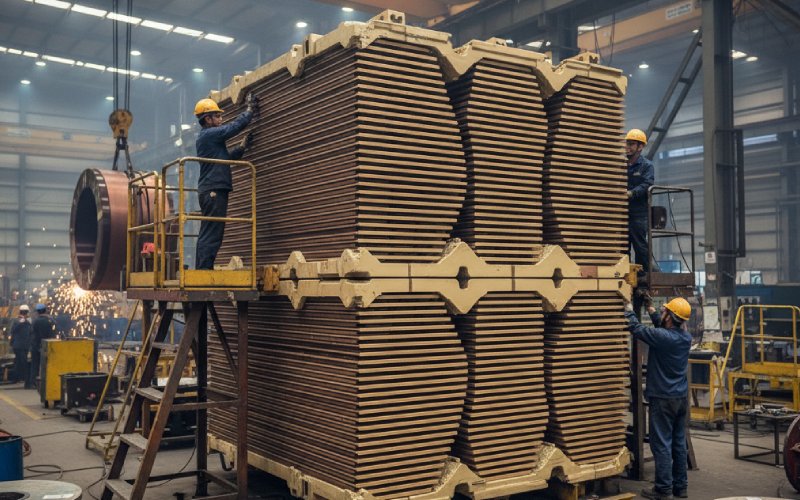
Backlack-style self-bonding coatings on transformer laminations give you tighter, quieter, more stable cores, while taking away some repair flexibility and pushing process discipline and material cost higher. That trade is not theoretical; it shows up on your loss figures, noise tests, capex plan, and eventually on how painful your next major repair will be.
The steel doesn’t change. The flux paths don’t suddenly discover new physics. What changes is how each lamination talks to the next one.
Instead of relying only on a thin inorganic insulation plus clamps, step-lap geometry, welds, or interlocks, Backlack adds an organic bonding varnish that acts both as insulation and as an adhesive. Under heat and pressure, the coating cures and laminations lock to each other over their whole surface, turning a loose pack into a rigid, insulated block.
Suppliers describe this as a full-area bond that can replace most mechanical joining methods, especially where thin-gauge NGO/GO steels are used and traditional interlocks or welds become troublesome.
That sounds simple. It isn’t, but the idea is.
Core losses are already dominated by material grade, lamination thickness, and geometry. Coating choice usually comes later in the discussion. With Backlack, it moves up a notch.
A conventional transformer core uses an inorganic core-plate coating to break up eddy-current paths between laminations; each sheet is effectively a separate conductor with higher resistance along the thickness. When you introduce full-surface bonding, you keep that insulation but also remove a lot of tiny air gaps and burr-driven contacts that appear around interlocks, weld nuggets, rivet holes, and rough cut edges. Marketing language usually promises “lower core loss”; the real picture is narrower.
Studies and supplier tests on bonded electrical steel stacks show that:
For a distribution transformer, that doesn’t mean miracle numbers. Think of it more like shaving a few percent off core losses that were already acceptable, especially at higher flux densities where any extra local hotspot hurts. The effect is strongest when you would otherwise have to weld or rivet the core and introduce local stress and metallic bridges.
On the other hand, the coating itself adds a small non-magnetic thickness. If the process isn’t well controlled and the film is too thick or uneven, the stacking factor drops and part of your gain is given back. This is why Backlack lines obsess over film thickness and bonding pressure; the coating can help stacking factor by filling micro-gaps, but it can also hurt it if the layer is excessive.
In short: self-bonding coatings help you avoid bad contact, not bad steel. If you’re already using high-grade GO with careful cutting and minimal welding, the electrical advantage is real but not infinite.
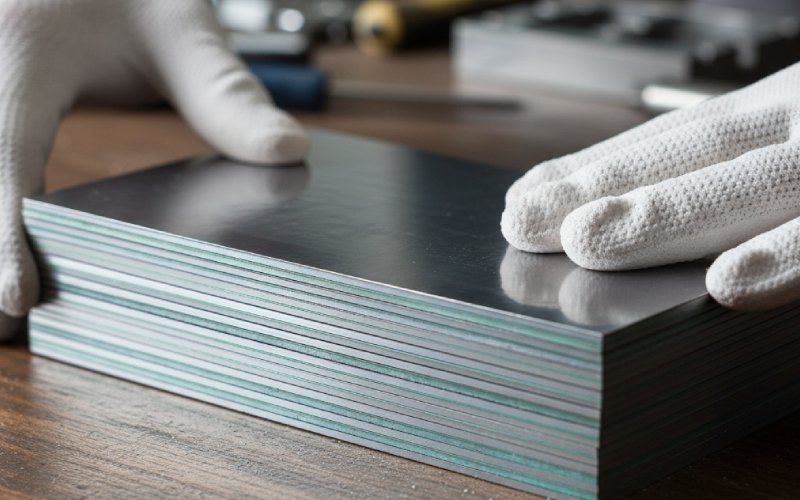
Mechanically, a bonded lamination stack behaves more like a single composite block than a bundle of loose leaves. That has consequences.
When laminations are glued to each other over their full face, you get higher stiffness and better shape retention. No rattling at joints, fewer issues with laminations creeping under vibration, and less risk of local shifting when the transformer sees electrodynamic forces during inrush or faults, as long as the external clamping is designed sensibly. Supplier data and long-running motor experience show that full-face bonding gives high mechanical stability and dimensional accuracy by avoiding weld-induced stresses.
Now to noise. Magnetostriction makes transformer cores “sing”. Every small gap or loose edge becomes a miniature loudspeaker. Classic work on silicon-iron laminations showed that bonding laminations with a flexible adhesive significantly reduces magnetostrictive vibration compared with loose stacks. Modern bonding varnishes are designed with damping in mind; manufacturers explicitly promote noise reduction as one of the main benefits of Backlack-style coatings.
For distribution transformers in residential or office environments, that reduction in audible hum is often more important than the last watt of core loss. And it works in both dry-type and oil-immersed units, though the details differ.
There is a flip side. If you rely emotionally on the adhesive to carry short-circuit forces, you are doing it wrong. In large power transformers, mechanical forces during faults are still handled by frames, spacers, and clamps. The adhesive should keep laminations from buzzing and sliding, not substitute steel supports. If the bond cracks locally under stress because of poor curing or overtemperature, you can end up with very localised noise and no easy way to fix it without core disassembly.
Air is an awful thermal conductor. Adhesive varnish is not amazing, but it is distinctly better than air.
Backlack suppliers highlight that full-surface bonding improves axial heat transfer because the varnish’s thermal conductivity exceeds that of the air pockets left by interlocking or discrete welding. Self-bonding lamination manufacturers report stack designs where axial temperature can drop several degrees Celsius compared with mechanically joined laminations, given the same loading.
On a thermal map, that means a smoother gradient along the limb: fewer local hotspots where laminations lose contact or lift slightly around mechanical joints. For oil-filled transformers, better heat spreading inside the core also makes oil flow patterns less extreme, which is nice for ageing margins.
High-temperature behaviour is where caution starts. Some bonding varnishes designed for NGO steels can retain useful peel strength after short exposures at 250 °C. That doesn’t turn the coating into a high-temperature structural adhesive; it simply means the bond will usually survive common assembly cycles and some overload scenarios without instantly debonding.
Long-term, the organic layer still ages. If your transformer routinely runs with a hot-spot near the upper end of its class and sees frequent overloads, the adhesive becomes one more component to validate in your life-expectancy model. It usually survives, but it is not immortal.
On paper, Backlack simplifies things: fewer welds, no interlocks, no separate glue, just press and heat. In production, it adds a new kind of complexity.
A self-bonding coating is usually based on an epoxy system that cures under a defined combination of temperature, pressure, and time, forming a high-strength bond over the full lamination area. Suppliers provide processing windows that define stack temperature and holding time, often with fast-bonding options that use inductive heating to reach bonding temperature in minutes.
This creates a few realities for a transformer plant:
You now depend on good temperature uniformity through the entire stack. Thin motor cores are relatively easy to heat; thick transformer limbs and yokes are not. If the core centre lags behind the surface, you may end up with a partially cured bond: strong near the outer laminations, weak in the middle. That shows up later as noise, local movement, or odd failures in bond tests.
You also acquire more process parameters to control: coating thickness, storage conditions, curing schedule, lamination cleanliness. Scrap due to under- or over-bonding is not as visually obvious as a bad weld. It often appears only in acoustic tests or mechanical checks, which may mean you discover problems late.
On the cost side, the coated steel is more expensive than a conventional core-plate coating alone. You save on welding and interlocking operations, and possibly on assembly time if your bonding presses are sized correctly for volume. Bonding varnish is marketed as a way to reduce overall joining cost for thin-gauge steels where welding is awkward. Whether that is true for your transformer line depends on volumes, existing tools, and what you already depreciated.
So you trade welding jigs and skilled welders for presses, ovens (or induction systems), and process engineers. It’s still metalwork; just with a bit more chemistry.
Transformers live long, boring lives until they don’t. Core repair is an important chapter in that story, and Backlack changes the script.
Traditional stacked cores held together with clamps, wedges, and a modest amount of varnish can be disassembled. Repair shops routinely restack laminations, replace damaged sheets, and rebuild the core after insulation failures or mechanical accidents. The process is messy but feasible.
A fully bonded core is different. Once the laminations are glued over their full area, separating them without destroying them is almost impossible at scale. Small repairs around the outer edges might still be possible; anything deeper tends to turn into scrap.
That has two consequences.
First, you need higher confidence in your initial design margins, especially for units where field repairability is part of the business model. Second, when something catastrophic happens in a bonded-core transformer, the economics tilt more quickly toward full replacement instead of deep repair. For small and medium distribution units, that may be acceptable. For very large power transformers with complex logistics, maybe not.
Bond failure itself is another mode. It usually shows up as localised noise or vibration, not immediate electrical failure. If a region of the core loses bonding due to improper curing or thermal ageing, laminations can start to buzz against each other, increasing local losses and acoustic output. You can sometimes detect this with careful sound and vibration measurements, but fixing it often means disassembling a lot to reach a small area.
With Backlack, you commit. And later, you pay for that commitment, one way or another.
The table below compares Backlack/self-bonding coatings on transformer laminations with more traditional inorganic coatings plus mechanical clamping or welding. It is written from the viewpoint of someone trying to decide for a new design, not for marketing.
| Aspect | Backlack / self-bonding laminations | Conventional coating + clamping / welding |
|---|---|---|
| Interlaminar insulation and core loss | Full-surface bond with good insulation; reduces local shorts at burrs and mechanical joints, often giving slightly lower overall core loss, especially where welding would otherwise be used. | Relies on core-plate coating plus clamps; any welds, rivets, or interlocks create local metallic bridges and stress, which can increase loss in those regions. |
| Stacking factor | Can achieve high stacking factor if film thickness is tightly controlled; adhesive fills micro-gaps and keeps laminations flat. | Very high stacking factor possible, but air gaps from interlocks and weld distortion partly offset this; rough assembly practices can hurt more. |
| Acoustic behaviour | Bonded faces and viscoelastic varnish damp magnetostrictive vibration; typical result is a quieter core, especially under higher flux. | More prone to lamination buzz and joint vibration, particularly near welds and clamps; acoustic treatment often needed elsewhere in the design. |
| Thermal path | Full-area contact gives better axial heat transfer than air gaps; hot spots along limbs and yokes tend to be smoother. | Heat must cross gaps and imperfect contacts; local temperature peaks around joints and lifted laminations are more likely. |
| Mechanical rigidity | High stiffness and shape stability of the stack; less risk of laminations shifting during handling and normal operation, assuming correct curing. | Rigidity comes mainly from frames, clamps, and welds; laminations can move slightly inside the pack, giving noise or wear over long service. |
| Short-circuit / fault behaviour | Adhesive contributes but should not be the main structural element in large cores; still needs strong mechanical bracing to carry electrodynamic forces. | Entirely reliant on mechanical structure; behaviour is well known and repair methods are established, at the cost of more structural metal and sometimes higher local stress. |
| Manufacturing and cycle time | Eliminates many welding and interlock steps; requires presses and controlled heating. Fast-bonding methods can achieve short bonding times but demand tight process control. | Uses standard, widely understood processes; may be slower in high-volume thin-gauge production because of mechanical joining and post-weld corrections. |
| Capital and operating cost | Higher steel price and investment in bonding equipment; can reduce labour in welding and rework. Economics improve with volume and thin-gauge steel. | Lower material cost and simpler tools if you already own welding and clamping equipment; labour-intensive where high precision and low noise are demanded. |
| Service and repair | Cores are effectively non-disassemblable; deep repairs often mean scrapping the core and replacing the unit or active part. | Cores can usually be disassembled, laminations restacked or replaced, and the core reused after major failures, especially in large units. |
| Quality sensitivity | Strong dependence on film thickness, curing profile, cleanliness, and storage; failures can hide until late tests. | More tolerant of small process variations; problems such as bad welds or damaged laminations are easier to see early. |
| Typical sweet spot | High-volume, low to medium power, noise-sensitive applications where material upgrades and process control are justified by efficiency and acoustic targets. | One-off or low-volume designs, very large units, or plants with entrenched welding/clamping infrastructure and strong in-house repair practices. |
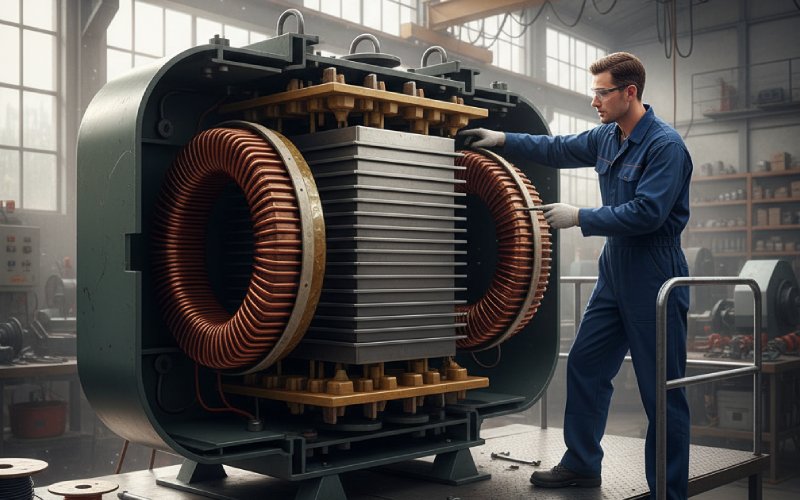
If you view transformers as mostly mechanical objects with copper and steel, Backlack is a manufacturing choice that happens to touch performance.
For small and medium distribution transformers, especially dry-type or low-noise designs, self-bonding coatings make sense when you are ready to invest in process control. You get quieter cores, slightly lower losses, better thermal spreading, and parts that survive handling with less drama. You also lock yourself into a different repair philosophy and rely more heavily on the stability of one organic layer for decades.
For very large power transformers, the case is less clear. Mechanical bracing, transport constraints, and established repair practices dominate the decision. Bonded laminations may still play a role in specific subassemblies or in experimental designs, but clamped, restackable cores remain the conservative path.
So the question is not “Is Backlack good?” It is “Where does a rigid, quiet, hard-to-repair core fit into your product mix, your factory, and your service model?”
Once you answer that, the coating choice mostly follows.


 English
  German
  Spanish
  French
  Italian
  Japanese
  Korean
  Dutch
Dutch  Indonesian