Let Sino's Lamination Stacks Empower Your Project!
To speed up your project, you can label Lamination Stacks with details such as tolerance, material, surface finish, whether or not oxidized insulation is required, quantity, and more.
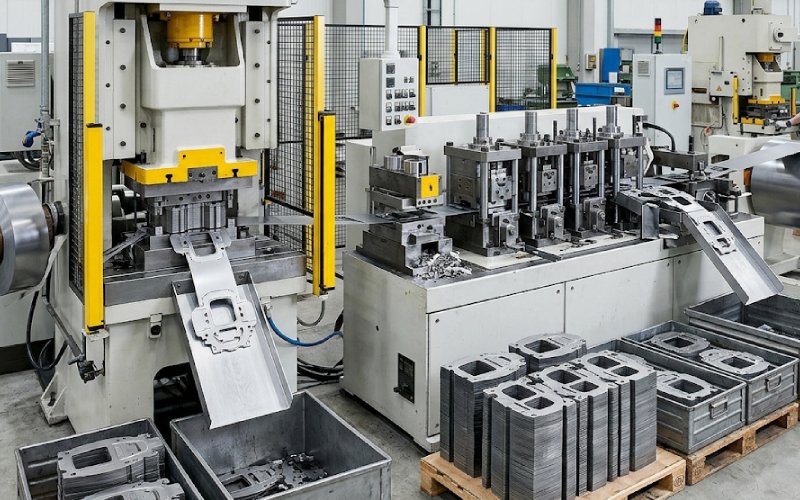
Most comparisons stop at tooling cost and output rate. That is the easy part. The harder part is what shows up later: cut-edge damage, stack joining, flatness drift, and the quiet jump in core loss after the line is already approved. For lamination stacks, the die choice is not just a press-room decision. It leaks into motor performance.
Quick answer:
Choose progressive stamping when demand is stable, the die needs multiple sequenced features, and in-die interlocking or automated stack flow is part of the plan. Choose compound stamping when flatness matters more, the lamination is larger, the program is still changing, or the stack will be joined outside the die anyway. The real trade-off is not speed alone. It is edge condition plus stack assembly method.
Compound stamping finishes the key features in one stroke. Progressive stamping spreads the work across multiple stations while the strip advances through the die. That basic difference drives almost everything else: tooling cost, automation level, feature sequencing, setup burden, and how much variation can accumulate before the lamination leaves the press.
For lamination stacks, though, the meaningful split is a little less neat. Compound tends to simplify the hit. Progressive tends to simplify the system around the hit. One favors part completion in a single event. The other favors flow, repeatability, and integrated stack handling once the volume is real.
Compound stamping usually makes sense when you want the lamination itself to stay clean, flat, and predictable. One stroke means fewer station-to-station handoffs inside the die, fewer alignment dependencies, and fewer places for strip progression issues to bleed into the part. On programs where part flatness and feature-to-feature consistency matter more than full-line automation, that is still a strong argument.
It also tends to be easier to justify early. Tooling is simpler. Setup is lighter. Design changes hurt less. That matters when the rotor or stator geometry is not fully frozen yet, or when annual volume is not high enough to amortize a more complicated die without regret. The choice is not glamorous. It is just cheaper to change direction before launch.
There is another case where compound keeps coming back into the discussion: larger laminations, or layouts that stop looking elegant once strip utilization and station count are pushed too far. At that point, a simpler one-hit approach can be the safer path, even if the raw output number on paper looks lower. Not always. Often enough.
Progressive stamping is the better fit when the lamination program is really an automation program. Multiple operations can be sequenced in one die. Strip transfer is controlled. Feature registration is managed from station to station. For small to medium laminations running in stable, long production cycles, that makes progressive stamping hard to beat.
This is where progressive dies earn their cost. Not only in stroke rate, but in what they let you combine: piercing, blanking, forming, and stack-related features in a continuous process. If interlocking is part of the stack concept, progressive stamping becomes even more attractive because the final station can feed directly into stack formation instead of pushing work downstream.
The catch is familiar and still easy to underestimate. Every added station is another place for wear, misfeed sensitivity, scrap behavior, burr growth, or coating disturbance to build quietly. The part can remain dimensionally acceptable while the magnetic penalty gets worse. That is a very normal failure mode in lamination work.
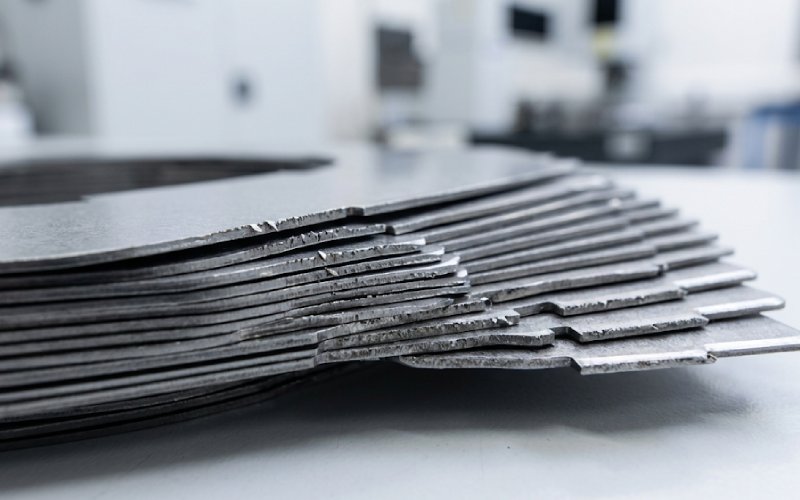
This is the part too many blog posts skip. For laminations, the cut edge is not a cosmetic detail. Punching creates plastic deformation near the edge, and that deformation changes magnetic behavior and raises iron loss. Tool wear makes the damage worse. Burrs do not stay as a drawing note either; they can become electrical bridges between sheets and start costing efficiency in the finished stack.
So when someone says progressive is faster, or compound is simpler, fine. True enough. But that is not the full decision. The better question is which route gives you tighter control over the damaged edge zone over the actual tool life you plan to run. Sometimes the winner on paper loses after the punches age.
Stack joining should be part of the process decision from the start, not a downstream note. Riveting, interlocking, and welding can all introduce local damage, residual stress, or interlayer electrical contact that pushes losses upward. Interlocking can also disturb flux paths locally. Welding can add thermal effects that do not show up in a simple dimensional check.
That shifts the compound-versus-progressive choice more than people expect. If the stack depends on in-die interlocking, progressive stamping usually has the stronger logic because the die architecture already supports controlled sequencing and stack formation. If the stack will be bonded or joined outside the die to protect isolation between sheets, compound becomes more competitive again. Different line logic. Different risk shape.
| Decision Point | Compound Stamping | Progressive Stamping | What It Means for Lamination Stacks |
|---|---|---|---|
| Tooling investment | Usually lower | Usually higher | Compound is easier to justify for unstable or lower-volume programs; progressive needs volume to pay back. |
| Tooling complexity | Simpler die layout | More complex multi-station design | Progressive brings more integration, but also more variables to monitor. |
| Production fit | Lower to medium volume, design still moving | High-volume, stable production | Progressive wins when the process stays fixed long enough to exploit automation. |
| Flatness control | Often stronger because the part is made in one hit | Can be excellent, but depends on station control | If flatness is the first concern, compound usually starts with an advantage. |
| Complex feature sequencing | Limited compared with multi-station flow | Strong | Progressive handles staged features and stack-related details better. |
| In-die interlocking / stack flow | Less natural | Strong fit | Progressive is usually the more efficient route when interlocking happens in the die. |
| Edge-condition risk over long runs | Fewer internal stations, simpler path | More opportunity for wear-driven drift | In both cases the cut edge matters, but long multi-station runs need tighter wear control. |
| Best use case | Larger laminations, flatter parts, evolving programs | Small to medium laminations, stable mass production | The die choice should follow program maturity, not only target SPM. |
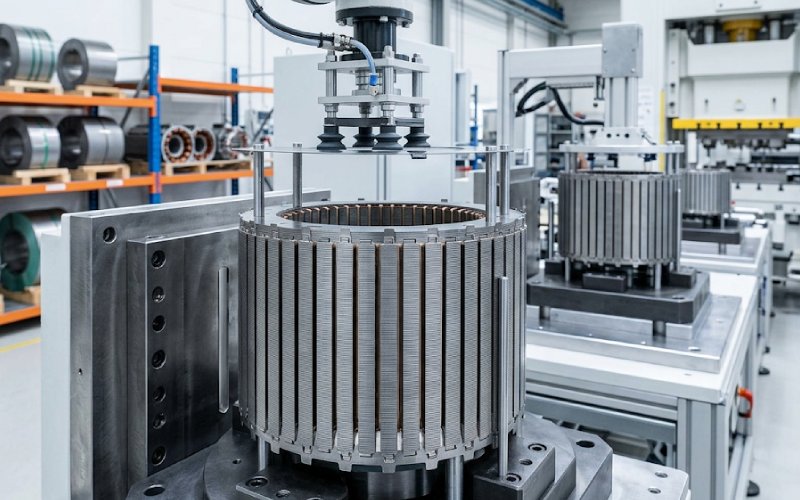
Choose compound stamping when the part is large, flatness is non-negotiable, the geometry may still change, or the stack will be bonded, welded, or otherwise assembled after blanking. In that situation, lower die complexity and easier revision usually matter more than maximum line integration.
Choose progressive stamping when the part is headed into a stable, long run and the process benefits from multiple sequenced operations, automated transfer, and in-die stack features. This is usually the cleaner answer for mature lamination programs where the volume is real and the stack concept is already settled.
Pause before deciding if the sourcing discussion is only about piece price, die price, or nominal stroke rate. That is usually a sign the stack has not been evaluated through the right lens yet. For laminations, the late surprises come from edge degradation, burr behavior, joint design, and tool wear. Not from the slide deck summary.
Usually, yes. But only when the volume is stable enough to justify a more complex die and when the process actually benefits from sequenced stations or in-die interlocking. High volume by itself is not the whole case.
Often, yes. Since the lamination is produced in one stroke, compound stamping usually gives a cleaner path to flatness and feature consistency. That advantage gets stronger when downstream joining is already planned outside the die.
Cut-edge damage. Punching deforms the edge zone, raises iron loss, and becomes more sensitive as tool wear grows. Burrs can also create interlayer short paths in the stack. That problem does not always appear in a basic dimensional inspection.
Yes. Interlocking, riveting, and welding can change loss behavior and local magnetic conditions in the finished stack. If joining is part of the performance problem, it needs to be included in the die decision early, not after sourcing.
Usually when three things line up: the geometry is stable, annual demand is high enough to carry the die cost, and the stack concept benefits from integrated in-die operations. If one of those is missing, the switch can be early by a year or two. Sometimes more.
At minimum: burr trend, tool-wear effect on the cut edge, insulation disturbance near the edge, and how the chosen joining method changes stack behavior. For lamination stacks, that is where the process starts telling the truth.




 English
  German
  Spanish
  French
  Italian
  Japanese
  Korean
  Dutch
Dutch  Indonesian