Let Sino's Lamination Stacks Empower Your Project!
To speed up your project, you can label Lamination Stacks with details such as tolerance, material, surface finish, whether or not oxidized insulation is required, quantity, and more.

If your RFQ only says “M4 CRGO, step-lap, as per drawing”, you are leaving loss, noise, and delivery risk on the table. A tight lamination spec is not hard; it’s just more detailed than most purchasing forms allow. The goal is simple: for any core in any lot, the supplier either clearly meets the numbers you wrote, or they clearly don’t.
Most lamination RFQs talk about grade, kVA, and a drawing number. That’s fine for price comparison, not for performance. Suppliers then optimize something you didn’t ask for: cheaper coil source, looser burr control, mixed heats in the same stack, different step pattern, or a coating that behaves differently under clamping.
Tenders from utilities and OEMs tell the same story in reverse. They spend pages locking in CNC cutting, stack height tolerances, coil traceability, burr levels, coating type, and testing on finished stacks, because they’ve already paid for failures in the field.
This article assumes you already know GOES datasheets and transformer design basics. The focus is just one thing: what you actually write in the RFQ.
Grade labels and trade names are messy. One mill’s “M4” is another mill’s completely different code. What survives across suppliers is the performance table: watts per kilogram at a defined flux density, frequency, and temperature.
Technical papers and mill guidance already push buyers to specify core loss at 1.7 T, 50 Hz, with a numeric limit, instead of only writing older designations like MOH or MIH. Modern high-grade CRGO examples encode thickness and loss directly in the name, such as 23ZH100 or equivalent, but even then, the contract anchor should be the W/kg value.
So in the RFQ, don’t just say “CRGO M3 Hi-B”. Add a sentence that fixes the actual requirement, for example: “Total specific core loss ≤ 0.90 W/kg at 1.7 T, 50 Hz, per IEC 60404-2, guaranteed on Epstein test.” Then let suppliers map their mill grades to that number.
Two practical points help here. First, decide the design Bmax upfront; a lot of projects quietly migrate from 1.65 T to 1.75 T during optimization, then the RFQ still talks about loss at 1.5 T. Second, write a realistic design margin between what you need and what you buy; a 3–5% safety cushion on W/kg is cheaper than a transformer that misses no-load tests.
Suppliers have plenty of inventory levers: 0.30 mm conventional grades with good price, 0.27 mm or 0.23 mm high-grade material with better loss, plus seconds and offcuts. Industry guidance often frames typical ranges as 0.23–0.30 mm thickness, Bmax around 1.7–1.9 T, and loss windows that match your efficiency class.
If you care about eddy losses and noise, the RFQ should not let thickness float freely. For example, “Lamination thickness 0.23 mm ± 0.01 mm. No substitution to 0.27 mm or 0.30 mm without written approval.” That one line blocks a lot of “equivalent” swaps.
Joint pattern is similar. Whether you want butt-lap, full miter, or step-lap, write it as a requirement, not a suggestion. If you are ordering step-lap, define at least: number of steps, nominal step length, and which members are stepped (yokes only, or limbs and yokes). A supplier switching you from step-lap to simple miters keeps cost down for them and hands you higher local flux peaks and noise.
Many large buyers now explicitly demand cutting on CNC cropping or core cutting lines “only”, with laminations made exactly as per issued drawings. That wording avoids surprises like manual shearing, different cut angles, or undocumented V-notch geometry.
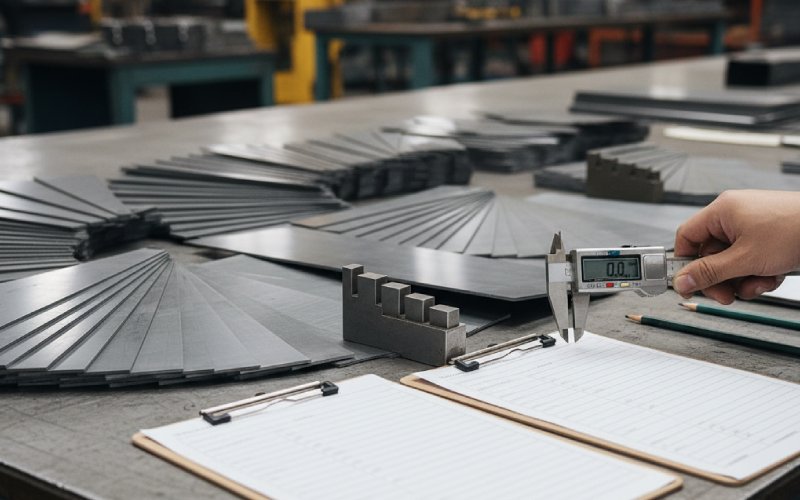
You rarely see a transformer failure report that says “root cause: burrs too high by 8 microns”, but that’s exactly the kind of thing that erodes your design margins.
Typical technical sheets for CRGO laminations quote burr limits in the range of about 10–20 microns, depending on thickness band. When you write the RFQ, don’t just copy those. Decide what your core builder can actually handle and still hit stacking factor and noise targets, then write a single numeric limit per thickness segment and inspection method.
Coating and stacking factor belong together. Mill documents define lamination factor (stacking factor, space factor) as the ratio of the “solid” steel volume to the measured volume of a compressed stack. The coating type you choose, such as C2, C5, or Carlite-type phosphate coating, will change that factor and interlaminar resistance.
So the RFQ should do three things at once. First, call out the coating class and the minimum surface insulation resistance you need, aligned with your core clamping practice. Second, state the minimum stacking factor for the finished core or test stack at a defined pressure. Third, link burr height and deburring to that stacking factor, so the supplier isn’t incentivized to polish away half your insulation.
If you keep these as three separate documents—coating, burrs, stacking—you get three separate arguments. Put them in the same clause.
Drawings hold nominal dimensions. RFQs decide how strictly the supplier must follow them when production starts cutting thousands of sheets on a Friday night.
Tender documents from large utilities and OEMs already stress stack height and sheet count, sometimes allowing around +1% weight tolerance per purchase order only to reach the required stack height. That tells you what they care about: magnetic path, not kilograms.
For a smaller project, mirror that thinking in simplified form. Fix nominal lengths and widths from your drawing, but clearly define length, width, and step tolerances that matter to window height, limb section, and clamping hardware. Also think about how much deviation in step length your winding and core assembly teams can accept before they start doing on-the-floor rework.
Corner radii, notch positions, hole diameters, and lamination identification marks often sit in a separate CAD file or email chain. If any of those affect insulation clearances, clamp fit, or oil flow, reference them in the RFQ body rather than assuming “latest revision drawing” will always be used.
And if stack height really is your critical dimension, say so explicitly. That lets the supplier work backwards from stack height to sheet count and weight in a structured way, instead of improvising when the last stack comes out short.
You can buy CRGO laminations from shops that cut anything they can get, or from manufacturers locked into prime coils, approved mills, and audits. Your RFQ language gently nudges you toward one of those.
Industry advice to transformer manufacturers is increasingly blunt: buy from lamination makers who are approved by state utilities or recognized international bodies, and who can show prime material usage and traceability. Some utilities even carry out stage inspections at the lamination plant specifically to confirm coil origin and grade.
Even if you don’t have that leverage, you can write a small set of requirements that push in the same direction. Examples include restricting material to prime coils from specified mills or equivalent, banning CRGO seconds and scrap-based laminations unless explicitly agreed, and requiring every stack or pallet to carry coil heat numbers and mill test certificate references.
If your core design is sensitive, you might also specify “single heat per core limb and yoke assembly” to avoid mixing slightly different magnetic characteristics in one path. It sounds strict, but it removes one uncertainty later during failure analysis.
Suppliers are proud of their mill certificates. They matter. But mill Epstein values don’t directly guarantee your finished stacked core.
Better RFQs borrow from high-end core manufacturers and ask for a mix of tests:
They keep the Epstein or similar single-strip tests that confirm coil quality against your loss and permeability limits at specified B and f. Then they add stack-level checks: no-load loss on assembled cores or representative test stacks, measurement of stacking factor under defined clamping pressure, and verification of interlaminar resistance after actual manufacturing steps.
You already know the methods, so the RFQ part is simple. Specify which tests must be done per coil, per lot, and per order, and state which of those are hold points with your witness. Also, if you care about noise, consider adding a small requirement on maximum flux density during factory NLL testing, so cores aren’t tested at a milder point than your design.
Make sure acceptance criteria live in the main RFQ or purchase specification, not just in an attached email or lab template. People lose attachments; they do not usually misplace rejection clauses.
Docs and packing sound like commercial details, not technical ones. Then you see a stack of laminations arrive twisted, damp, lightly rusting at the edges, and your design effort loses some meaning.
You already expect the basics: mill test certificates, inspection reports, test results, and a compliance statement that ties material back to standards and your drawing. But it helps to be specific about lot size versus document granularity. For example, “all test values reported per production lot of maximum 10 tonnes, not per monthly production.”
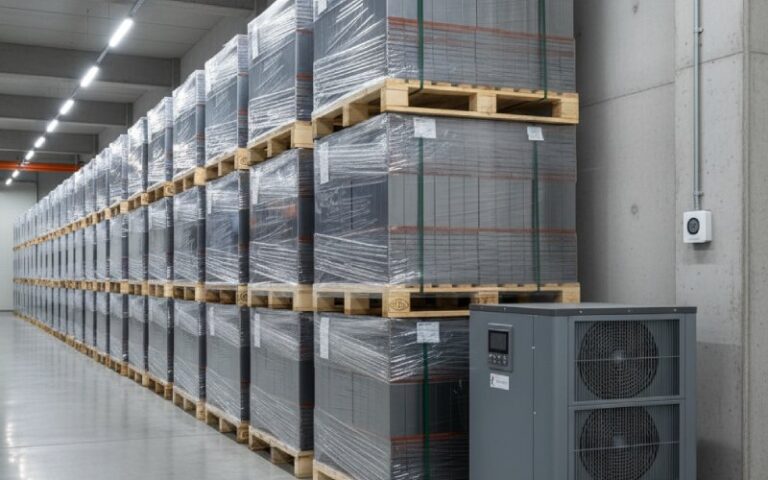
Packing instructions do not have to be poetic. Just say what protects coating, burr level, and flatness: vertical or horizontal orientation, separators, moisture barriers, and any limit on the number of stacks per pallet. If you need corner protection or special strapping to avoid lamination creep, say that too.
Finally, decide how long you want the supplier to retain detailed quality records. If you have a ten-year product warranty, keeping lamination records for only two years is asking for a headache.

Here is a condensed view of what a more complete CRGO lamination RFQ might lock in. The exact numbers are just examples; the pattern is the useful part.
| RFQ item | Example RFQ wording (conceptual) | What the supplier actually controls |
|---|---|---|
| Magnetic grade and loss | “CRGO steel with total specific loss ≤ 0.90 W/kg at 1.7 T, 50 Hz, per IEC 60404-2; supplier to state mill grade code (e.g., 23ZH100 or equivalent).” | Choice of mill, coil selection, confirmation that their grade consistently beats the W/kg limit. |
| Flux density point | “All guaranteed losses referenced to B = 1.7 T; design Bmax = 1.75 T; overload conditions per project spec.” | Matching material and joint design so your operating point sits comfortably inside the guaranteed curve. |
| Thickness | “Lamination thickness 0.23 mm ± 0.01 mm; no substitution to 0.27 mm or 0.30 mm without written approval.” | Which coils they load on the cutting line and whether they ever change thickness on a running order. |
| Joint and cutting pattern | “Three-phase core, step-lap mitred joints on all yokes; 5-step pattern, step length 40 mm nominal; cutting on CNC core cutting line as per drawing XYZ.” | Machine setup, step program, and adherence to your joint geometry instead of using a generic pattern. |
| Burr and deburring | “Maximum burr height 15 µm for 0.23–0.27 mm; 20 µm for 0.30–0.35 mm, measured per IS/IEC method; deburring process shall not damage coating.” | Slitting and cutting tool condition, deburring process, inspection frequency, and rejection of bad edges. |
| Coating and stacking factor | “Insulation coating type C2 or equivalent phosphate; minimum surface insulation resistance per mill data sheet; minimum stacking factor 96.5% at 50 psi on test stack.” | Coil coating choice, line handling to avoid scratches, and tight stacking that respects both coating and burr limits. |
| Dimensions and stack height | “All dimensions as per drawing; length and width tolerance ±0.25 mm; stack height per limb and yoke as per table; total weight per PO may vary up to +1% to achieve stack height.” | Cut length accuracy, sheet count per stack, and minor over-delivery to hit your magnetic section. |
| Material source and quality class | “Prime coils only, sourced from approved mill list or equivalent; no CRGO secondary or scrap-based laminations; lot identification to include mill, heat, coil number.” | Purchasing and internal segregation between prime, downgraded, and scrap material. |
| Testing and acceptance | “Mill test certificate per coil; Epstein test per coil verifying loss and permeability; finished stack or core loss test and stacking factor check per lot; purchaser witness at agreed stages.” | Running and documenting the tests, keeping equipment calibrated, and stopping production when a lot drifts. |
| Documentation, packing, handling | “Full traceability documents with each shipment; records retained minimum 10 years; laminations packed to prevent mechanical damage and moisture ingress, with handling instructions on each pallet.” | How your laminations are protected from plant to your factory and whether you can actually trace any lot later. |
If your RFQ template cannot hold all of this neatly, that is a process issue, not a technical one.
Imagine a batch of cores failing no-load loss by five percent. You are standing in the test bay with the supplier on a video call. Now look at your draft RFQ and ask yourself three short questions.
First, does the document clearly say which test, at what flux density and frequency, decides acceptance of their lamination lot and your core? Second, can you trace any core back to a heat and coil using only the markings and paperwork you have required? Third, if they change thickness, joint pattern, or coating, will that obviously breach a written clause, or will it only show up as a polite argument about “equivalent material”?
If any of those answers are vague, the fix is usually one extra paragraph, not a bigger transformer.
Specifying CRGO laminations in an RFQ is not about adding theoretical content. It is about turning your existing design and standards into a short set of numbers and boundary conditions that a cutting line operator can actually obey. Once that is in place, price comparisons start to mean something, suppliers know where they cannot compromise, and your future test reports read a lot closer to the design sheet you started from.




 English
  German
  Spanish
  French
  Italian
  Japanese
  Korean
  Dutch
Dutch  Indonesian