Let Sino's Lamination Stacks Empower Your Project!
To speed up your project, you can label Lamination Stacks with details such as tolerance, material, surface finish, whether or not oxidized insulation is required, quantity, and more.

On transformer drawings from 15+ years ago you see “M4, 0.27 mm”. On today’s RFQs you see:
CRGO laminations, IEC 60404-8-7 grade M100-23P, 0.23 mm, C-5 coating
or
ASTM A876 grade 23P090, laser-scribed, 0.23 mm
or a JIS-style:
JIS C 2553 23P090, 0.23×80 mm, step-lap
Same physics. Different committee stamps.
The standards are doing three jobs at once:
Everything below is about reading those codes fast, and specifying lamination stacks so that suppliers in different regions still land on the same steel.
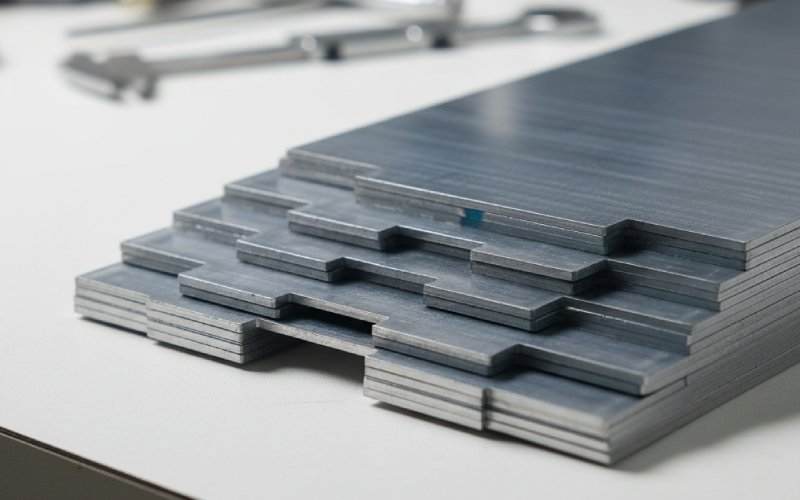
IEC 60404-8-7 is the current reference for cold-rolled grain-oriented electrical steel strip and sheet in fully processed condition, with nominal thicknesses like 0.20 / 0.23 / 0.27 / 0.30 / 0.35 mm.
You already know that from the standard. What matters for lamination stacks is how it leaks into the datasheet and then into your PO line.
Typical IEC-style grade:
M100-23P5
Rough mental decoding (mill conventions differ):
23 → thickness 0.23 mm (×100).100 → core loss at 1.7 T, 50 Hz ≈ 1.00 W/kg (×100).P5) → family / permeability / sometimes frequency family.So when a lamination spec says:
“CRGO laminations, IEC 60404-8-7, grade M100-23P or better”
it’s really saying:
Designers usually start from the loss number and induction. Purchasing tends to start from the thickness and the standard name. Both are in that single token.
On the lamination drawing, the IEC name is not enough. You still need:
Without those, “M100-23P” is only half a spec.
ASTM A876 covers flat-rolled, grain-oriented, fully processed low-carbon silicon-iron electrical steel for transformer cores.
Two quirks:
23P060, 23P090, etc.A876-style decoding:
23 ≈ 0.23 mm060 ≈ 0.60 W/lbSo:
ASTM A876 grade 23P090
says “0.23 mm GO steel, max core loss around 0.90 W/lb at 1.7 T, 60 Hz, high-permeability family”.
When you compare that to an IEC spec based on W/kg at 50 Hz, you know the usual drill:
On paper this all looks neat. In practice, RFQs often say something imprecise like:
“CRGO laminations as per ASTM A876”
which is like ordering “beer as per German purity law”. The family is clear. The strength is not.
JIS C 2553 defines cold-rolled grain-oriented electrical steel strip and sheet with insulation coating on both sides, in nominal thicknesses 0.23 / 0.27 / 0.30 / 0.35 mm.
A common JIS-style code:
23P090
Typical pattern:
23 → nominal thickness 0.23 mm090 → max specific core loss 0.90 W/kg at 1.7 T, 50 Hz (notation P1.7/50)This mirrors the logic in IEC and ASTM. The code is just aligned with Japanese practice and JIS measurement methods like JIS C 2550.
So in JIS language:
Cross-reference databases show that a single physical steel like M100-23P can appear as IEC, JIS and ASTM designations simultaneously (e.g. IEC 60404-8-7 grade M100-23P5, JIS 23P100, ASTM A876 grade 23P060 for roughly equivalent material families).
That’s what your lamination supplier is really juggling when they say “same steel, different name”.
This table is illustrative, not a purchasing spec. Always check the mill datasheet.
| Design intent (approx.) | Nominal thickness (mm) | IEC 60404-8-7 style example | JIS C 2553 style example | ASTM A876 style example | Legacy shorthand |
|---|---|---|---|---|---|
| Low-loss Hi-B CRGO core for large power | 0.23 | M090-23P (≤0.90 W/kg @1.7T/50Hz) | 23P090 (≤0.90 W/kg @1.7T/50Hz) | 23P060¹ (≈0.60 W/lb @1.7T/60Hz) | Close to “M2” / “M0H” in old speech |
| Workhorse distribution transformer core | 0.23 | M100-23P | 23P100 | 23P070 | Often called “M3” |
| Cost-sensitive distribution / retrofit | 0.27 | M112-27 | 27P110 | 27P080 | “M4”-ish |
| Older design, thicker laminations | 0.30 | M130-30 | 30P130 | 30P090 | “M5” style |
¹ Example based on cross-reference where one EN/IEC grade M100-23P links to JIS 23P100 and ASTM A876 23P060; exact mapping shifts by producer and generation.
Use the table like this:
Most lamination problems start in purchasing, not in Maxwell’s equations.
When you send out an RFQ for CRGO lamination stacks, and the drawing just says “M4, 0.27 mm”, suppliers will fill in gaps based on their stock and comfort, not yours.
Bare minimum, per stack size:
If these items don’t exist in the RFQ, they will exist later in the NCR.
The three standards care about strip and sheet. Your transformer cares about stacks.
Some details live outside IEC / ASTM / JIS text, yet change real-world performance:

A few short templates for lamination stacks. You adjust numbers to your design.
Material: Cold-rolled grain-oriented electrical steel, fully processed, as per IEC 60404-8-7. Grade: M090-23P or better. Thickness: 0.23 mm nominal; tolerance per mill datasheet, max deviation ±0.02 mm. Magnetic properties (after stress-relief anneal at 800 °C, 2 h, neutral atmosphere): – P1.7/50 ≤ 0.90 W/kg (SST per IEC 60404-3) – B8 ≥ 1.88 T Surface insulation: Equivalent to IEC 60404-1-1 class C-5; interlaminar resistance ≥ [value] Ω·cm². Lamination factor: ≥ 0.96 at 50 psi, verified per supplier method. Geometry and fabrication: – Step-lap configuration as per drawing xxx – Burr height ≤ 0.02 mm – Max camber [value] mm per 2 m – All laminations punched / cut with rolling direction labelled and kept consistent in stacking.
Accepted standards: IEC 60404-8-7, JIS C 2553, ASTM A876. Target material class: – IEC: M100-23P (0.23 mm, P1.7/50 ≈ 1.00 W/kg) or better – JIS: 23P100 or better – ASTM: 23P070 or better (convert to W/kg at 50 Hz for verification) Supplier shall declare the exact grade code and standard on the inspection certificate, plus: – measured P1.7/50 and P1.5/50 – test frequency and method – measured lamination factor and coating type
This kind of spec lets you source from Europe, Japan or North America without rewriting the drawing every time, while keeping the physics aligned.
If your next RFQ for CRGO lamination stacks makes an engineer, a buyer, and a mill all reach the same interpretation without a follow-up call, the spec is probably in good shape.




 English
  German
  Spanish
  French
  Italian
  Japanese
  Korean
  Dutch
Dutch  Indonesian