Let Sino's Lamination Stacks Empower Your Project!
To speed up your project, you can label Lamination Stacks with details such as tolerance, material, surface finish, whether or not oxidized insulation is required, quantity, and more.
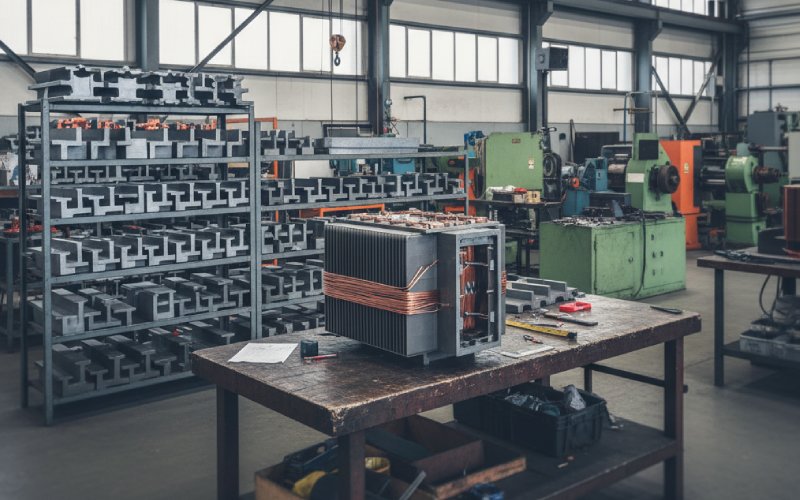
If your flux path is mostly one-directional and every watt of no-load loss hurts, pick CRGO. If the field swings around, your geometry is messy, or cost and punching simplicity matter more than squeezing out the last percentage point of efficiency, pick CRNGO. Everything else is just you proving that decision to yourself, to purchasing, and to the loss budget.
By now you’ve seen the standard story: grain-oriented electrical steel (CRGO) is optimized for magnetization along the rolling direction and dominates in power and distribution transformers; non-grain-oriented electrical steel (CRNGO) has near-isotropic properties in the sheet plane and is the default for motors, generators and rotating machines.
Those articles are fine for first-year engineers. They talk about grain alignment, manufacturing steps, silicon content, sometimes even show a nice micrograph. Useful once. After that, the real questions are different: how far can you push B before loss explodes, what happens under stress from stamping, and when is CRNGO “good enough” for a transformer so you can hit a price point without destroying lifetime operating cost. That’s where the choice actually lives.
When design teams argue CRGO vs CRNGO, they almost never argue about definitions. They argue about three things that are slightly messier than the datasheets.
First is the flux pattern. Not the idealized drawing, but the real one once you add joints, cutouts, notches and tolerances. If the main path through your stack is aligned and stays aligned with one sheet direction, CRGO can genuinely earn its keep. If your field rotates every electrical cycle, or your laminations are forced into shapes where you constantly cut across the rolling direction, the advantage shrinks and CRNGO starts looking like the more honest choice.
Second is the loss budget at your actual operating induction and frequency, not the marketing numbers. CRGO looks brilliant in the classic P1.5/50 test; CRNGO looks worse there by design, but some high-grade CRNGO steels are tuned for higher frequencies or different flux densities and the picture shifts a bit when you leave the textbook 50/60 Hz world.
Third is manufacturability and cost. Punch quality, burr height, coating, stress relief, scrap rate, coil width. CRGO is often thinner, more sensitive to handling damage, and less forgiving of rough tooling. CRNGO is usually cheaper per kilogram, more available in motor-friendly thicknesses like 0.35–0.50 mm, and easier to source in the grades purchasing already buys for motors.
If you ignore those three and only stare at the loss number on a single line of a catalogue, you can “win” a spreadsheet and still lose the system.
On paper, CRGO offers roughly 30% higher magnetic flux density along the rolling direction compared with non-oriented steel, at similar silicon levels. That’s why transformer folks get attached to it. In a well-designed leg, with joints aligned and stress controlled, you really can run higher B for the same or lower core loss.
But real cores are not Epstein strips. You cut, punch, mitre, stack, clamp. Each of those steps introduces localized stress and regions where flux takes a less-than-ideal path. Grain orientation helps most where the flux path is long, straight and parallel to the rolling direction. The benefit erodes where you have corners, yokes and T-joints. This is why some manufacturers deliberately use higher grade CRGO only in the main legs and accept more ordinary material in the yokes, or mix grades to balance cost and performance.
CRNGO, by contrast, is boring in exactly the way rotating machines need. Within the sheet plane, properties are designed to be as uniform as possible. You sacrifice the best-case along-rolling performance, but you avoid catastrophic worst-case regions as the field rotates. For a motor designer, that flattening of extremes is often worth more than an impressive single-direction B–H curve.
So the question quietly becomes: how “one-dimensional” is your flux in the finished product, not in your FEA with perfect material symmetry turned on.
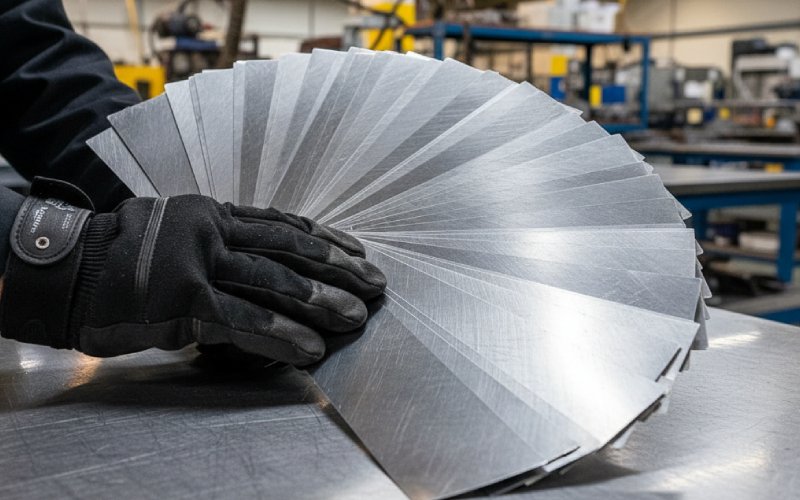
Let’s put some scale on the trade-off with real published numbers rather than just adjectives.
Typical commercial CRGO laminations today show core losses around 0.7–1.1 W/kg at 1.5 T, 50 Hz, depending on grade (M2 through M6, 0.18–0.35 mm). Real-world transformer data from manufacturers and testing houses often quote around 0.9–1.3 W/kg at 1.5 T, 50 Hz for the steels actually used in grid transformers.
Commercial CRNGO grades span a wider band. Standard grades for motors and general-purpose transformers often sit in the 4–6 W/kg range at 1.5 T, 50 Hz, with improved grades below 4 W/kg and cheaper grades above that. Thickness is usually 0.35, 0.5 or 0.65 mm, with thinner sheets reserved for high-performance machines or higher frequencies.
So, imagine a 100 kg core running around 1.5 T at nominal voltage. Shifting from 1 W/kg CRGO to 4 W/kg CRNGO adds roughly 300 W of no-load loss. Over 20 years of continuous operation, that extra 0.3 kW becomes about 52,000 kWh. At even USD 0.10 per kWh, you are in the region of USD 5,000 of extra energy cost, for one transformer. The steel price difference on day one is rarely that large. In a substation, CRGO wins that argument almost every time.
Now flip to a small 3 kVA low-frequency transformer that rarely runs at rated voltage. The core mass is tiny; the duty cycle is low. Those same per-kilogram numbers shrink into the noise floor of the whole installation. Suddenly, the lower purchase price and easier sourcing of CRNGO can be perfectly rational, and many vendors quietly do exactly that for low-power equipment.
Context changes the right answer, even with the same materials.
Datasheets hint at stress sensitivity; production reminds you it is real. CRGO’s low loss figures assume careful stress relief annealing or at least minimal plastic deformation. Aggressive punching, tight bending, or clamping without thought can erase a frightening share of the advantage you paid for.
CRNGO grades are not immune to punching damage, but some are formulated with mechanical strength and punchability as part of their design target, particularly in automotive-focused series. If your plant has relatively old tooling, high volumes, and you cannot guarantee gentle handling, it may be safer to assume you will never hit the ideal CRGO numbers from the catalogue.
Noise is another quiet differentiator. CRGO has strong anisotropy in magnetostriction; when you magnetize along the rolling direction and design joints well, you can control audible hum to a useful degree. Misaligned flux or heavy transverse magnetization can make things noisier than expected. CRNGO has a more uniform magnetostriction behavior; rotor and stator designers then manage acoustic noise through slot geometry, skew, and excitation rather than relying on material anisotropy.
None of that shows up in a simple “CRGO vs CRNGO” marketing comparison, but it determines whether your prototype behaves like your model.
Per-kilogram, CRNGO is usually cheaper than CRGO of comparable thickness, especially in high-volume standard grades. CRGO, especially Hi-B and premium grades, carries a price and sometimes a lead-time penalty. Mills have finite capacity for grain-oriented production; specialized coatings and tighter tolerances add more constraints.
On the other hand, CRNGO is often the material your organization already buys for motors, compressors, alternators. Volume alone can secure better pricing, better service, more coil width options. That simplification of the supply chain is a quiet but real reason many manufacturers push CRNGO into smaller transformer ranges, often up to roughly 100–150 kVA, when efficiency regulations allow it.
So whenever someone says “CRGO is too expensive”, the question is not just the steel price. It is: what is the enforced efficiency level for your product family, what is the duty cycle, and how much of your fleet’s lifetime energy cost is visible to whoever signs the purchase order.
Here is a compact comparison that keeps the numbers honest while still being practical. Values are typical ranges; specific grades will differ.
| Design aspect | CRGO lamination (grain oriented) | CRNGO lamination (non-grain oriented) | Design consequence |
|---|---|---|---|
| Magnetic behavior in sheet plane | Strongly directional, optimized along rolling direction; poorer transverse properties | Nearly isotropic in plane; similar properties in any direction | CRGO excels where flux is aligned and steady; CRNGO is safer where flux rotates or geometry is complex. |
| Typical core loss P1.5/50 | About 0.7–1.3 W/kg for common transformer grades | About 4–6 W/kg for standard grades, <4 W/kg for improved grades | CRGO usually wins no-load loss by a factor of 3–5 at 50/60 Hz, though premium CRNGO can narrow the gap. |
| Typical thickness range | 0.18–0.35 mm laminations in power applications | 0.35–0.65 mm common; thinner grades for high-performance motors | Thinner CRGO helps with eddy currents at low frequency; thicker CRNGO is easier to process and cheaper. |
| Frequency “comfort zone” | Optimized for 50/60 Hz power, up to a few hundred Hz in special cases | Designed across a wide band: 50/60 Hz up to several hundred Hz or more, depending on grade | For high-frequency machines, advanced CRNGO grades are usually more appropriate. |
| Typical applications | Power and distribution transformers, large reactors, some large static inductors | Motors, generators, rotating machines, small transformers, chokes, relays | The classic rule still holds: CRGO for transformers, CRNGO for motors, with exceptions at the margins. |
| Cost per kg and availability | Higher cost, especially for premium grades; constrained mill capacity | Lower cost for standard grades; broad availability and product families | For small units or cost-sensitive products, CRNGO often wins the business case. |
| Sensitivity to processing stress | High; poor tooling or clamping can seriously worsen loss and noise | Also affected, but many grades are tuned for punching and mass production | Your actual manufacturing quality can erase much of CRGO’s theoretical advantage. |
This table is not an exam answer. It is a reminder of what you are really trading.
There are cases where you barely need to think.
If you are designing medium-to-large power or distribution transformers for continuous grid service, regulations and buyer expectations around no-load losses almost force you into CRGO or even amorphous steels. The loss penalty of CRNGO at 50/60 Hz is simply too big once core masses reach hundreds of kilograms. Any steel savings on day one evaporate in operating cost and compliance trouble.
If your flux path is cleanly oriented, your fabrication line can respect the material (good punching, low burr, proper stacking, controlled clamping), and you bind yourself to realistic operating induction limits, CRGO remains the quiet workhorse. You do not need a poetic description of its grains to justify that choice.
CRNGO is not a “cheap substitute”. It is the correct answer in most rotating machines and a fair answer in many small transformers.
In motors, generators and alternators, the flux rotates. High-grade non-oriented steels are engineered for that reality: balanced properties in all directions, often with coatings and mechanical strengths suited for tight slot punching and high-speed rotors. Trying to build a modern traction motor out of transformer-grade CRGO would be fighting the material.
In smaller transformers, ballasts, auxiliary supplies and low-duty magnetics, you sometimes have a different constraint: cost and supply. Here, CRNGO allows you to reuse the same steel family and processing lines as your motor products, simplify purchasing, and still meet efficiency requirements because the absolute core mass and duty cycle are modest.
There are even datasheet notes from steel producers saying non-oriented grades are acceptable for transformers up to a certain power level (on the order of 150 kVA) when designed accordingly. That is not a trick; it is a recognized design path.
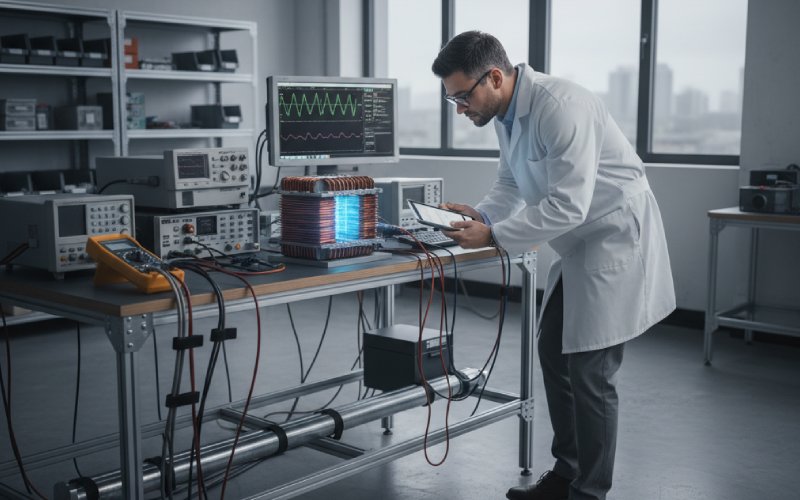
Life would be dull if rules never broke.
High-frequency transformers in power electronics sometimes mix strategies. For example, a designer might pick very thin CRNGO or specialized high-frequency grades when cost or availability of amorphous and nanocrystalline metals is limiting, even if those CRNGO grades look poor at 50 Hz. The actual operating point is up at tens of kilohertz; the relative differences shift.
Large motors with unusually fixed flux paths or unconventional topologies might experiment with oriented steels in specific laminations, although the processing pain is real and the gains modest unless the design is very constrained. Academic work has explored partially oriented textures in CRNGO to blur the line a bit, trading some isotropy for better rolling-direction performance.
And then there is regulation. As efficiency classes tighten for both transformers and motors, steel producers keep introducing new high-grade CRNGO and improved CRGO variants. The gap in loss for premium CRNGO vs mid-range CRGO at a given operating point can shrink enough that your decision becomes less obvious and more about downstream manufacturability and mechanical constraints than about a single W/kg figure.
So you keep an eye on the datasheets not because you forgot the basics, but because the frontier keeps moving.
When you choose between CRGO and CRNGO laminations for a new design, you can treat it almost like a short design review with yourself.
Start from flux behavior. Sketch the real path through the core, including joints and slots, not just the main leg. If flux is largely one-directional and the application is grid-connected or otherwise energy-cost sensitive, assume CRGO until something strong pushes you away from it. If flux rotates or spends significant time off-axis, assume CRNGO.
Then look at the loss budget at the actual B and frequency you will use in service. Use manufacturer core-loss data or your own measurements at that operating point, not just the headline P1.5/50 figures. If a shift to CRNGO adds tens or hundreds of watts of continuous loss, compute the lifetime energy hit in money, not only watts, and compare that to the added steel cost of CRGO.
After that, interrogate your factory reality. Tooling age, burr control, annealing capability, stacking method, coatings, handling. If you cannot realistically preserve the delicate microstructure of CRGO from coil to finished core, you are paying for performance you will never see. In that case CRNGO, even with higher ideal loss, might produce a finished product closer to its datasheet than CRGO does.
Finally, bring purchasing and regulation constraints into the same room. Efficiency standards, CO₂ reporting, supply risk, vendor diversification. The “best” technical answer that cannot be sourced at scale is not the best answer.
None of this requires dramatic theory. It just asks you to match the steel to the actual physics and economics of your design, instead of to the marketing slogan on the first article you read.
You rarely choose between CRGO and CRNGO in a vacuum. You choose between a lower-loss, directionally optimized material that demands careful handling and typically costs more, and a more forgiving, isotropic material that carries a loss penalty at classic power-frequency operating points but integrates smoothly into mass production for rotating and small static machines.
If you treat that as a one-line slogan, you get the same article everyone else publishes. If you treat it as a starting point, and you fold in your flux paths, real core geometries, factory limitations, and lifetime energy costs, the “right” answer tends to reveal itself fairly quickly. And it will often be the same simple rule: big, efficient, grid-tied transformers lean toward CRGO; rotating machines and cost-sensitive or smaller units lean toward CRNGO. The value is not in memorizing that rule. It is in knowing exactly why, and where, you are allowed to break it.




 English
  German
  Spanish
  French
  Italian
  Japanese
  Korean
  Dutch
Dutch  Indonesian