Let Sino's Lamination Stacks Empower Your Project!
To speed up your project, you can label Lamination Stacks with details such as tolerance, material, surface finish, whether or not oxidized insulation is required, quantity, and more.
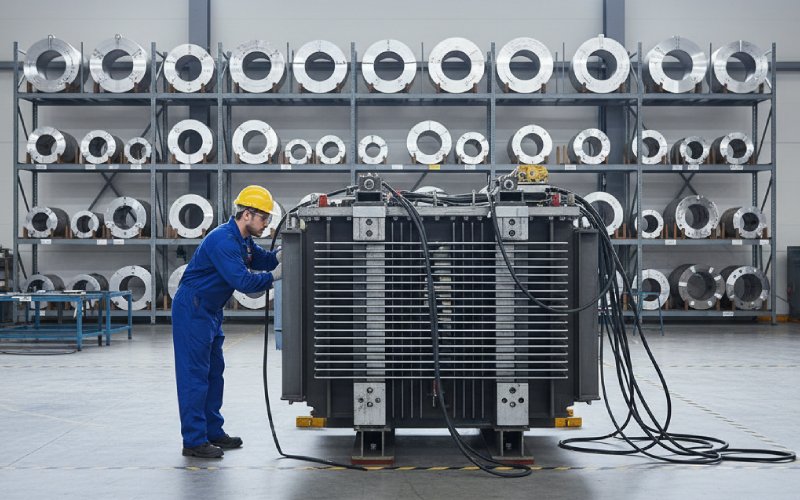
What this article is about: CRGO lamination stacks vs nanocrystalline cores, from a design + purchasing point of view.
You already know the basics:
The data sheets say similar things, in slightly different fonts. The question is how they behave when you build actual cores and lamination stacks, and where each choice really earns its keep.
Let’s put typical catalogue values on one page. These are ballpark engineering numbers, not design limits.
| Parameter (typical) | CRGO lamination stack | Nanocrystalline tape-wound core |
|---|---|---|
| Saturation flux density Bs | ≈ 1.8–2.0 T | ≈ 1.2–1.3 T |
| Relative permeability µr (usable range) | ≈ 30,000–50,000 | ≈ 80,000–150,000 (tunable up, even higher) |
| Core loss @ 50 Hz, 1.7 T | ≈ 0.9–1.6 W/kg (Hi-B at low end) | Not usually run that hard at 50 Hz |
| Core loss @ 20 kHz, 0.1 T | >150 W/kg | <15 W/kg |
| Curie temperature | ≈ 730–750 °C | ≈ 550–580 °C |
| Electrical resistivity | ≈ 40–50 μΩ·cm | ≈ 100–120 μΩ·cm |
| Typical stacking / lamination factor | ~0.96 for good step-lap stacks | ~0.75–0.80 for wound ribbons |
| Sweet-spot frequency band | 50/60 Hz, up to a few hundred Hz | A few kHz up to tens of kHz (depends on flux) |
| Geometry in practice | EI, step-lap cores, wound legs, reactors | Toroids, cut cores, C-cores, special stacks |
| Relative material cost per kg | Lower | Higher |
| Relative power density potential | Limited by losses at higher f | Very strong in medium-frequency range |
Data above merges published examples from core vendors and material notes, not just one marketing sheet.
A couple of things jump out:
Those two facts already hint at where each wins.
If you’re doing MV/HV power or distribution transformers at grid frequency, you’re almost certainly on CRGO laminations for the main core:
For a 1 MVA 50 Hz unit, switching to nanocrystalline for the main legs is usually a non-starter:
So for classic power transformers, CRGO lamination stacks win by a wide margin on cost per kVA, practicality, and ecosystem.
Whenever the spec smells like:
…you’ll appreciate having ~1.9–2.0 T saturation instead of ~1.25 T.
Nanocrystalline can deal with high induction in special cases, but the point is simple: if the core lives near the limit during faults, CRGO is usually safer.
On big cores:
Nanocrystalline cores in those sizes exist (laminated nano stacks, not just toroids), but they’re specialty items with fewer suppliers and tighter process windows.
If your purchasing team wants second and third sources for every strategic part, CRGO stacks keep life simpler.
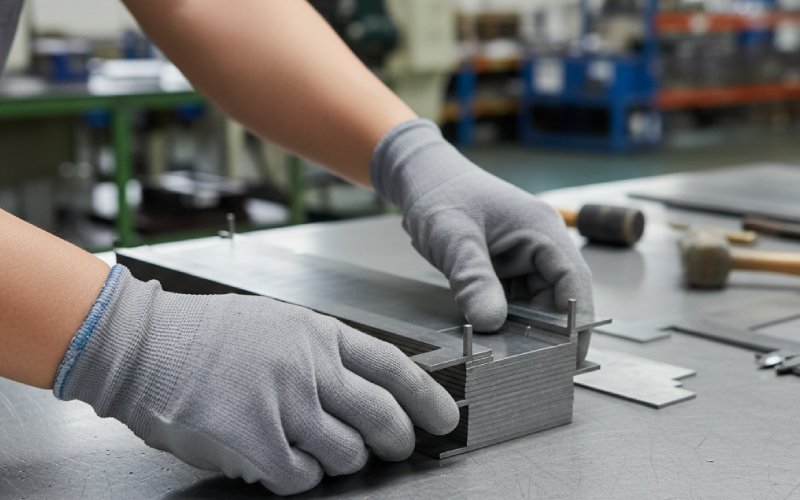
Now the interesting part. Places where CRGO is technically possible, but not wise.
Think:
In that band, CRGO core loss explodes. Nanocrystalline stays calm:
So if your fundamental or dominant switching frequency is in the 5–50 kHz region and power isn’t tiny, nanocrystalline is usually the front-runner, not ferrite and not CRGO.
Common-mode chokes and EMI filters are classic nanocrystalline territory:
With CRGO you’d either:
So if your BoM has multiple large ferrite CM chokes, swapping to nanocrystalline tape-wound cores is often the easiest density upgrade.
For current transformers (CTs) and precision instrument transformers:
If the CT sees distorted waveforms – drives, EV chargers, UPS outputs – nanocrystalline cores tend to maintain ratio and phase accuracy where silicon steel starts to wander.
Sometimes the fundamental is still 50/60 Hz, but:
Here, nanocrystalline behaves like “CRGO + filter ferrite in one material”. You get:
That’s one reason you see nanocrystalline in modern dry-type transformers and special reactors aimed at power electronics.
Not strict rules. Just a sanity check for early selection:
If your design sits exactly on a boundary, expect iterations, not a single “correct” answer.
On a part level, nanocrystalline may look expensive. On a system level, once you factor:
…it can land cheaper per kW handled, especially in medium-frequency converters.
CRGO strip and laminations:
Nanocrystalline:
If your project is safety-critical or long-lived, it’s worth designing mechanical envelopes and lamination stack windows that can accept at least two nanocrystalline core geometries, not just one proprietary part.
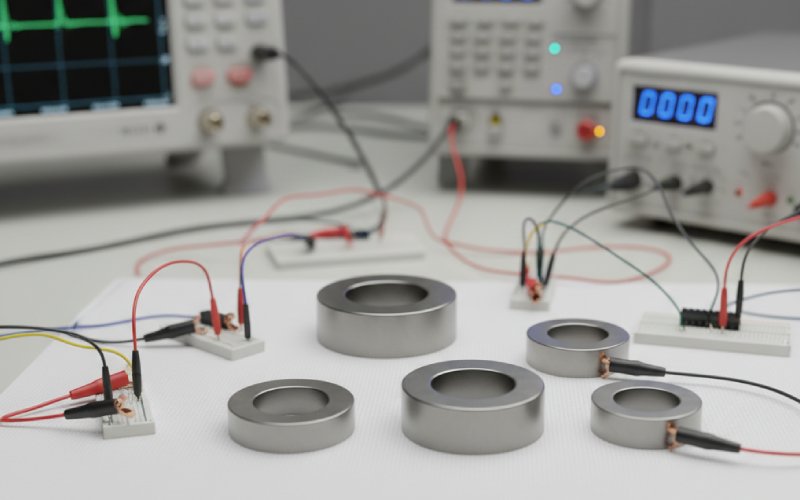
These aren’t on the data sheet, but they hit yield.
Nanocrystalline ribbon is:
Excess clamping or uneven pressure can:
Design your clamping scheme to treat the wound core as a precision component, not as a stack of heavy laminations.
For lamination stacks:
So if you’re chasing fractional-percent efficiency, core shop process control is as important as material grade.
Designs sometimes say “50 Hz transformer” when the load is a drive cabinet:
In that case:
You can sanity-check your material choice with a few blunt questions.
You can of course mix both: CRGO main lamination stack + nanocrystalline CTs and CM chokes in the same product is already common in modern switchgear and power converters.
Usually no.
Nanocrystalline wants a different flux density, different window utilization, and often different cooling strategy.
Direct one-for-one swaps tend to either saturate the core or under-use the material.
If you want nanocrystalline benefits, treat it as a new magnetic design, not a replacement lamination grade.
Yes, but they’re not commodity parts.
Researchers and some manufacturers build laminated nanocrystalline cores by stacking treated ribbons or tape-cut tiles, mainly for high-frequency power electronics where standard toroids don’t fit.
For now, though, most commercial nanocrystalline parts you’ll see are:
toroids (solid or cut)
C-cores
special wound shapes
If your business is classic power transformers, you’ll still live mostly in CRGO lamination stacks for a while.
At a high level:
Both have much lower loss than CRGO at line frequency. Amorphous can cut core losses by up to ~70% vs conventional silicon steel in many cases.
Nanocrystalline often improves on amorphous at higher frequencies, with higher permeability and lower loss in the tens-of-kHz band.
So:
For ultra-efficient 50/60 Hz distribution transformers in big volumes: amorphous and advanced GOES compete.
For medium-frequency magnetics and EMI: nanocrystalline tends to win.
Sometimes yes.
For a 20–50 W flyback at 100 kHz:
Ferrite is cheap, easy, and good enough.
Nanocrystalline starts to make more sense as power, current, or DC bias go up, or when size is severely constrained.
For higher-power SMPS (kW-class) with demanding EMI and efficiency targets, nanocrystalline transformers and chokes can be a strong lever.
Three short points usually help:
At the converter level, loss and cooling cost more than steel. Lower core loss can reduce heatsink, fan, or liquid cooling requirements.
Higher permeability means less copper, fewer turns, and sometimes cheaper PCB and assembly.
In many projects, magnetics volume and weight are now system-level constraints (rack space, vehicle packaging), not just line items in the BoM.
If that still doesn’t land, run a simple cost-per-watt-saved comparison between CRGO and nanocrystalline designs. The numbers tend to speak quietly but clearly.
CRGO lamination stacks aren’t going away. They’re unbeatable for large, low-frequency transformers and anything that lives at high flux under fault conditions.
Nanocrystalline cores aren’t magic either. They just bend the trade-offs in your favor once:
If you treat both as tools, not teams, and align them with the right frequency band and duty, your lamination stacks, wound cores, and purchasing decisions will all start to line up much more easily.



 English
  German
  Spanish
  French
  Italian
  Japanese
  Korean
  Dutch
Dutch  Indonesian