Let Sino's Lamination Stacks Empower Your Project!
To speed up your project, you can label Lamination Stacks with details such as tolerance, material, surface finish, whether or not oxidized insulation is required, quantity, and more.
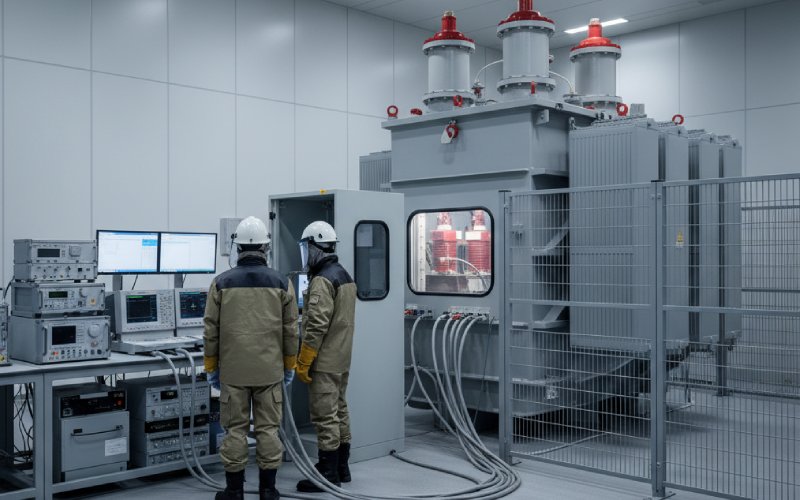
This article is about the decisions between your spec sheet and the lamination stack on the shop floor – where a quiet 5–25% of no-load loss is usually hiding.
Most specs still say something like:
CRGO, 0.23–0.27 mm, max loss X W/kg @ 1.5 T, 50 Hz.
On paper that sounds fine. In practice:
If you only control the grade name, you’re not really controlling no-load loss.
A few practical anchors:
Instead of “M3 equivalent”, write your spec around:
That’s the only way to stop low-cost laminations with pretty mill certificates but ugly assembled losses from slipping through.
You don’t need a full materials lecture here. Just the levers that change your loss and cost curves in a noticeable way.
A 2024 study compared different GOES / CRGO types and lamination thicknesses and found a modern high-permeability grade with optimized domains gave about 66% lower core loss than a reference M6 material at the same flux density.
So, for a given kVA:
Key point: Don’t treat “domain refined” as a marketing tag. Ask for:
Thinner laminations cut eddy current paths. You know that already. The trick is to tie it to frequency and economics, not fashion.
Common ranges:
In many utility specs, the thinner gauges are effectively required just to meet modern ecodesign and DOE/IS 1180 style limits.
So instead of arguing forever about “0.23 vs 0.27”, map:
Then pick the cheapest combination that still hits the assembled no-load loss target, not just the sheet W/kg.
Amorphous cores can cut no-load loss by about 60–70% compared with CRGO.
For high-load power transformers, CRGO + disciplined lamination stacks is still the main workhorse. For lightly loaded distribution units, amorphous is often the right answer and this whole article becomes a bit academic. Just worth admitting that upfront.
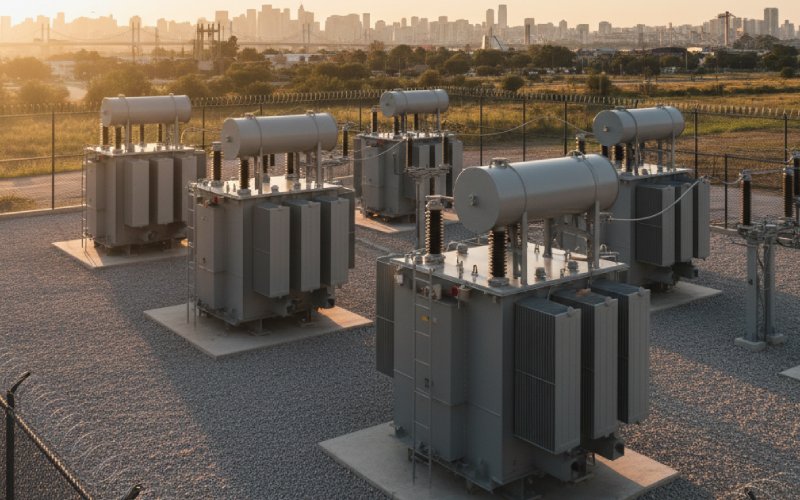
Now to the lamination stacks themselves – where a lot of vendors quietly decide your BF.
There’s a temptation to build cores with multi-layer packets (2–3 laminations per stack) to speed up assembly.
A well-known 1000 kVA study looked at CRGO cores with 1, 2, and 3 laminations per stack (same geometry, 0.3 mm M5 grade). Result at 1.5 T, 50 Hz:
Flux leakage at corner joints and building factor both worsened with more laminations per packet.
So when a manufacturer tells you “multi-layer stacking doesn’t affect loss much”, ask them:
Then decide if the assembly time saved is worth 5–8% more iron loss for 30 years.
Here’s where the geometry of your lamination stacks really starts to pay – or cost – you.
A recent technical write-up on no-load losses listed measured results for different joint forms:
Step-lap construction then spreads the flux transition over several small steps, reducing rotational flux, gaps, and joint hot spots. CRGO step-lap laminations are routinely advertised as “low no-load loss” for exactly this reason.
Design note that sometimes gets ignored:
If your target is tight, you basically cannot afford straight butt joints with casual stacking and hope to win.
Another subtle lever: lap width at the corner.
Evidence from recent transformer core studies says:
So instead of “lap width: as per manufacturer standard”, specify a numeric range and require loss verification at that geometry.
Brief but important:
You don’t need to redesign classical shapes, but you do want your lamination supplier and your mechanical designer talking the same language about:
Even perfect drawings and materials lose the fight if the lamination process is sloppy.
Measured data from an OEM knowledge article is pretty blunt: when burr height exceeds about 0.03 mm, you get:
None of this appears in the datasheet. It all appears in your no-load test.
So your RFQ needs:
CRGO is stress-sensitive. Bending, bad clamping, rough shearing – all expand the hysteresis loop and push loss up.
Lamination manufacturers now advertise:
If you buy domain-refined steel and then punch a lot of holes or bend corners aggressively, you pay for low loss and then stress it away.
Manufacturers like JFE Steel or thyssenkrupp Electrical Steel supply CRGO with specific coatings optimised for:
On your side, the only thing that matters is:
Does the coating system, in your actual stack and clamping arrangement, maintain the promised resistivity and loss?
So:
Industry practice is slowly moving from “sheet W/kg only” to explicit BF targets.
For example:
If your vendor can only hit the sheet spec by over-stressing or dirty stacking, you’ll see it in BF.
That one number quietly ties together:
And that’s exactly what you want.
Table is intentionally simple. You already know the equations.
| Decision lever | Typical options | Expected impact on no-load loss (qualitative) | Notes for lamination stacks |
|---|---|---|---|
| CRGO grade & domain treatment | Conventional CRGO vs high-induction vs domain-refined CRGO | Domain-refined can cut sheet loss by 10–30% vs older grades; some studies show ~66% vs M6 reference in specific cases. | Gains only materialise if stress and burrs are controlled. |
| Lamination thickness | 0.30 mm vs 0.27 mm vs 0.23 mm | Thinner → lower eddy losses, especially at higher frequency; cost and processing difficulty rise. | Be explicit in RFQ; don’t let vendor up-gauge without telling you. |
| Packets per stack | 1 layer vs 2–3 layers per packet | Adding layers per packet increased loss by ~6–8% in 1000 kVA tests. | Faster assembly, but BF goes up. Decide consciously. |
| Joint form | Straight butt / staggered vs stepped vs semi-miter vs full miter | Stepped joints ~6% lower loss vs staggered; full miter with correct orientation can give 15–25% lower loss vs straight. | Usually the biggest single geometric lever. |
| Lap width at joints | Narrow, optimised vs “large for safety” | Too wide → larger discontinuous region → more loss. | Specify numeric lap width range, not “as per standard”. |
| Burr height & coating condition | ≤ 0.02–0.03 mm vs uncontrolled | High burrs and scratched coating sharply increase eddy loss and hot spots. | Needs explicit QC steps, not just visual checks. |
| Core cross-section & limb–yoke matching | Optimised multi-step / elliptical vs simple rectangular | Poor matching and rectangular sections require >10% more area and still have worse flux distribution. | Agree geometry details with lamination supplier, not just with CAD. |
| Core material choice at system level (brief) | CRGO vs amorphous vs nanocrystalline | Amorphous can cut no-load loss by ~60–70%; nanocrystalline more for special cases. | Outside the scope of “CRGO only”, but useful benchmark. |
Values are indicative, based on manufacturer data and published technical studies rather than a single test run.
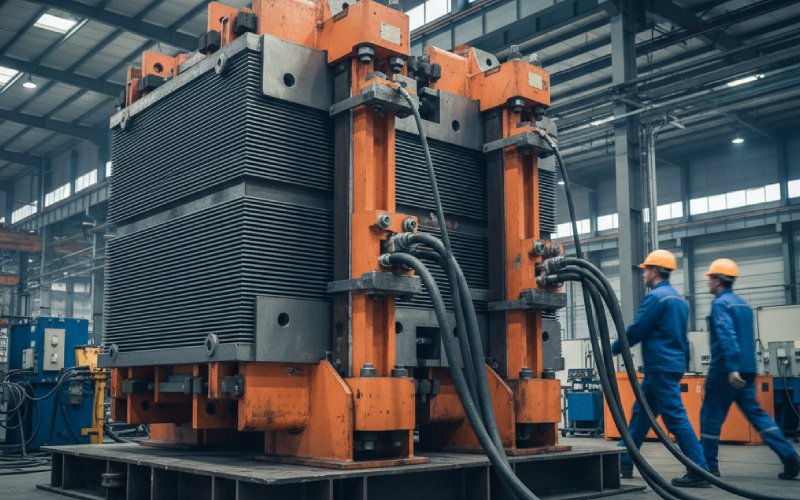
You can plug this straight into a B2B spec or vendor questionnaire.
A. Material & data sheet
B. Lamination design
C. Manufacturing controls
D. Verification and testing
E. Commercial guardrails
This is how you stop “cheapest CRGO lamination” from silently turning into “highest lifetime iron loss”.
Not always. If your current BF is 1.3+ because of stacking and burr issues, fixing mechanical process and joint design typically gives you more loss reduction per dollar than changing material grade.
Domain-refined steel shines when:
Assembly quality is already good.
Loss limits are tight (e.g. premium efficiency or ecodesign-driven transformers).
Only partly.
Mill values are measured on ideal samples (Epstein or single-sheet).
Assembled core losses are higher because of joints, stress, burrs and 3-D flux.
You should always work with both:
Guaranteed sheet loss.
Required assembled loss and maximum building factor.
If you want minimum no-load loss, single-layer stacking still wins in most published data. The 1000 kVA study mentioned earlier showed 2- and 3-layer packets added about 6–8% loss at 1.5 T.
If you accept a small loss penalty for assembly speed, document that choice and verify the result with actual no-load tests.
For CRGO cores with proper grain orientation, tests show:
Stepped joints perform better than simple staggered joints.
Mitered / step-lap joints generally give 10–25% lower loss and lower excitation current than straight butt joints.
So yes, in practical transformer designs step-lap is the preferred option for low no-load loss – assuming cutting and stacking quality are under control.
For many medium and high-voltage power transformers: yes.
CRGO with modern grades, thin gauges, and disciplined lamination stacks still meets demanding efficiency standards at acceptable cost.
For lightly loaded distribution networks or where losses are heavily penalised in tenders, amorphous cores become attractive.
Your decision should be based on lifetime no-load energy cost vs extra core cost, not just on today’s lamination price.



 English
  German
  Spanish
  French
  Italian
  Japanese
  Korean
  Dutch
Dutch  Indonesian