Let Sino's Lamination Stacks Empower Your Project!
To speed up your project, you can label Lamination Stacks with details such as tolerance, material, surface finish, whether or not oxidized insulation is required, quantity, and more.
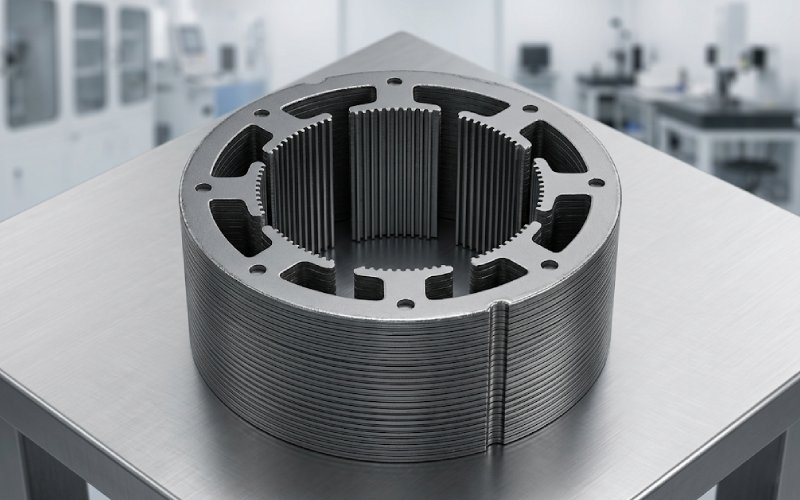
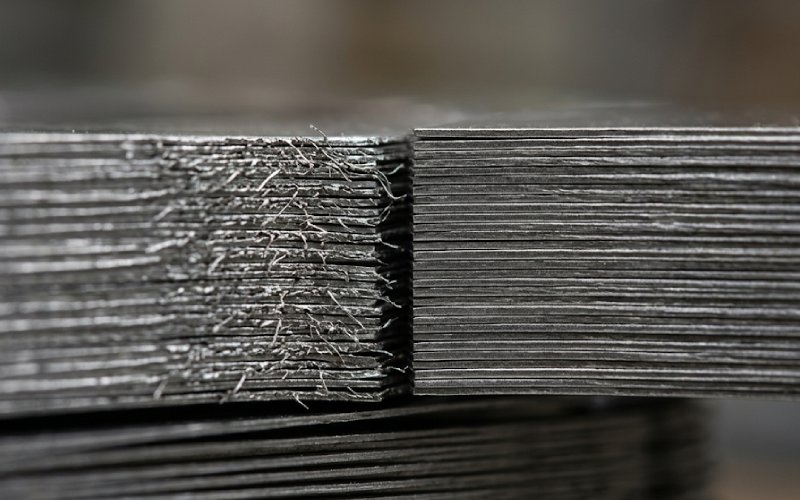
Motor lamination stacks do not usually fail because one sheet looks bad. They fail because small edge defects repeat, layer after layer, until the stack starts behaving differently than the print suggested. A burr that seems minor on one lamination can scratch coating, distort stack build, and in some cases help create conductive contact between adjacent sheets. Fine blanking for motor laminations is attractive for exactly that reason: it is built to produce a cleaner, squarer edge with less fracture and less burr than ordinary blanking. The catch is simple. The cleaner edge costs more.
A practical answer comes first. Fine blanking is usually worth the cost when burr-related scrap, deburring, insulation damage, or stack instability are already costing real money. If your current stamping line already controls burr height, keeps coatings intact, and holds stack geometry without much rework, the premium often does not pay back. Not because fine blanking fails. Because the problem it solves is no longer big enough. That judgment follows from published work on edge quality, interlaminar fault risk, deburring cost, and cut-edge damage in electrical steel.
Burrs in electrical steel are not just a cosmetic issue. During stacking and pressing, raised edges can impair the insulation between adjacent laminations and create random metallic contact points. When that happens, interlaminar current paths can form, which raises local loss and heat. In a big stack, that can become a performance problem rather than a surface-finish problem.
There is also a geometry problem. Burrs and edge fracture affect how laminations sit against each other. That influences stack height, local flatness, tooth definition, and slot consistency. Sometimes the effect is small. Sometimes it is the reason one build runs smoothly and the next one needs sorting, pressing adjustment, or rework.
Published electrical-steel data give a useful reference range for burr limits: about 0.03 mm for sheet thicknesses from 0.35 to 0.54 mm, 0.04 mm for 0.65 mm, and 0.06 mm for 1.00 mm. Those are not universal acceptance rules for every motor. Still, they are a good reminder that burr tolerance is tied to thickness and application, not to one generic target.
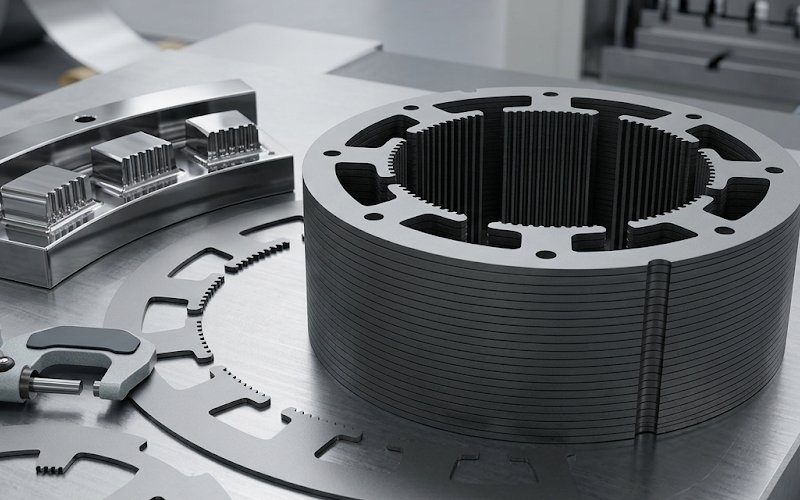
Fine blanking changes the cut by changing the stress state during separation. The process uses very small die clearance together with strong blank holding, a V-ring, and counterpressure. The result is a much larger clean-cut zone, less edge fracture, better edge squareness, and very low burr compared with ordinary blanking. In many cases, that also reduces or removes secondary edge finishing.
That does not make it cheap. Fine blanking needs specialized tooling, tight process control, and a press setup that is more demanding than a standard stamping line. So the comparison should never be cost per hit by itself. The useful comparison is total cost per acceptable lamination stack. That sounds obvious. It often gets skipped anyway.
The right question is not, “Is fine blanking expensive?” It is.
The right question is, “What costs disappear when the edge gets cleaner?”
That usually comes down to seven numbers:
| Cost or saving bucket | What to measure |
|---|---|
| Tooling premium | Additional annualized die and setup cost versus current blanking |
| Press premium | Added machine-hour or outsourced process cost |
| Maintenance | Sharpening, repair, downtime, and setup stabilization |
| Deburring removal | Labor, consumables, equipment time, inspection |
| Scrap reduction | Laminations or stacks rejected due to burr, coating damage, or height variation |
| Rework reduction | Stack sorting, restacking, edge finishing, extra pressing |
| Quality escape reduction | Insulation faults, local hot spots, returns, and internal containment |
Broad manufacturing studies on burr control and deburring have reported that deburring and cleaning can absorb a meaningful share of manufacturing expense, with medium-complexity parts sometimes landing in the 15% to 20% range and higher figures reported in some cases. Lamination stacks will not all fall there. Many will not. Still, the point holds: a process that prevents burrs can be cheaper overall even when the cutting stroke itself costs more.
Use this before you switch processes:
Annual fine blanking premium = annualized tooling premium
Annual savings from cleaner edges = deburring cost removed
Payback period = annual fine blanking premium ÷ annual savings
That formula is plain on purpose. It is enough for an internal first pass. If the result is still close, then the right move is a trial with real burr-height, coating-damage, and scrap data.
The numbers below are illustrative. They are not industry averages. Replace them with your own.
| Item | Annual value |
|---|---|
| Tooling and setup premium | $42,000 |
| Added press/process premium | $31,000 |
| Added maintenance | $12,000 |
| Total annual premium | $85,000 |
| Deburring removed | $28,000 |
| Scrap reduced | $34,000 |
| Rework reduced | $19,000 |
| Internal quality loss avoided | $21,000 |
| Total annual savings | $102,000 |
In that case, fine blanking pays back within the first year. Not dramatically. But clearly enough.
Now flip the situation. Suppose deburring is already minimal, scrap is low, and the current line holds burr within spec. Then the savings might be only $30,000 to $40,000 a year against the same $85,000 premium. That version does not work. Same process. Different plant math.
Fine blanking tends to make sense when the lamination stack is sensitive to edge defects and the production volume is high enough to spread tooling cost over a large number of parts. Thin electrical steel, narrow teeth, tight slot geometry, and stacks where coating damage or burr-driven sorting already show up in daily production are the usual signs. In those cases, the process is not just buying a nicer edge. It is buying stability in stacking, less secondary finishing, and fewer ways for a small defect to turn into a larger cost.
It also makes sense when the current line solves burr problems with extra labor. Manual deburring. Added inspection. Restacking. Selective sorting. Those are expensive ways to protect a part after the damage is already there. Process-side prevention is often cheaper once volume gets real.
Fine blanking usually does not make sense when ordinary stamping already controls burr height, stack build, and coating integrity well enough that downstream correction is small. The same is true for low-volume programs, parts with changing geometry, or projects where the main loss mechanism is not burr at all. If the real problem sits in stack welding, pressing, handling damage, or inconsistent assembly, a premium cutting process can become a tidy but partial fix.
That is the part people miss. A clean edge is valuable. It is not magical.
Cutting electrical steel changes more than burr height. Published work on punching shows that the material near the cut edge can suffer magnetic degradation from plastic deformation and residual stress. Fine blanking improves the sheared edge and usually reduces fracture-related damage, but it does not erase every cut-edge effect, and it does not remove losses added later by assembly steps. So if your burrs are already under control and machine performance is still lagging, the missing answer may be elsewhere.
That does not weaken the case for fine blanking. It narrows it. Which is useful. A process decision should be narrow.
Use this as a fast screen before you ask for trials or quotes.
| Production situation | Likely verdict | Why |
|---|---|---|
| Burrs are damaging coating or creating stack shorts | Usually worth it | The cleaner edge removes direct quality risk |
| Deburring is manual or costly | Often worth it | Savings show up immediately in labor and throughput |
| Thin gauge, narrow teeth, tight slot tolerances | Often worth it | Edge quality has a larger effect on stack quality |
| Very high annual volume, stable design | More likely worth it | Tooling premium is spread across many parts |
| Current stamping already controls burr and stack build | Often not worth it | There is not enough cost left to remove |
| Design still changes often or annual volume is low | Usually not worth it | Tooling and setup premium are hard to recover |
| Main problem is assembly damage, not cut quality | Usually not worth it | Wrong problem, expensive fix |
Fine blanking for motor laminations is worth the cost when burrs are already costing money after the press. That is the cleanest way to say it. If burrs are driving deburring, scrap, rework, coating damage, or insulation risk, the premium can pay back fast enough to make sense. If ordinary blanking already holds the edge where it needs to be, the same premium becomes hard to defend.
So the decision is not really about whether fine blanking is better. It is. The decision is whether that improvement is large enough, in your stack and at your volume, to remove more cost later than it adds now.
No. It reduces burrs and edge fracture far more effectively than ordinary blanking, but actual results still depend on tool condition, material, part geometry, and process control. Low burr is realistic. Zero burr as a permanent production promise is not.
No. It is strongest when the stack is sensitive to edge defects and production volume is high. If your current process already controls burr well and downstream correction is limited, fine blanking can improve quality without improving total economics enough to matter.
A common reference range is about 0.03 mm for 0.35 to 0.54 mm sheet, 0.04 mm for 0.65 mm sheet, and 0.06 mm for 1.00 mm sheet. Those values are useful starting points, not a substitute for a part-specific limit based on coating, stack pressure, and motor design.
Not always. Lower burr reduces the risk of insulation damage and interlaminar contact, which helps. But cut-edge strain can still affect magnetic behavior near the edge, so burr control alone does not explain all performance differences between processes.
Measure five things from your current line: burr-related scrap, deburring cost, rework hours, coating-damage rate, and annual volume. Then compare those savings against the annualized tooling, press, and maintenance premium of fine blanking. If the removed cost is larger than the added cost, the answer is already close. If not, it probably is not the right move yet.





 English
  German
  Spanish
  French
  Italian
  Japanese
  Korean
  Dutch
Dutch  Indonesian