Let Sino's Lamination Stacks Empower Your Project!
To speed up your project, you can label Lamination Stacks with details such as tolerance, material, surface finish, whether or not oxidized insulation is required, quantity, and more.
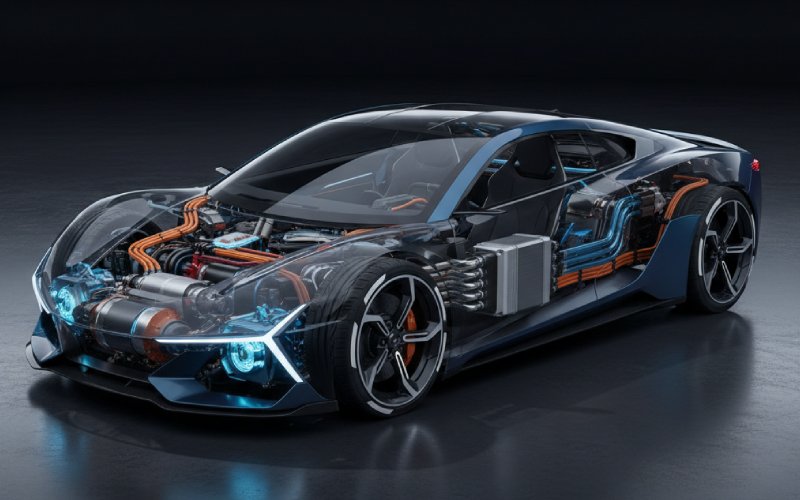
The Taycan motor is not the wildest unit on the market anymore. It is something more useful for designers: a very fast, very dense, first-generation 800-volt drive that shows where Porsche compromised, where it refused to, and how a real OEM reconciles simulations, factory tooling, and warranty lawyers in a single piece of rotating metal.
On paper, the Taycan rear motor looks almost modest next to newer 900-volt hardware. The research literature quotes roughly 350 kW from about 47 kg of active parts in the Porsche unit, around 7–8 kW/kg. Lucid’s 900-volt motor comes in near 500 kW from roughly 34 kg, more than 14 kW/kg.
That gap is not just about clever magnet tricks. It reflects target use cases and risk appetite. The Taycan needed repeatable performance with premium-brand durability, using a brand-new 800-volt stack and hairpin stators that were still relatively fresh in volume production. Porsche went for high power density per litre of package, not record power per kilogram at any cost. The official documents emphasize that the front and rear drive modules reach class-leading kW per litre thanks to aggressive slot fill and compact packaging.
For designers, the first lesson is uncomfortable. Power density numbers exist on at least three axes at once: per litre, per kilogram, and per minute of sustained output. The Taycan quietly optimises the first and the third, and lets the second drift a bit. That is a valid pattern when your customer cares about back-to-back laps more than bragging rights about motor mass. Copying the Taycan blindly while chasing Lucid-style specific power will just give you the downsides of both.
So, before opening a CAD model, write down which density you actually care about. Then accept that the others will move the wrong way. The Taycan shows that this is not failure, just a conscious choice.
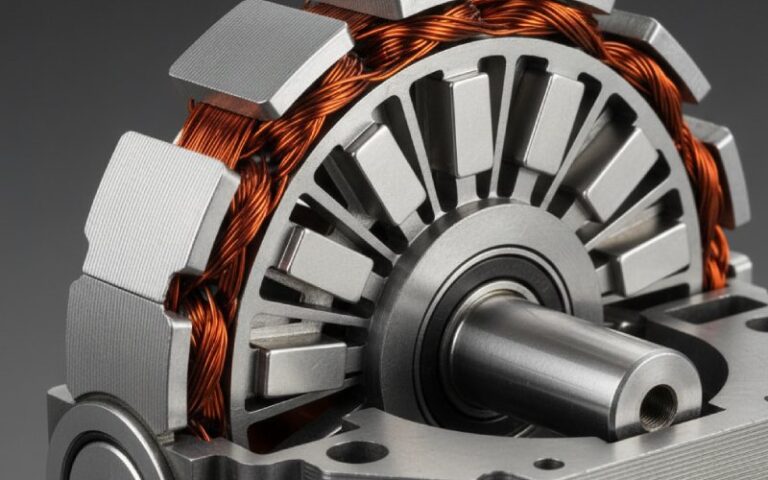
The headline design move in the Taycan motor is obvious: rectangular copper hairpins in the stator instead of round wire. Porsche’s own material quotes a copper fill moving from the mid-40 percent range with conventional windings to just under 70 percent with hairpins, in the same stator volume. That is a huge gain; you do not often find 20-plus percentage points just by changing geometry.
But hairpin is not “free torque in exchange for some tooling”. Public winding-technology pieces and academic work on hairpin machines keep repeating the same warning: once you pack that much copper into the slots, AC losses, insulation stress, and joining quality become the limiting factors instead of slot utilisation.
The Taycan stator sits right in this tension zone. High fill, very good thermal contact from flat conductors to the laminations, water jacket around the outside, and then the uncomfortable bits: laser-welded joints at every hairpin end, complex busbar geometries, and 800-volt stresses pressing on all of it. The official story highlights efficiency and cooling gains, but teardown commentary also hints at manufacturing cost and process complexity that will be trimmed in future generations.
If you are specifying a winding method today, the Taycan suggests three practical rules. First, treat hairpin as a cross-functional choice across electrical, thermal, process, and cost engineering; not as a late “performance option”. Second, commit to industrialising the joining and quality assurance around it, because a hairpin stator is only as good as its weld repeatability. Third, design your insulation and creepage strategy from the start for your future voltage, not just the current model year, because moving a hairpin machine from 400 to 800 volts is not a simple scaling exercise.
The Taycan shows hairpin done with a safety margin. Newer motors from China and California push harder on AC-loss mitigation, segmented conductors, and more advanced cooling to reclaim some of the penalties. Designers reading this are probably in the uncomfortable middle. That is exactly where the Taycan lived in 2019.
The marketing line is simple: 800-volt battery, lower current, thinner cables, faster charging. The maths in recent analysis is equally clean: at around 250–270 kW DC charging power, an 800-volt system needs roughly 350–380 A where a 400-volt pack would be pulling 600 A-plus. Joule loss scales with current squared, so the thermal burden drops sharply.
Motor designers do not live in marketing though. Higher voltage shifts the pain into insulation design, clearance distances, partial discharge management and EMI. Technical writing on high-voltage windings points out that 800-volt and higher machines must increase the number of series turns and rethink insulation stacks; you cannot simply double the DC link voltage on the same stator without paying somewhere.
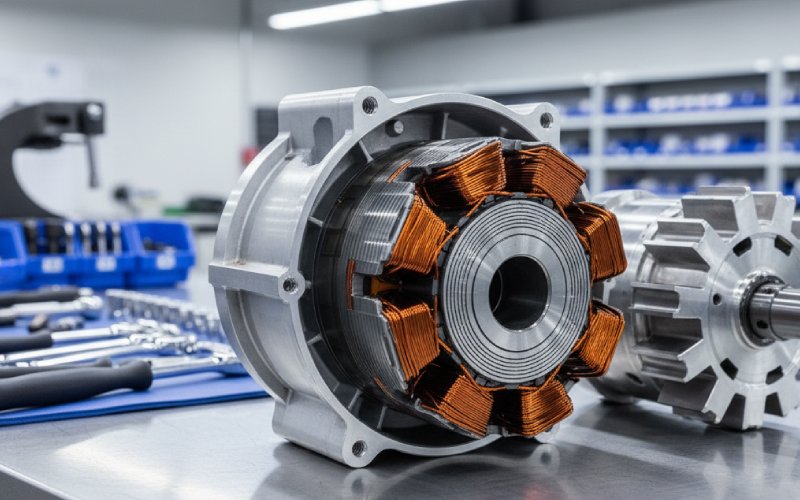
Porsche’s solution ties everything together. The hairpin stator’s rectangular conductors sit in well-defined slots with good geometric control, making it easier to define insulation thickness and creepage paths. The pulse-controlled inverter sits right on the drive module in a “balcony” arrangement on the rear axle, keeping AC path lengths short and allowing Porsche to treat the whole motor-inverter assembly as one 800-volt insulation object. At the same time, resolver feedback and inverter control are tuned tightly enough that synchronous operation, field-weakening and recuperation all behave acceptably across that voltage range.
For designers, the main takeaway is that the electrical stack has to be architected as a unit. Stator slot geometry, varnish, busbar routing, DC-link layout, and inverter packaging need to be in the same design loop. The Taycan did that at 800 volts when most rivals were still at 400; they paid with early-generation complexity, but they cleared the systems-engineering bar.
It is very tempting to do this the other way: motor team here, inverter supplier there, battery somewhere else, and someone glues them together at the end. The Taycan motor argues against that quietly, with its tightly integrated module and very short 3-phase paths.
Teardown work and independent commentary on the Taycan keep returning to a single theme: this car has a very busy cooling network. Multiple loops, extra radiators, and lots of hose work under the floor, all in service of battery and motor temperature control during sustained performance use.
On the motor side, Porsche combines the usual water jacket around the stator with oil end-spray on the hairpin overhangs, a method now common on high-density EV motors. The oil extracts heat from the copper ends, then dumps it into the water-cooled circuit. A technology brief that uses the Taycan as an example notes that many OEMs now add an extra radiator and pump to support this spray system and keep slot temperatures in check.
From a pure power-density perspective, that is the right call. Hairpin stators with nearly 70 percent copper fill have superb thermal conduction to the laminations, but the hottest zones are at the end windings where current crowds and local AC losses spike. Oil at those points buys you continuous output and repeatable track performance in a car that weighs over two tonnes.
From a system and cost perspective, it hurts. More components, more potential leak points, more calibration work, and higher service complexity. Alternative approaches such as direct conduction encapsulation try to reach similar thermal performance with passive resin-based paths instead of active oil spray, claiming significant cost savings per motor.
So the Taycan becomes a design case study in “pay for cooling now, simplify later”. If you are early in your EV platform, you might choose complexity to secure thermal margin and brand credibility, with the medium-term plan of replacing that loop with more passive methods once your understanding of duty cycles and failure modes matures. The important point is being honest that you are buying learning with plumbing. Porsche clearly did.
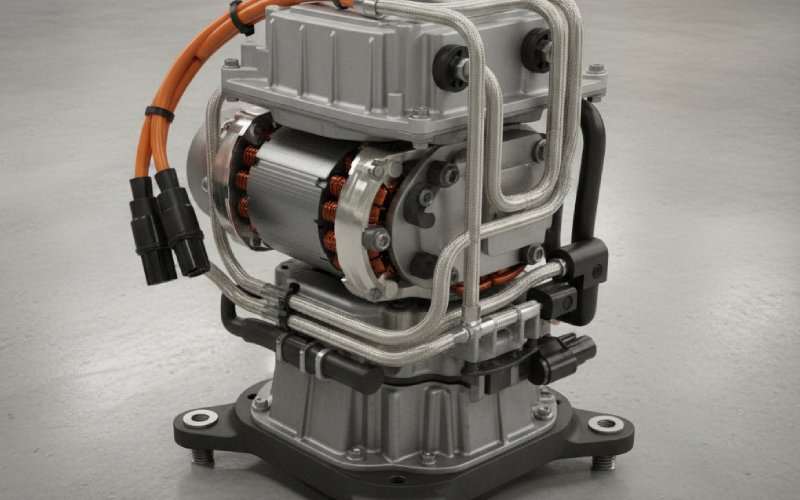
The Taycan drive modules are notable not just for what is inside them but where they sit. Porsche’s own technical notes stress that the front-axle unit uses a coaxial layout of motor, gearbox and axle shafts to minimise longitudinal space, while the rear-axle module places the two-speed gearbox and motor parallel to the axle with the inverter mounted above in that “balcony” position.
This is not only about squeezing in a frunk. Integrating the inverter on the module simplifies high-current wiring, shortens phase cables, and lets engineers treat NVH, seals, and thermal interfaces in a unified way. It also means that the motor is born as part of a bigger product: a sealed drive unit, with specific mounting points, crash loads, and acoustic targets.
For designers working on motors in isolation, this is a quiet warning. Your motor is rarely just a motor. It is a mechanical, cooling, and electrical node in a bigger assembly that will be benchmarked as a module. Porsche explicitly notes the kW per litre of the whole drive unit, not just the e-machine. That is how internal gatekeepers will compare you to Taycan-class hardware.
The Taycan also shows the cost of this integration. Serviceability is tougher; any fault in the motor or gearbox may imply replacement of the whole module. But NVH and crash robustness are easier to control when the major components arrive as one tuned package from the same design team.
All of the above compresses into a small set of design axes. The table below is not a full spec sheet; it is a summary of what the Taycan does on each axis and what a designer might copy, question, or invert. It combines official Porsche information, independent teardown insights, and recent research that compares the Taycan with newer 800–900 volt platforms.
| Design axis | Taycan choice (simplified) | Takeaway for motor / EV designers |
|---|---|---|
| Power density priority | Very high kW per litre at module level; moderate kW per kg of active parts compared with latest 900-V motors. | Decide which density truly matters for your use case; design around that and accept that the others will look worse in comparison. |
| Winding technology | Rectangular-wire hairpin with ~70% copper fill, laser-welded joints, complex busbar layout. | Treat hairpin as a system choice involving AC losses, weld quality, and insulation, not as a late performance upgrade. Invest early in the joining and QA process. |
| Voltage architecture | 800-V pack and 800-V motor/inverter stack, reducing current and cable mass at the cost of higher insulation and BMS complexity. | Integrate motor, inverter, and battery design; higher voltage is beneficial only when the entire chain — including slot insulation and busbars — is redesigned for it. |
| Cooling strategy | Water-jacketed stator plus oil spray on hairpin end windings, supported by a relatively complex multi-loop cooling system with additional radiators. | Early generations may justify aggressive, complex cooling to secure thermal margin and performance reputation. Plan a long-term path toward simpler, more passive solutions as your understanding improves. |
| Module packaging | Highly integrated drive units: motor, gearbox, and inverter packaged as one module with tight packaging around both axles. | Design motors as parts of modular drive units rather than as stand-alone components; packaging, NVH, and wiring benefits usually outweigh the service penalties. |
| Performance philosophy | Track-capable continuous power with strong recuperation, not just short-burst acceleration numbers; two-speed rear gearbox to stretch the efficiency window. | Define duty cycles honestly. If repeated high-load operation matters, prioritise continuous power and thermal resilience even when headline figures suffer. Gearbox or no gearbox should follow from that, not from marketing fashion. |
By 2025, the Taycan motor is no longer the absolute cutting edge. Chinese and Californian units push to higher speeds, more aggressive cooling, and higher specific power. Yet the Taycan remains one of the clearest production examples of how to launch a clean-sheet, high-performance drive system under real constraints and brand risk.
If you strip away the showroom noise, you are left with a few simple patterns. High copper fill and 800-volt architecture buy you performance, but only when you pay attention to insulation and AC losses. Rich cooling buys you continuous output, but you pay in plumbing and cost until you can simplify in the next cycle. Integration of motor, gearbox and inverter buys you package and NVH quality, at the price of service access and modularity.
The Taycan motor is a snapshot of a particular point on that trade-space. Not the only right answer, not even the best answer now that later hardware exists, but a very honest one. If you are designing your own unit, you can do worse than to ask, section by section: would we make the same trade here, with what we know today? And if not, are we sure we understand why Porsche did.


 English
  German
  Spanish
  French
  Italian
  Japanese
  Korean
  Dutch
Dutch  Indonesian