Let Sino's Lamination Stacks Empower Your Project!
To speed up your project, you can label Lamination Stacks with details such as tolerance, material, surface finish, whether or not oxidized insulation is required, quantity, and more.
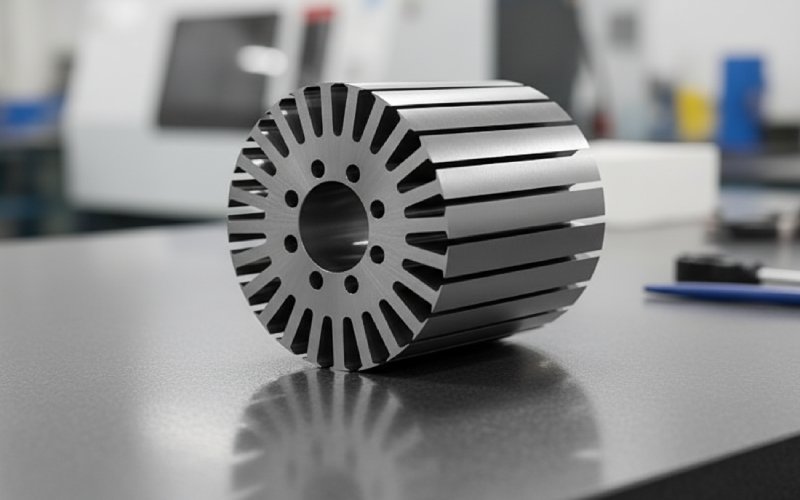
A bridge is not a clean-up feature added after electromagnetic design. In real rotor lamination stacks, bridge thickness sits right in the middle of burst margin, leakage flux, steel grade, punching limits, and whatever your supplier can actually hold in production. Recent high-speed IPM studies keep pointing in the same direction: bridge thickness often moves rotor stress far more than rib width does, while extra bridges or stiffeners improve survivability by opening more leakage paths at the same time.
That is the real argument in rotor design. Not “strength versus efficiency.” More like geometry versus everything else.
In one high-speed comparison, increasing bridge thickness from 1 mm to 2 mm reduced rotor stress from 3961 MPa to 2385 MPa, a drop of 39.8%. Moving from 2.5 mm to 3.5 mm only reduced stress by another 11.2%. The shape of the tradeoff matters. Early bridge growth buys a lot of mechanical relief. Later bridge growth still costs magnetic performance, but the mechanical return starts flattening out.
The magnetic side is not subtle either. In that same study, the no-load leakage flux factor increased from 1.12 to 1.56 as bridge thickness moved from 1 mm to 3.5 mm. So yes, thicker steel helps the rotor survive. It also gives flux an easier place to go that is not the air gap.
And once speed goes up, the problem gets less forgiving very quickly. Rotor stress from centrifugal loading rises with the square of speed, which is why a bridge that looks acceptable in a lower-speed design can become the weak point after the speed target moves. Earlier high-speed IPM work made the same point in a different way: bridges and ribs at the rotor outer diameter are the mechanically limiting features in many conventionally laminated IPM rotors, and their sizing has to be considered together with electromagnetic impact, not after it.
A lot of teams still treat bridge thickness as a late-stage safety lever. That works, up to a point. But it is not a neutral lever.
Three patterns show up again and again:
That is why “make the bridge thicker” is rarely a finished answer. It is just the first answer.
Another thing that gets missed: bridge geometry is not acting alone. Material strength changes the allowable stress window. Magnetic behavior changes how much flux the bridge and rib will carry once saturation starts moving around. A recent combined electromagnetic-mechanical optimization study found an optimum rotor diameter under a given stress limit, instead of a simple bigger-is-better trend. Past that point, the extra geometry needed to stay inside the stress limit started eating into the electromagnetic benefit. That is a useful reminder for lamination stack projects: rotor geometry should not be frozen before the stress limit, steel choice, and manufacturing route are known.
Ribs matter. Usually less than people hope, mechanically, and more than they expect magnetically.
The 2022 multi-physics comparison is blunt on this point: bridge thickness had a strong effect on rotor stress and deformation, while rib thickness changed them more mildly. A 2024 high-speed IPM optimization study also treated bridge thickness and stiffener thickness as primary stress-control variables because rotor reliability and electromagnetic performance were moving against each other.
That does not mean rib design is secondary. It means rib design is usually a finer tool.
In some layouts, the better move is not a wider rib but a different bridge strategy. A 2025 study on multi-bridge V-shaped rotors showed that adding bridges can improve mechanical strength effectively, especially through central bridge thickness, but the paper still frames the core problem as a contradiction between mechanical strength and electromagnetic performance. The practical reading is simple enough: add only as much bridge as the stress case forces you to add. No more.
There is also a second path. Rearrange the leakage path instead of only reinforcing it. A 2018 V-shape IPMSM study removed magnetic ribs and introduced center bridges for a small-rotor case where the ribs were already thin; the reported torque gain was 10% or more. A 2024 rotor concept went further and removed the bilateral bridge, relying on a central bridge to keep strength while reducing total bridge width, leakage, and torque loss. Under equal-strength comparisons, another 2024 study found that the rotor without central bridges had the largest leakage flux and the lowest torque but the smallest torque ripple; narrower bilateral bridges produced the highest torque and the highest torque ripple; wider bilateral bridges landed in between on torque and came out highest on efficiency. That is a better picture of reality than any universal “best bridge layout” rule.
| Design move | What it usually improves | What it usually costs | What it means for production |
|---|---|---|---|
| Increase outer bridge thickness | Large early drop in rotor stress | More leakage flux, less useful main flux | Narrow-feature stamping gets less fragile, but magnetic penalty grows fast |
| Increase rib width slightly | Local stiffness, deformation control | Can change saliency, leakage, ripple | Easier than ultra-thin ribs, but not a free mechanical fix |
| Add middle bridges or stiffeners | Better stress distribution at high speed | More leakage paths | Tooling and assembly become less forgiving |
| Shift to center-bridge or rib-less concepts | Can reduce leakage in some topologies | Ripple and torque behavior may move in both directions | Needs case-specific validation, not rule-of-thumb approval |
| Upgrade steel strength | Better stress margin with thinner sections | Material cost and magnetic tradeoffs | Supplier capability and material consistency matter more |
The point of the table is not to hand out defaults. It is to stop teams from acting as if one geometry move only changes one thing. It never does.
This is usually the part missing from competitor articles.
Simulation will happily tell you that a narrow bridge or rib is still acceptable. The shop floor may disagree. A 2023 review on electrical steel manufacturing effects breaks the process into cutting, joining, stress-relief annealing, and shrink fitting, then points out that each step can degrade magnetic quality and often increase local hysteresis losses near cut edges. That matters more as bridge and rib features get narrower, because the damaged region is no longer a small detail sitting somewhere off to the side.
There is a second reason to be careful with narrow features. A 2016 study on punched non-oriented silicon steel reported a residual-stress-affected zone of about 0.4–0.5 mm from the sheared edge. Read that again, then look at any drawing with a very narrow magnetic bridge. On paper, the bridge width may still look reasonable. In production, the edge-affected zone can occupy a meaningful share of the feature itself. That does not make thin bridges impossible. It does move the real optimum away from the clean FEA optimum more often than teams expect.
If the rotor uses thin bridges, narrow ribs, or a bridge-sensitive topology, do not send only a DXF and a material code.
Send this instead:
That changes the conversation. It moves the RFQ away from price-only quoting and toward manufacturability review, which is where bridge-sensitive designs should start anyway.
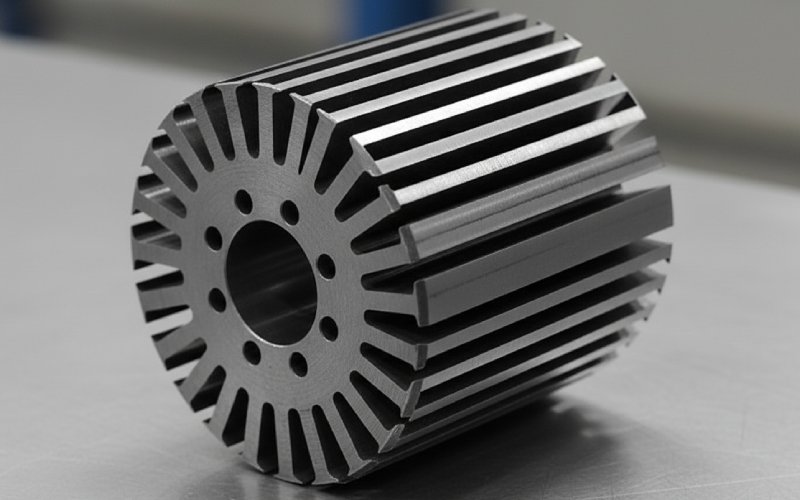
Send your DXF files, material options, target speed, and stack requirements to our engineering team for a bridge-and-rib feasibility review.
We will check the drawing against stamping limits, narrow-feature risk, and lamination stack production constraints before quotation.
For rotor stress in many high-speed IPMSM cases, yes. Published comparisons show bridge thickness often has a much larger effect on rotor stress and deformation than rib thickness. That does not make rib geometry unimportant. It means bridge thickness is often the first variable that decides whether the rotor survives the speed target.
Sometimes. A 2018 V-shape IPMSM study reported 10% or more torque gain in a small-rotor case after removing magnetic ribs and introducing center bridges. That result is topology-dependent, not universal, but it does show that leakage paths can sometimes be rearranged instead of only reinforced.
Mechanically, it often helps. Electromagnetically, it usually hurts. The 2025 multi-bridge V-shaped rotor study treats that contradiction as the central design problem, which is why bridge number and size still need to be minimized once the minimum strength target is met.
Because the edge-affected zone stops being small relative to the feature. The 2016 punching study reported a residual-stress-affected zone of about 0.4–0.5 mm, and the 2023 manufacturing review shows that cutting and related processes degrade magnetic quality and raise local losses near cut edges. On narrow rotor features, that is no longer background noise.
Treating the bridge like a drawing feature instead of a process-sensitive feature. If the supplier does not know the speed target, overspeed margin, steel options, burr limit, and joining route, the quote may still come back fast. It just will not tell you much about whether the stack will behave the way the simulation said it would.


 English
  German
  Spanish
  French
  Italian
  Japanese
  Korean
  Dutch
Dutch  Indonesian