Let Sino's Lamination Stacks Empower Your Project!
To speed up your project, you can label Lamination Stacks with details such as tolerance, material, surface finish, whether or not oxidized insulation is required, quantity, and more.
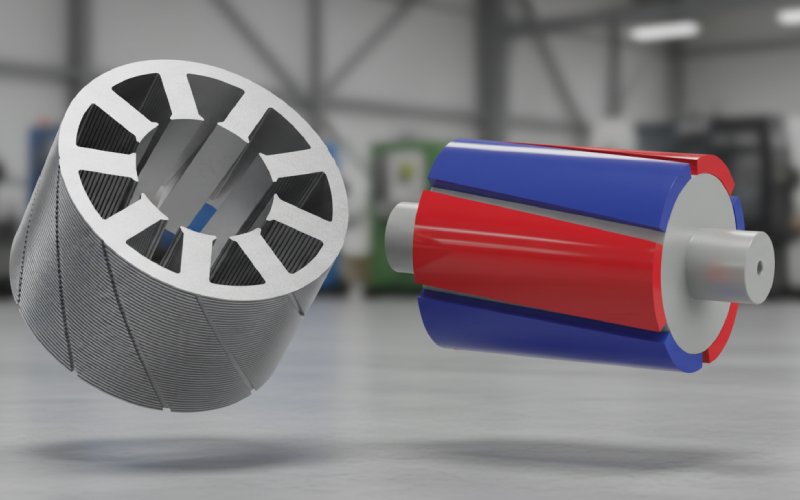
Rotor skew is not free. It is a trade cut into steel.
In rotor lamination stacks, skew angle is basically a built-in harmonic filter. A small skew can knock down slot-driven force waves, smooth cogging, and calm the housing. Push the angle too far and the same move starts eating useful electromagnetic output, shifting axial force, and making the stack harder to build repeatably. That is the real design problem. Not “should we skew.” More like, “which harmonic are we paying to kill, and what are we willing to give back.”
The first change is obvious: cogging torque drops because the rotor no longer presents the same tooth-to-slot alignment along the full axial length at the same instant. The second change is less friendly: the useful fundamental is also attenuated as skew grows, so average torque and back-EMF margin can slip. The third change is where many teams get surprised. NVH does not track cogging one-to-one. A cleaner no-load waveform can still leave you with bad loaded force harmonics, or with axial force you did not budget for.
That is why we do not treat rotor skew as a checkbox in lamination stack design. We treat it as a balancing parameter between electromagnetic cleanliness, acoustic behavior, and stack manufacturability. Some machines tolerate a moderate skew well. Some do not. Some even show a small efficiency benefit at one slot combination, then turn negative as angle keeps increasing. Same motor family. Different slot pairing. That part is annoying, but normal.
For efficiency, the lazy answer is “skew reduces losses by smoothing torque.” Not enough.
What usually happens is more uneven. Moderate skew can reduce parasitic harmonic content and soften ripple-related losses, so the net efficiency change may be small, sometimes neutral, sometimes slightly positive in a narrow design window. But once the skew angle keeps climbing, the drop in useful EMF or torque constant starts to matter more than the harmonic cleanup. In published machine studies, some skewed variants held efficiency roughly flat, some improved slightly at specific slot combinations, and many showed no gain or a gradual decline as angle increased.
So we do not sell skew internally as an efficiency feature. We sell it as a harmonic management tool that must survive an efficiency audit. If the business case is energy first, skew needs to prove it at the real operating points, not on a quiet no-load plot. Load, saturation, and slot combination can move the optimum enough that a no-load winner becomes a rated-load compromise.
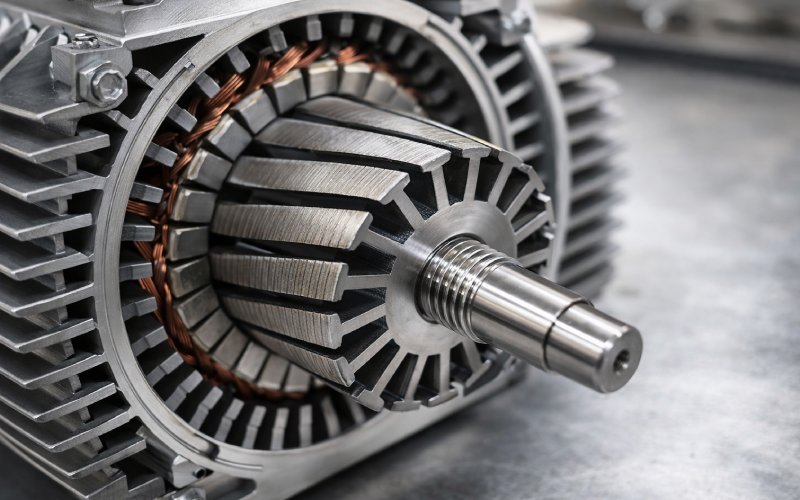
Cogging is where rotor skew keeps paying rent.
The reason is simple enough that it barely needs a lecture: axial offset prevents the whole stack from reinforcing the same reluctance event at the same rotor position. In analytical and test work, moderate skew or multi-step skew regularly cuts the dominant cogging orders hard; in some cases by more than half, in others far more. Discrete skew methods have reported up to 70% torque-ripple reduction, and skewed notch or PM skew studies have shown very large cogging reductions when the targeted harmonic order is matched well.
There is one catch. Full cancellation on paper is easier than full cancellation in steel. End leakage, segment edge effects, saturation, and axial field distortion keep showing up and spoiling the perfect result. That is why the “one ideal skew angle” story is usually too neat for production lamination stacks. The target harmonic may collapse. The machine rarely becomes magically ripple-free.
This is the part that gets missed in too many motor discussions.
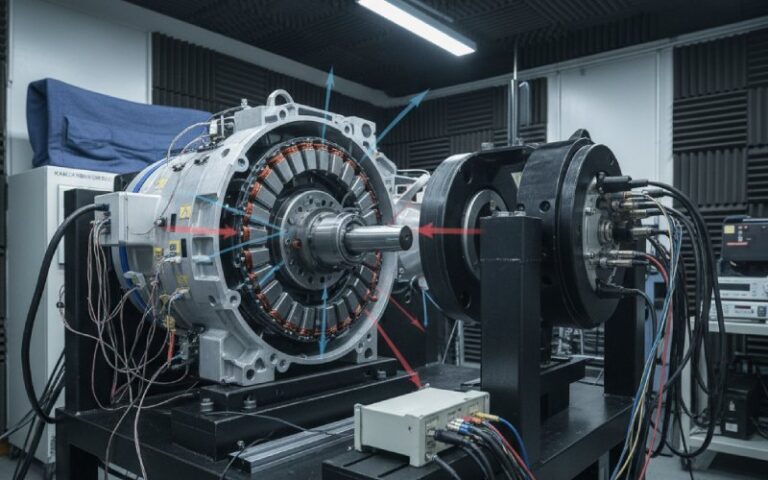
Skew can improve NVH because it weakens the electromagnetic sources that feed structure-borne noise: cogging components, torque ripple components, back-EMF harmonics, and radial force waves. But the loaded NVH result depends on which force orders remain, how the housing and stator modes line up, and whether the skew pattern introduces axial force or directional imbalance. That is why serious skew studies now look at axial force, radiated noise, and forward/reverse behavior together, not just torque FFTs.
In other words, a lower cogging trace is not the finish line. We have seen skew angles that make the no-load waveform look cleaner, then cost average torque, then shift force content into an area the structure likes to sing. Different problem, same customer complaint. For traction-style machines, segmented skew and asymmetric two-step skew have shown large vibration reductions, but only after the angle and stack pattern were tuned against both electromagnetic and structural response.
The table below is the way we frame rotor skew in production stack discussions. Not as a theory chart. As a decision chart.
| Skew choice in rotor lamination stacks | Efficiency effect | Cogging torque effect | NVH effect | Factory-side note |
|---|---|---|---|---|
| No skew | Highest chance of preserving raw EMF and average torque | Highest risk of slot-alignment-driven cogging | Stronger risk of discrete tonal content | Simplest stack build, easiest registration |
| Small skew | Often near-neutral | Noticeable reduction in dominant cogging orders | Often helpful, not always enough under load | Good first production candidate |
| Moderate skew | Usually the best compromise zone | Stronger cogging suppression | Often the best practical NVH trade | Step-skew segmentation usually works well here |
| Aggressive skew | Higher chance of average torque and EMF penalty | Diminishing returns can start showing | Can help, but may introduce axial-force or structural side effects | Harder stack control, more tolerance sensitivity |
| More skew segments | Average torque often changes little after a point | Ripple usually falls first, then the gain flattens | Can improve force distribution | More segments mean more assembly complexity |
That pattern is consistent with current FEA and experimental work: moderate skew tends to deliver the best overall trade, while aggressive skew gives smaller extra ripple wins and starts charging in torque, axial-force, or build complexity. Also, adding segments is not a forever move; some studies show improvement up to a point, then a plateau or even a slight reversal depending on the skew pattern.
Because the skew angle on the drawing is not the skew angle that reaches the test stand.
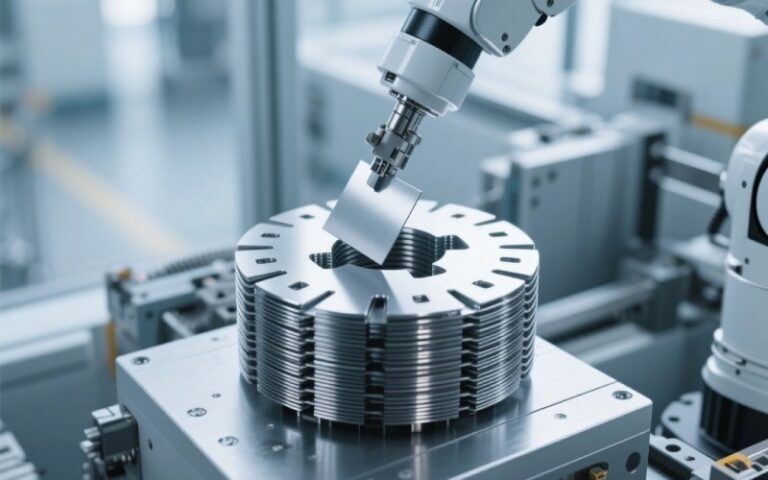
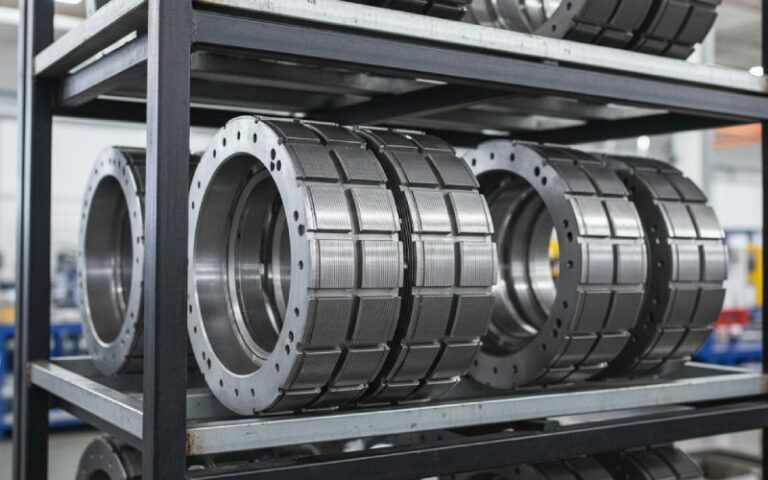
Step-skewed rotor lamination stacks live or die by stack registration, segment indexing, weld or bond distortion, burr control, and axial position consistency. On paper, the skew pattern may cancel the targeted harmonic nicely. In the shop, small segment mismatch can blunt that benefit fast. The more segmented the stack, the more this matters. So when we quote skewed lamination stacks, we do not only quote angle. We quote how tightly that angle survives assembly.
This is also why continuous skew is not always the commercial answer, even when it looks elegant in simulation. Step-skew lamination stacks are a practical approximation because they fit tooling, stacking, and inspection better. And if the harmonic set is understood well enough, two-step or multi-step skew can get very close to the intended electromagnetic result without turning the rotor into a manufacturing argument.
We start from the bad harmonic, not from a round-number degree value.
A useful mental shortcut is this: skew should be large enough to break the force order you actually dislike, while staying small enough to preserve the useful wave you are paid to keep. Analytical skew-factor work on induction machines shows why moderate skew often survives review. Around a one-to-two tooth class skew distance, the fundamental can remain very high while certain higher slot harmonics collapse sharply. That is the kind of trade you want. Not a dramatic angle for its own sake.
After that, we check five things. Rated-load torque ripple. No-load cogging. Radial force spectrum. Axial force. Stack build tolerance. This is not elegant. It works. And it prevents the classic mistake of optimizing skew on a no-load trace, then discovering at rated current that the real operating optimum moved somewhere else.
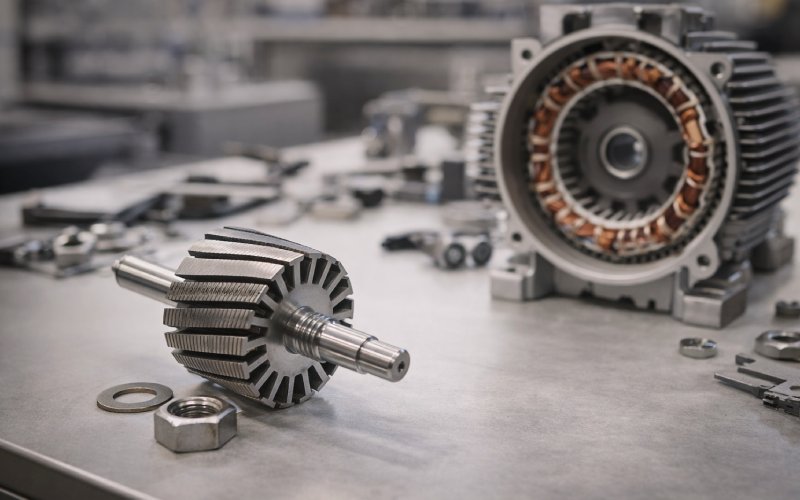
Rotor skew angle should not be chosen as a styling parameter for lamination stacks. It should be chosen as a controlled compromise.
If the machine is failing on cogging and tonal NVH, skew is often one of the cleanest geometry-side fixes. If the machine is already tight on back-EMF margin, torque density, or axial-force allowance, skew needs more discipline. And if someone claims one fixed skew rule for every slot/pole combination, every load point, every lamination stack architecture, they are skipping the hard part.
For most B2B lamination stack programs, the winning answer is not the maximum skew angle. It is the smallest skew that kills the expensive harmonic. Usually that is enough. Usually.
Usually it reduces the dominant cogging components, yes. But not in a perfectly linear way, and not without side effects. Once end effects, leakage, saturation, and segment edges show up, the extra gain from more skew can flatten out while average torque and EMF margin keep slipping.
No. Lower cogging helps smoothness, but efficiency depends on the full balance between harmonic loss reduction and the loss of useful electromagnetic output. Some machines see little change, some improve slightly in a narrow window, and others lose efficiency as skew angle increases.
Not reliably. Recent work shows the optimum skew for minimum torque ripple can move with load, electric loading, and saturation. A skew angle chosen only from no-load cogging data can miss the real loaded optimum.
In many production rotors, yes. Step-skew is the practical approximation because it is easier to manufacture and inspect, and two-step or multi-step approaches can still remove major ripple components effectively. More segments can help, but only up to the point where the benefit stops paying for the added stack complexity.
It can. Skew may reduce torsional excitation and force harmonics, but it can also create non-zero axial force. That is why NVH optimization should include axial-force review, not just torque ripple plots.
It is a common starting region because moderate skew often preserves the fundamental reasonably well while cutting higher slot harmonics sharply. But it is still only a starting point. Final selection belongs to the actual slot/pole combination, load case, and stack architecture.


 English
  German
  Spanish
  French
  Italian
  Japanese
  Korean
  Dutch
Dutch  Indonesian