Let Sino's Lamination Stacks Empower Your Project!
To speed up your project, you can label Lamination Stacks with details such as tolerance, material, surface finish, whether or not oxidized insulation is required, quantity, and more.
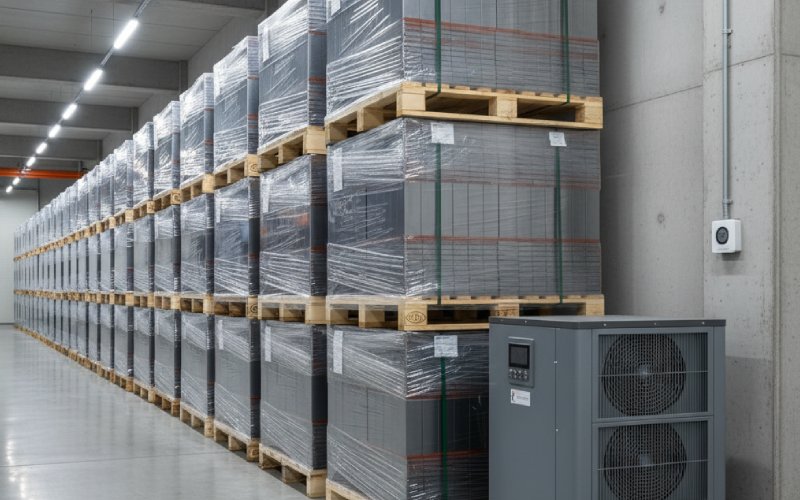
If you keep the coating dry, keep temperature swings boring, and treat condensation as the real trigger, most “mystery” insulation-coating problems stop showing up. The rest is just managing time: how long coils, blanks, and stacks sit unwrapped, cold, or contaminated.
A lamination insulation coating can look fine and still behave wrong. Surface insulation goes soft in spots. Stacks measure a little too conductive. Punch edges show early rust staining. Bonded stacks that used to cure cleanly start acting inconsistent. None of that requires the coating to “peel.” It just needs moisture to get a vote.
Standards and supplier classes (ASTM A976 “C-x” style groupings) are useful labels, but storage doesn’t care what you called the coating. It cares whether you created condensation, whether you left chemistry reactive in open air, and whether you gave corrosion a wet surface to work with.
People argue about relative humidity because it’s easy to read on a wall sensor. Condensation doesn’t negotiate with that sensor.
The practical rule is simple: if any steel surface drops below the dew point of the surrounding air, you can get water on the coating. One catalog example spells it out: at 25 °C and 80% RH, condensation can start if the temperature falls to about 22 °C. That is not a dramatic temperature change.
A power-electronics note uses the same idea with a chilled bottle: 20 °C air at 60% RH has a dew point around 12 °C; cool a surface below that and droplets appear. Swap “bottle” for “coil that came off a truck” or “stack sitting near a door” and the mechanism is identical.
So when someone says “our warehouse is under 65% RH,” that might be true and still irrelevant. If material comes in colder than the room, or the room cools overnight, or the pallet sits on a cold floor, you can cross dew point anyway. Quietly.
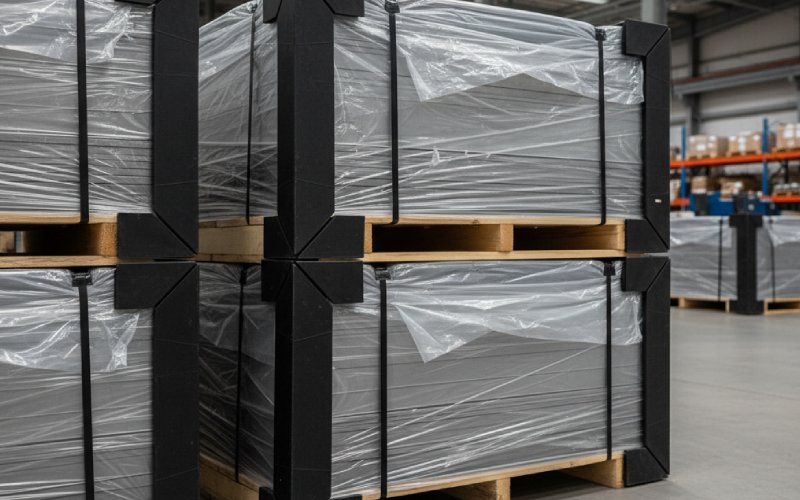
Some of the most useful storage guidance comes from suppliers who sell reactive lamination varnish systems, because they can’t afford ambiguity. For self-bonding varnish coated electrical steel (Backlack), voestalpine calls out a hard ceiling of +40 °C, recommends about +23 °C for storage, limits maximum storage to six months from supply, and says dry storage must be ensured with condensation avoided.
Thyssenkrupp’s insulation-coating product information says something similar in different words: below 40 °C, in dry conditions, storage life is at least six months, material should be protected from sunlight/UV, and temperature must not fall below the dew point. That last line is the tell. They’re not talking about “nice” humidity. They’re talking about not creating water on the surface.
Also worth noticing: coatings get corrosion resistance evaluated in condensation-atmosphere tests (DIN EN ISO 6270-2 is a common one), and the standard itself explicitly distinguishes constant humidity vs alternating atmospheres when temperature and humidity changes matter. Alternating is basically “warehouse reality.”
Even with a good storeroom, the risky moments are transitional.
A coil is unwrapped at receiving, sits “for a bit,” then gets moved again. A skid of punched laminations is staged near the press because it’s convenient. A half-used pallet is rewrapped poorly at shift end. None of these look like humidity problems in a monthly dashboard. They look like normal production. Then a week later you’re chasing interlaminar resistance drift.
If you want one mental model that holds up: you are not controlling a room, you are controlling a microclimate around coated steel. Packaging, re-sealing discipline, and acclimation time before opening matter as much as a dehumidifier.
Punching lubricants and post-punch handling change the game. One very specific note in thyssenkrupp’s documentation ties premature corrosion risk to water-dilutable lubrication and even gives a constraint: oil content should be above 5%, and “time in stock for lamination” is capped at five days in that context. That’s not marketing fluff; it’s an admission that storage time and wet chemistry interact fast once you’ve processed the surface.
So if your operation punches, then queues parts for a week in a humid corner, humidity control is not a facility project. It’s a scheduling constraint you either respect or you pay later.
The point of a table here isn’t to replace your supplier’s datasheet. It’s to make the failure modes legible when you’re walking the line and deciding whether a pallet is safe to run.
| Situation you can recognize | What is probably happening | What tends to work in practice | What you record so it isn’t a debate later |
|---|---|---|---|
| A cold coil or stacked blanks enter a warmer area and you open the wrap immediately. | The steel surface can sit below dew point long enough to form a thin water film even if average RH looks fine. | You keep it wrapped until the steel temperature is safely above the local dew point, then you open and re-seal cleanly between uses. | You log steel temperature and dew point at opening, not just room RH. |
| You see light rust tinting at edges or between laminations, but the coating “looks intact.” | Condensation events plus time are enough for corrosion staining and conductivity drift in stacks, especially after processing. | You shorten post-punch queue time and keep processed parts in drier, more stable staging, because “later” is when rust gets a longer window. | You track queue time since punch and where it sat, because “in stock” is not a single condition. |
| Bonded stacks start curing inconsistently compared to previous lots. | Reactive varnish systems are sensitive to storage temperature, storage duration, and condensation exposure, even when they arrive dry to the touch. | You enforce supplier limits (temperature ceilings and storage-life limits) and stop staging reactive-coated material near heat sources or doors. | You log delivery date, storage duration, and any excursions above the supplier’s limit temperature. |
| A “humidity-controlled” room still produces sporadic moisture issues. | Local surfaces (floors, exterior walls, dock-adjacent zones) can be colder than the air sensor, so dew point crossings happen locally. | You treat floor contact and perimeter zones as different climates, and you store coated steel off the floor with spacing for air movement. | You place at least one sensor where the material actually sits, because one wall sensor is a story, not a measurement. |
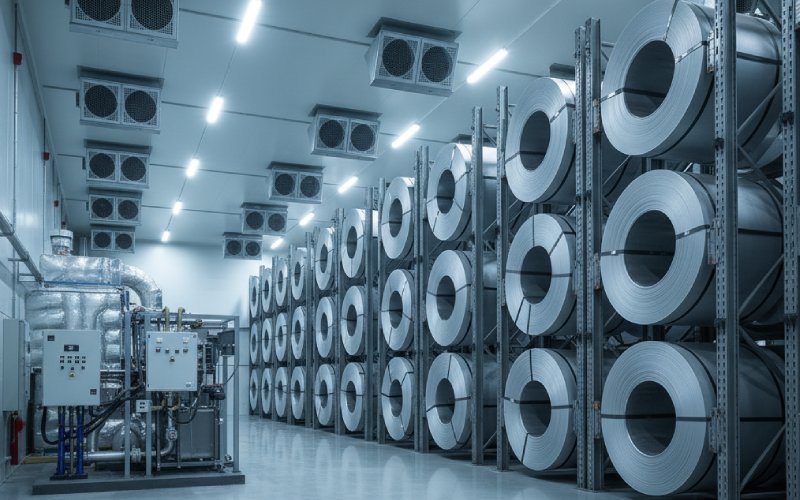
A lot of materials only meet their published shelf life under controlled storage. Even a simple insulating spray datasheet ties its two-year shelf life to humidity-controlled storage, explicitly calling out 10 °C to 27 °C and less than 75% RH. That’s not about being neat. It’s about not letting moisture and temperature reshape the product in the can.
Insulation varnishes and hardeners can be even less forgiving. One varnish product sheet flags moisture sensitivity in the hardener and warns about gelling risk if temperature is high, recommending keeping varnish temperature below 30 °C. Translation: you can “store it indoors” and still wreck it if your storage area runs warm and wet.
And yes, sometimes the boring SDS language is the right baseline: keep materials in original containers, in a cool, dry, well-ventilated area. Not poetic. Still correct.
If you only take one metric into your process controls, make it dew point plus surface temperature. The dew point framing is already how serious industries explain condensation risk, because it survives real-world swings in temperature.
Then you can run a plain policy that doesn’t need fancy language: do not open packaging when steel is colder than dew point margin allows; do not store reactive-coated electrical steel above the supplier temperature limit; do not let post-punch parts sit long enough that “storage” becomes a corrosion test you didn’t plan to run. Those aren’t slogans. They’re just the shortest path to keeping lamination insulation coatings insulating.






 English
  German
  Spanish
  French
  Italian
  Japanese
  Korean
  Dutch
Dutch  Indonesian