Let Sino's Lamination Stacks Empower Your Project!
To speed up your project, you can label Lamination Stacks with details such as tolerance, material, surface finish, whether or not oxidized insulation is required, quantity, and more.
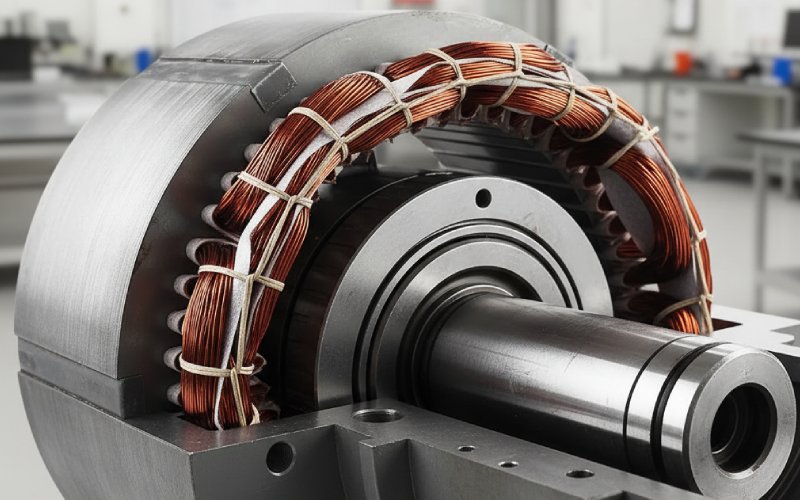
Designers know the theory: core loss, skin depth, Steinmetz, all that. What’s harder is this: at what point do thin-gauge laminations actually justify the extra cost and manufacturing pain?
This article is for that point. The grey zone where a 0.20 mm stator looks attractive, the tooling cost makes sales nervous, and someone in the room still wants 0.35 mm “because it always worked before.”
Let’s anchor some numbers first.
Typical practice today, looking across industrial and traction motors:
So “thin” isn’t one magic number. It’s a band, and it shifts with:
To compare options at a glance:
| Lamination thickness (mm) | Typical electrical frequency band* | Common motor segment | Where it usually makes sense |
|---|---|---|---|
| 0.50 – 0.35 | 50 – 200 Hz | Standard industrial motors | Cost-sensitive, large volume, moderate efficiency targets |
| 0.35 – 0.27 | 50 – 400 Hz | General-purpose drives, mild hybrids | “Good enough” efficiency, relaxed temp margins |
| 0.27 – 0.20 | 400 – 800 Hz | EV traction, high-speed pumps | Efficiency is contractually important |
| 0.20 – 0.10 | 800 – 2000 Hz | High-speed compressors, aerospace machines | Every watt and every kilogram audited |
| < 0.10 | > 2 kHz | Special HF drives, test rigs | Niche, expensive, process-sensitive |
*Electrical frequency at the core, not necessarily line frequency.
These are not strict design rules. They’re the ranges where data sheets, academic studies and real motors start to agree.
You already know the punchline: eddy current loss in a lamination goes roughly with thickness² and frequency² for a given material and flux swing.
So if you drop thickness from 0.35 mm to 0.20 mm:
In real cores, hysteresis and “excess” loss blunt that ideal, but test curves still show the same direction: thinner laminations consistently give lower total core loss compared to thicker ones at the same grade and flux density.
What changes as you push frequency up:
So thin-gauge laminations are less about fashion and more about where eddy-current loss stops being a rounding error and starts rewriting your thermal budget.
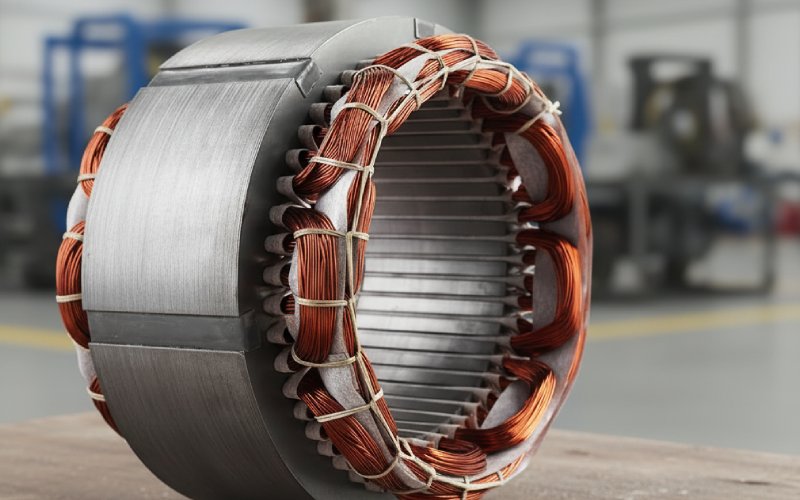
Take published guidance around cobalt-based alloys for high-frequency machines:
Similar patterns show up in thin-gauge silicon steel data from electrical steel producers: grades around 0.10–0.20 mm are positioned specifically for high-frequency use because they reduce loss at higher induction levels.
If your motor spends real time in those bands under load — not just transient testing — thick laminations will cost you:
At that point, arguing for 0.35 mm purely on material price is usually short-sighted.
EV traction motors, integrated starter-generators, oil-cooled e-axles, aerospace generators — all of them compress power into tight envelopes.
In these machines:
Thin-gauge laminations, especially high-grade non-oriented SiFe around 0.20 mm and below, are widely adopted in these sectors because they support higher base speeds and field-weakening ranges before loss and temperature hit their limits.
In short: once you’re in high-speed, high-power-density territory, thin-gauge is not a “premium option”; it’s part of the baseline stack for competitiveness.
Thin laminations are not a universal answer. There are honest cases where thicker stacks win the project.
If the motor:
Then 0.35 mm or even 0.50 mm steel may keep the BOM and tooling costs under control without breaking any spec.
Some steel producers even argue that, for mild hybrids or short-range electrification, it can be rational to accept slightly lower efficiency via 0.30–0.35 mm gauge, in exchange for lower material cost and reduced battery capacity requirements.
The business case can dominate here, not physics.
At very high mechanical speeds, rotor cores have another job: not exploding.
You see designs with:
Research on thick-lamination rotors shows that, for large machines, thicker plates combined with manual insulation can be an acceptable compromise to handle stress and manufacturability, especially when you’re already using high-strength steels and advanced machining (laser cutting, etc.).
So for rotors in the danger zone of mechanical stress, electromagnetic optimum is sometimes dialed back. You pay some extra iron loss to gain survival margin.
Theory is nice, but B2B engineering usually comes down to: which option does the job with less risk at acceptable cost?
Here’s a compact way to think through lamination thickness for high-frequency cores.
Not the catalog speed. The actual electrical frequency range where:
If more than ~30–40 % of energy is processed above 300–400 Hz, thin-gauge options deserve serious attention.
Use your existing simulations or test data and split losses into:
If core losses are:
Thin-gauge laminations are most powerful when iron loss is a top-two contributor.
Thin laminations introduce non-trivial issues:
If your supply base or factory isn’t ready for that, the theoretical gains might never arrive at the test bench.
Even without full finite-element runs, you can compare options:
Then ask: Is that worth the extra cost of material + tooling + process risk?
If the answer is “yes, but only barely,” it might still be smart to qualify both thicknesses — one as a performance version, another as a cost-down version.
Some small decisions have outsized effects when you move into thin laminations.
This is where a lamination supplier with actual high-frequency production experience earns their margin.
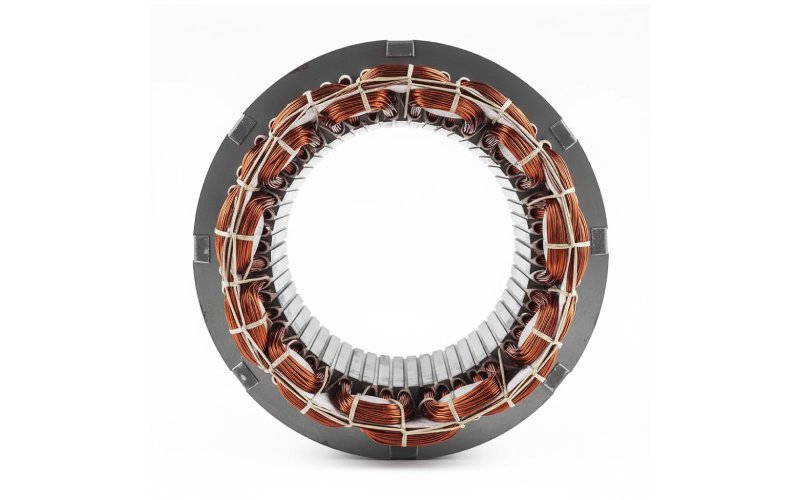
When you’re sourcing high-frequency stator and rotor cores, your RFQ and technical Q&A can quietly decide whether thin-gauge succeeds or fails. Some practical questions:
Suppliers that can answer these concretely are more likely to deliver the theoretical thin-gauge benefits in real hardware.
If you skimmed everything else, keep this:
No. Thinner laminations reduce eddy-current loss, but they also:
1. raise material and processing cost
2. complicate punching and stacking
3. can lower stacking factor
If your machine spends most of its life in a low-frequency region or has moderate efficiency targets, moving to an ultra-thin gauge may not repay the added cost and risk.
There is no universal cut-off, but many designers start serious evaluation of thin-gauge once significant torque is produced above roughly 300–400 Hz electrical. The exact threshold depends on flux density, duty cycle, cooling concept and material choice.
Numbers depend heavily on the design, but it’s common to see iron-loss reductions of tens of percent when dropping from 0.35 mm to ~0.20 mm in the high-frequency range for the same material grade. That might translate into around 1–2 percentage points higher overall efficiency in some high-speed designs, occasionally more, occasionally less.
Not necessarily. You can mix:
1. thinner stator laminations (better controlled cooling, more volume)
2. with slightly thicker rotor laminations (mechanical strength, fewer pieces)
What matters is the combined loss and temperature map, plus mechanical safety. Some high-speed rotors even move toward thicker laminations or solid structures with special treatments to survive stress, accepting additional core loss as the trade.
Soft magnetic composites (SMC) can outperform traditional laminations at very high frequencies (hundreds of Hz and above, depending on grade), especially where 3D flux paths dominate.
They shine in:
1. complex flux paths
2. very high-frequency applications
3. situations where you want integrated 3D geometries
But they bring different mechanical, thermal, and cost characteristics, so the decision is not just “laminations vs SMC,” it’s a full platform choice.
At minimum:
1. target electrical frequency range and duty cycle
2. expected flux density range in tooth and back-iron
3. allowed temperature rise in core regions
4. mechanical speed and environmental constraints
5. annual volume and expected lifetime of the program
With that information, a capable supplier can propose a realistic combination of steel grade and thickness, and highlight where thin-gauge will help or overcomplicate the design.


 English
  German
  Spanish
  French
  Italian
  Japanese
  Korean
  Dutch
Dutch  Indonesian