Let Sino's Lamination Stacks Empower Your Project!
To speed up your project, you can label Lamination Stacks with details such as tolerance, material, surface finish, whether or not oxidized insulation is required, quantity, and more.
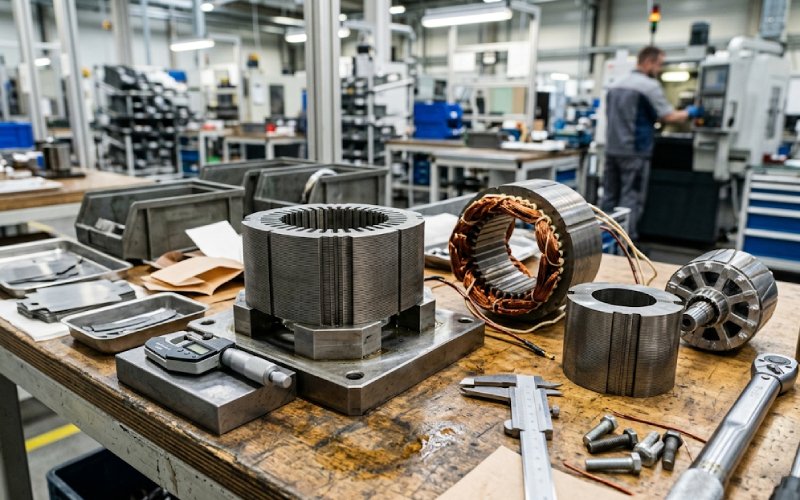
Steel price gets blamed first.
Easy target. Often the wrong one.
In air conditioner motors, the lamination stack is not just stamped metal that happens to carry flux. It sets iron loss, shapes copper loading, affects temperature rise, shifts noise behavior, and decides how forgiving the production line will be. A lower piece price that pushes the motor into extra heat or tighter efficiency margin is not real cost-down. It just moves cost somewhere less visible.
That is the frame for this topic.
Not “how do we buy cheaper steel.” More like: where can cost come out without asking the motor to pay it back in loss, heat, scrap, or rework?
Most cost-down reviews go straight to material grade. Too fast.
The stack cost usually sits inside six levers:
These levers are tied together whether the program team likes it or not. Shorten the stack, flux density rises. Flux density rises, core loss starts asking questions. Core loss rises, temperature follows. Then copper loss gets worse too. By that point the cheap idea is still on the slide deck, but not in the motor.
So the first question is simple:
What is already tight in this design—core loss or copper loss?
If core loss is already carrying the pain, a cheaper stack can become an expensive one very quickly. If copper loss dominates and magnetic loading is still conservative, there may be room to move. Maybe. Not by guesswork.
There is no universally cheap gauge. That rule has wasted enough time already.
Thinner electrical steel usually reduces eddy-current loss, which matters more in inverter-driven compressor motors and in duty with meaningful harmonic content. Thicker steel lowers sheet cost and sometimes eases supply pressure, but the magnetic penalty comes back fast once frequency and flux density move up.
A useful reference point: in one induction motor study, reducing lamination thickness from 0.50 mm to 0.35 mm improved efficiency by 1.4% and reduced loss by 13.27 W. That does not mean 0.35 mm is always the right answer. It means gauge is not a cosmetic variable. It changes the motor.
The decision has to be tied to:
This is the part people flatten into a slogan. “Go thinner.” “Go thicker.” Neither is serious.
A fan motor with wide margin may tolerate thicker laminations. A compact variable-speed compressor motor may not. Same category. Different answer.
Stack length reduction looks clean on paper. Less steel. Less mass. Less cost.
But stack length is not a trim feature. It is a magnetic redesign wearing a purchasing badge.
When stator or rotor stack length goes down, magnetic loading per unit length usually rises. Tooth flux goes up. Back-iron flux goes up. Saturation margin narrows. The winding then has less freedom to recover what the core just lost. Copper loss can climb. Acoustic behavior can drift too, especially when the design was already leaning on high utilization.
So the rule here is blunt:
The spreadsheet sees fewer kilograms. The motor sees a different circuit. Those are not the same thing.
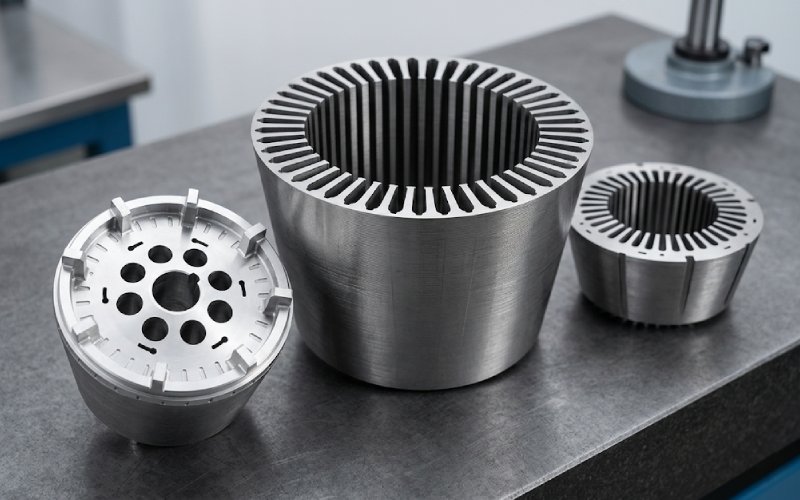
This split matters more than most teams admit.
If the design is core-loss limited, changing gauge, downgrading steel, adding magnetic damage at the edge, or using heavy joining features usually makes everything feel tighter at once. Efficiency drops. Heat rises. Seasonal performance gets harder to hold.
If the design is copper-loss limited, there may be more room to work on the stack. But only if magnetic loading is still under control and the stack is not already near saturation.
Use a simple filter before approving any stack cost-down:
| Motor condition | Main sensitivity | Lower-risk cost-down path | High-risk move |
|---|---|---|---|
| Core-loss limited | Steel loss, cut-edge damage, joining damage | Improve stamping and joining before changing material | Thicker gauge, shorter stack, heavy welds |
| Copper-loss limited | Winding resistance, slot fill, thermal path | Clean up process first, then test selective stack reduction | Material downgrade without flux-density review |
| Margin-rich fan motor | System balance | Small combined changes with validation | One large isolated material change |
| Compact inverter compressor motor | Harmonic iron loss, thermal headroom | Conservative joining and low-damage processing | Cheap steel plus shorter stack |
No trick in the table. The point is just to stop pretending all air conditioner motors respond the same way.
This is where a lot of quiet performance loss begins.
Punching is still the standard route for high-volume laminations. Fair enough. It is fast, scalable, and cost-effective once tooling is stable. But the cut edge is not magnetically neutral. Punching strain, burr growth, local deformation, and coating damage all disturb the material near the edge. In compact teeth and narrow bridges, that damaged region is large enough to matter.
The effect is not small. In small machines, punching damage has been associated with 0.5% to 2% torque reduction and 30% to 40% higher core loss. That is why a rough-cut cheap stack can behave like worse material than the incoming sheet ever suggested.
So a weak stamping process does three things at once:
That last point is easy to miss. A motor with clean edges may survive a small gauge change. The same motor with poor burr control may not.
For most programs, safer savings come from process discipline first:
Material downgrade gets attention because it is easy to name. Edge damage often hides until the bench says no.
Joining is where mechanical convenience and magnetic cleanliness start arguing with each other.
Interlocks help handling. They keep sheets together. They support transport and assembly. All true.
They also deform local material, interrupt lamination geometry, and create concentrated zones of magnetic damage. As the number of interlocks increases, iron loss tends to rise with it. Placement matters too. Tangential interlock placement usually hurts efficiency less than radial placement because radial interruption cuts more directly across the main magnetic path.
So the design rule is plain:
Interlocks are cheap until they are not.
Welding solves real assembly problems. It improves rigidity. It helps with handling. In some rotors, it is hard to avoid.
The magnetic bill arrives later. Long weld seams can damage coating, create conductive bridges between laminations, and expand the heat-affected zone. Residual stress is part of the problem too. A neat seam in production can be a messy seam magnetically.
This is why welding strategy matters more than the word “welding” itself. In one joining study, a gap-focused pulsed laser approach used only 23% of the energy of a more traditional pulsed method. Smaller energy input usually means a smaller thermal penalty. Not automatically. Usually.
Better practice looks like this:
Weld for the load. Do not weld as if the core is a bracket.
Bonding gets dismissed too early in a lot of projects.
Yes, it adds process requirements. Yes, it is not the right answer for every platform. Still, it can preserve magnetic continuity better than heavy interlocking or long weld seams, while also helping dimensional stability and buzz control.
When the stack is already magnetically busy, bonding deserves a serious look. Not because it sounds advanced. Because it interferes less.
A material downgrade only works when the design had unused magnetic margin in the first place.
That should be obvious. It still gets ignored.
Lower-cost silicon steel can be acceptable when:
It becomes dangerous when:
The common mistake is comparing datasheets as if the stack in the motor will behave like untouched sheet. It will not. The real stack also contains punching strain, burr, joining damage, residual stress, and handling variation. So the effective downgrade is often larger than the material table suggests.
That is why processed-core testing matters more than catalog optimism.
Annealing has a place. It should not be used like incense.
After cutting or joining, residual stress can degrade permeability and push iron loss upward. Annealing can recover part of that damage. In some reported test results, energetic improvement after annealing reached 28% for punched samples, 25% for laser-cut samples, and 14% for wire-cut samples.
Those numbers are strong enough to make the point. They are also selective. Annealing adds cost, time, and process complexity, so it should be used where the damage is large enough to justify recovery.
Good rule: use annealing as a scalpel. Not a default. Not a taboo.
Some cost-down plans are technically valid and still unwise.
Reducing stack factor, tightening tooth width, trimming back iron, or pushing slot geometry closer to the limit can keep the design functional in a narrow sense. Then production variation arrives. Burr variation arrives. Joining variation arrives. Heat arrives. The design still works, until it does not work consistently.
That kind of edge-running shows up as:
The part cost improves. The program usually does not.
A strong lamination design does not keep extra margin everywhere. It keeps margin where the process is least polite.
This section is not glamorous. It is usually where the easiest savings are hiding.
For high-volume lamination stacks, cost often comes out of flow before it comes out of steel:
That matters because a manual, correction-heavy flow can quietly erase the savings made upstream. Stacks get dented, mixed, miscounted, or overworked. The motor then pays for that disorder through rework, noise, imbalance, or loss spread.
The safest cost-down is often simple: remove labor and variation before removing magnetic headroom.
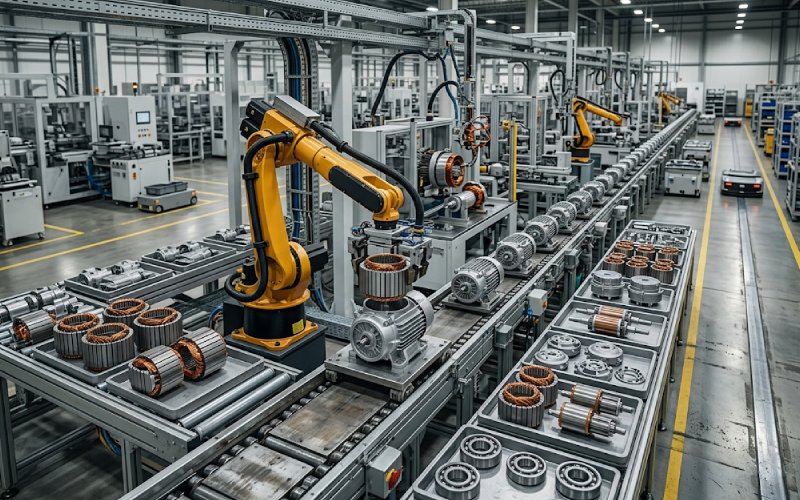
Use this as a release filter, not as a slogan.
| Proposed change | Why it looks cheap | What it can damage | Better release rule |
|---|---|---|---|
| Move to thicker gauge | Lower sheet price | Higher core loss, more heat in variable-speed duty | Check frequency range and flux margin first |
| Reduce stator or rotor stack length | Less active steel | Higher flux density, less saturation margin, more copper loss | Recheck efficiency and thermal behavior before approval |
| Add more interlocks | Easier handling | Lower permeability, higher local loss, more acoustic risk | Use the minimum number needed |
| Use long weld seams | Strong mechanical fixation | Coating damage, conductive bridges, larger heat-affected zone | Keep seams short and away from critical flux paths |
| Relax stamping maintenance | Longer die life | More burr, more edge strain, wider loss spread | Protect cut-edge quality before changing material |
| Downgrade steel without process review | Fast purchasing action | Combined process-plus-material penalty | Judge the assembled stack, not the raw sheet |
| Skip annealing after heavy process damage | Lower process cost | Residual stress remains in the core | Use annealing where damage recovery pays back |
The pattern is consistent. Process-first savings are usually safer than material-first savings.
Before approving any lamination cost-down in an air conditioner motor, ask these questions in order:
Split core loss from copper loss using the real duty map. Not one operating point.
Passing one benchmark does not prove the design is comfortable across the full speed range.
If burr, strain, or coating damage got worse, the steel in the motor is no longer behaving like the incoming sheet.
This happens more often than people admit.
That combination is where “small” changes stop being small.
Bare sheet data can flatter a decision. The motor only sees the processed core.
For most programs, the better order is this:
That order keeps the team from spending magnetic margin to solve a manufacturing problem that should have been solved directly.
The cheapest air conditioner motor lamination stack is rarely the one with the lowest steel price.
A more durable cost-down usually comes from cleaner stamping, less cut-edge damage, smarter joining, and tighter stack handling flow. Those moves reduce waste without asking the motor to absorb extra loss. Material downgrade can still work. Later. After the processed stack proves it can keep loss, heat, and variation under control.
If you already have a stator lamination, rotor lamination, or full HVAC motor stack design in production, a focused DFM and magnetic-loss review will usually show where cost can come out—and where it should stay put.
Usually by improving the manufacturing path before changing the steel. Better stamping quality, lower burr, cleaner joining, and more stable stack handling often remove cost with less risk than direct material downgrade.
No. Thinner steel often helps reduce iron loss, especially in variable-speed duty, but it is not always the lowest total-cost option. Frequency range, harmonic content, flux density, and process quality decide whether the gain is worth it.
Sometimes. But stack length reduction raises magnetic loading and narrows saturation margin, so it should be treated as a full electromagnetic review, not a simple purchasing decision.
There is no universal winner. Interlocking is practical but adds local damage. Welding is strong but can disturb magnetic performance if overused. Bonding can preserve magnetic continuity well, though it adds its own process demands.
Because the cut edge changes magnetic behavior. Burr, strain, and coating damage can raise local loss and reduce permeability, especially in narrow teeth and compact motor geometries.
No. It is wrong when done first, or done blindly. If the motor has real magnetic margin and the process is already controlled, a lower-cost steel grade may work. The decision should still be made from processed-core data, not raw sheet data alone.
No. Annealing is useful when process damage is large enough to justify recovery. It should be used selectively, not as a default step and not as something to avoid on principle.
Yes. Fan motors often have a different loss balance and may tolerate more simplification. Compressor motors, especially under inverter control, are usually more sensitive to core loss, harmonic loss, and thermal margin.
At minimum: efficiency, temperature rise, no-load loss, load loss distribution, acoustic behavior, and part-to-part consistency. Testing only the raw sheet is not enough.




 English
  German
  Spanish
  French
  Italian
  Japanese
  Korean
  Dutch
Dutch  Indonesian