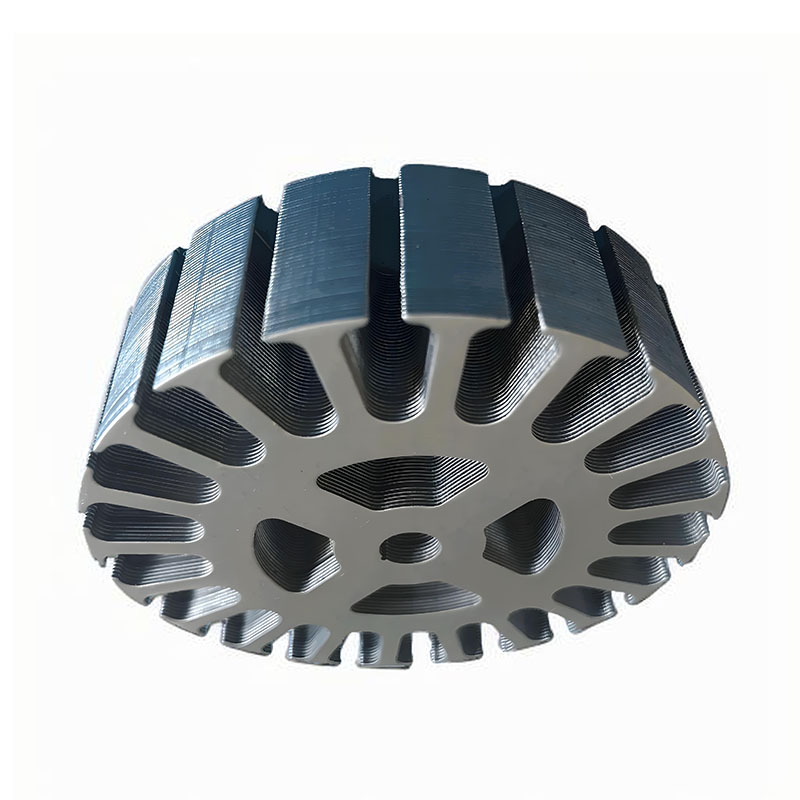
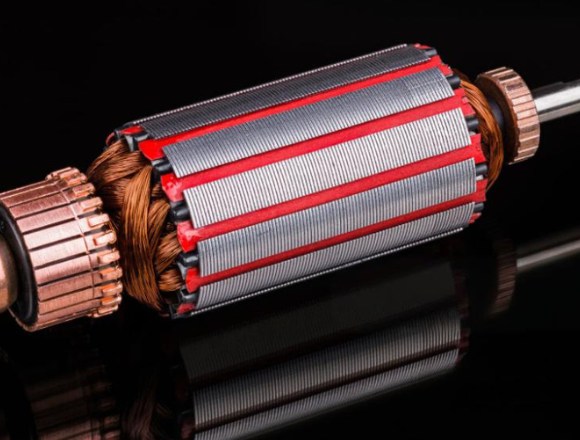
Once private laminations are precisely stamped, their assembly into total stator and blades cores is an essential action that significantly influences the final motor’s efficiency and mechanical integrity. Sino employs a varied variety of innovative setting up methods, each picked based on the particular application needs, wanted efficiency qualities, and production quantity.
Interlocking/Keying (Self-Locking Tabs)
Interlocking, likewise called keying or self-locking tabs, is an extensively adopted technique in our facilities, especially for tiny to tool DC electric motors. This technique entails marking tabs or keys directly into the lamination sheets, which are after that curved or pushed to mechanically lock the stack with each other.
- Advantages : No additional products or post-processing are required, bring about cost effectiveness. It supplies high automation possibility, with normal cycle times of much less than 2 seconds per stack in automated lines. Most importantly, it has minimal effect on magnetic residential properties as no warmth is presented.
- Limitations : The tab area can develop localized air spaces, somewhat increasing core loss. Mechanical stamina is moderate, making it less suitable for extremely high-vibration or large-diameter rotors. Tooling intricacy is modest, calling for precision marking passes away.
Welding (Laser, TIG, MIG, Resistance Spot)
Welding is utilized to fuse lamination stacks, usually at the perimeter or at certain factors. Laser welding (e.g., using equipment from Trumpf, IPG Photonics) is significantly preferred for its precision and minimal heat-affected areas, making it suitable for high-performance applications. Resistance place welding is also common, particularly in auto DC electric motor production.
- Benefits : Gives high mechanical honesty, making it superb for high-speed rotors. The process can be fully automated, with cycle times of much less than 1 second per weld, though complete pile time depends on the variety of welds.
- Limitations : Localized home heating throughout welding can raise core loss (as much as 10-15% in the weld area, according to 2022 IEEE research studies). There is also a risk of lamination bending, and in some cases, post-weld annealing may be called for to restore magnetic residential properties. Tooling is complicated and costly.
Riveting
Riveting includes inserting metal pins or tubes via pre-punched openings in the lamination pile, which are after that warped to hold the pile together. This technique is frequently used for larger DC makers and traction electric motors.
- Benefits : Supplies high mechanical toughness and involves no warm input, making it ideal for thick or large-diameter heaps.
- Limitations : Rivet holes minimize the effective magnetic cross-section, bring about raised regional core loss. The procedure is normally manual or semi-automated, limiting throughput with cycle times of 5– 10 seconds per pile. While tooling is reasonably basic, accurate alignment is crucial for magnetic efficiency.
Adhesive Bonding (Epoxy, Phenolic, Polyimide)
Sticky bonding includes using a slim layer of high-temperature-resistant adhesive in between laminations, adhered to by curing under stress. This method is acquiring traction in high-efficiency and noise-sensitive applications, such as e-mobility and aerospace.
- Advantages : No mechanical contortion or warm input, maintaining magnetic buildings. It supplies excellent resonance damping and makes it possible for making use of extremely slim laminations (< 0.2 mm).
- Limitations : Adhesive outgassing can trigger voids, and the curing time (ranging from mins to hours) can limit throughput. The cost of specialized adhesives can likewise be significant. Automation is feasible yet needs precise glue dispensing and pile alignment.
Shrink-Fitting
Shrink-fitting is a specialized method where the external ring or housing is warmed, the lamination stack is inserted, and then permitted to cool down and agreement, securing the stack. This is used in highly specialized high-speed rotors (e.g., turbo-machinery, some aerospace DC electric motors).
- Benefits : Offers consistent pressure and stays clear of openings or welds, therefore protecting the magnetic course.
- Limitations : High tooling and procedure control complexity. It is normally not ideal for high-volume manufacturing as a result of long cycle times and thermal biking needs, usually taking 5– 15 mins each.
Cleating (Edge Clamping)
Cleating uses metal strips or cables kinky around the perimeter of the stack to hold laminations with each other. This is an easier, lower-cost approach.
- Advantages : Simple, low-priced tooling, and no warmth or adhesives are involved.
- Limitations : Deals poor vibration resistance and cleats can loosen gradually, making it inappropriate for high-speed or high-precision applications. It is normally hands-on or semi-automated, with cycle times of 3– 5 seconds per stack.



 French
  English
  German
  Spanish
  Italian