Let Sino's Lamination Stacks Empower Your Project!
To speed up your project, you can label Lamination Stacks with details such as tolerance, material, surface finish, whether or not oxidized insulation is required, quantity, and more.
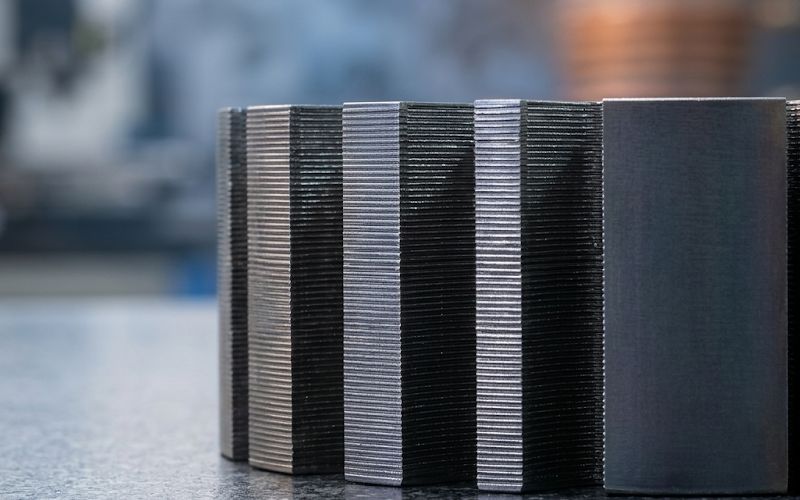
Stress-relief annealing improves loss in motor laminations when the extra loss is mainly coming from cutting damage, residual stress, and local plastic deformation. That is the real dividing line. In punched lamination stacks with narrow teeth, high cut-edge length, and a lot of flux running close to the edge, the treatment often pays back. In stacks where later assembly adds new stress, or where the steel grade reacts poorly to the heat cycle, the gain can be small. Sometimes negative.
A motor core looks stable once the stack is built, but the magnetic damage often starts much earlier, during punching or shearing. The cut edge is not just a geometric boundary. It is a disturbed zone. Material near the edge sees strain, residual stress, and local hardening, and that shifts magnetic behavior in the wrong direction: lower permeability, higher iron loss, less predictable flux flow. In electrical machine laminations, that degradation is well established and should be treated as a design variable, not a side effect.
This is why lamination stacks are more sensitive than broad lab coupons. In a wide strip, the damaged edge region may be a small share of the magnetic path. In a stack with small slots, narrow bridges, segmented teeth, or tight rotor features, the damaged zone can occupy a much larger fraction of the active section. So the same steel grade can look fine in a datasheet and behave worse in the finished motor. Not because the sheet changed on paper. Because the geometry made the cutting damage matter.
Stress-relief annealing is not there to create a better steel from scratch. In most motor-lamination applications, its job is narrower than that. It is used to reduce the residual stress state introduced by cutting and forming, and to recover some of the magnetic properties that were lost in manufacturing. Depending on temperature, atmosphere, and grade, recovery can come from stress reduction first, then from recovery or recrystallization near the cut edge if the treatment is pushed further.
That sounds straightforward, but it is not a universal repair step. One study on non-grain-oriented steel found clear improvement after stress-relief annealing at 800 °C in nitrogen for the lower-aluminium grade, while the higher-aluminium grade improved less and thinner sheets could even become worse after treatment. So yes, the furnace can remove one problem and introduce another. That is the part many process plans skip over.
Stress-relief annealing tends to work best in punched motor laminations where the loss increase is dominated by cut-edge damage. That usually means stator or rotor laminations with a high ratio of edge length to active cross-section, especially where flux spends much of its path near punched boundaries. In those cases, the treatment is not acting on a minor defect. It is acting on the main defect.
It also makes more sense when the cutting route is mechanically severe. Studies on punched non-oriented electrical steels show that cutting clearance affects the resulting loss behavior, and that heat treatment changes the outcome again. Put more simply: a stack produced with a tougher cut condition has more to recover, and so the upside from annealing can be larger. Not guaranteed, but larger.
Another useful sign is directional imbalance. Recent work on non-grain-oriented electrical steel showed that stress-relief annealing can reduce magnetic anisotropy caused or amplified by processing, with the recovery in the transverse direction stronger than in the rolling direction. For motor laminations, that matters because rotating machines do not live in one easy magnetization direction. A stack that becomes less directionally uneven after annealing may show a cleaner loss response in service, not just in a single lab setup.
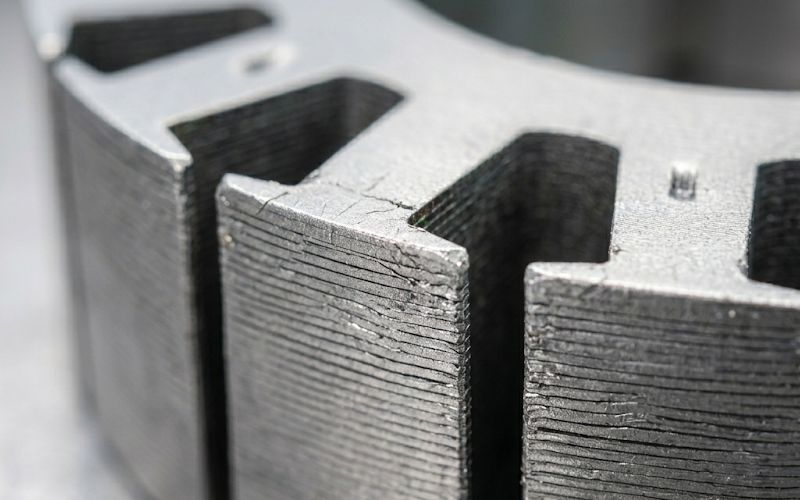
Not every lamination stack is a good candidate. If later assembly operations add strong compressive stress, some of the annealing benefit can be lost again. Shrink fitting is the obvious example. Studies on assembled stator cores show that compressive stress from shrink fitting raises core loss. So if a stack is stress-relieved and then heavily re-stressed during housing assembly, the process order is working against itself.
Atmosphere control matters too. Temperature alone is not enough. Work on non-oriented electrical steels has shown that annealing temperature and atmosphere change magnetic properties together, and that higher temperatures can damage the coating layer, form oxides, and alter flux density. In other words, a nominally correct stress-relief cycle can still be the wrong cycle if the atmosphere is not matched to the steel and coating system.
Thin sheet needs extra caution. The recent 2024 work already mentioned found that thinner, higher-aluminium non-grain-oriented steel could respond poorly to stress-relief annealing. That does not mean thin motor laminations should never be annealed. It means the process window is narrower, and “anneal by default” is a lazy rule. For thin high-speed motor laminations, test data matters more than habit.
The table below is the version that matters on the shop floor. Not theory first. Decision first.
| Lamination stack condition | Likely value of stress-relief annealing | Why |
|---|---|---|
| Punched laminations with narrow teeth, dense slots, or high cut-edge ratio | Usually high | More of the magnetic path sits close to the damaged edge zone, so recovering residual-stress damage has a direct effect on loss. |
| Mechanically cut stacks made with aggressive clearance or severe edge deformation | Often high | Cutting severity changes loss behavior, and post-cut heat treatment can change it again. |
| Wide laminations with low edge influence on the active path | Moderate to low | If edge damage is a small share of the working section, the recovery window is smaller. |
| Thin higher-aluminium non-grain-oriented sheet | Uncertain | Reported response can be weak or even harmful after SRA in thinner material. |
| Stack will be shrink-fitted or heavily compressed after anneal | Limited | Later compressive stress can push core loss back up. |
| Furnace atmosphere or coating compatibility is not well controlled | Risky | Oxidation, internal oxides, or coating damage can offset the stress-relief benefit. |
For most motor lamination stacks, the sensible sequence is simple: do it after the main cutting and forming damage has been introduced, but before any assembly step that adds new mechanical stress. That is not a perfect rule. Still, it is a useful one. If the stack is going into a process chain that includes strong press loading, interlocking damage, or shrink fitting, annealing too early can turn into a temporary fix.
There is also a second layer to this. Annealing should not be asked to rescue a bad cutting process. If the die condition, clearance, or edge quality is poor, the first job is to reduce the damage at source. Studies on cutting conditions and workability make that pretty clear. Heat treatment can recover part of the damage. It does not make damaged geometry disappear, and it does not turn unstable cutting into a stable manufacturing route.
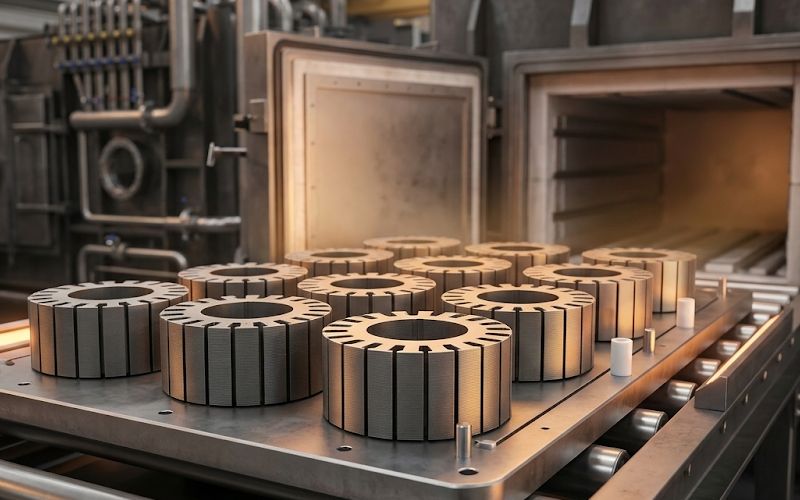
A useful screening question is this: is the loss rise mostly coming from the steel, the cut edge, or the assembly stress added later? If it is mostly cut-edge driven, stress-relief annealing deserves serious attention. If it is mostly an assembly-stress issue, look harder at the joining and fit method. If it is mostly a cutting-quality issue, improve the blanking route first and then retest. That is not a neat three-box model, but it keeps projects from blaming the wrong step.
The testing method matters as much as the decision logic. Evaluate before and after annealing at frequencies and induction levels that resemble the motor’s real operating window. Low-frequency checks alone can hide important differences. Recent work on cut non-grain-oriented steels examined loss behavior up to 400 Hz, and directional studies show that the recovery can vary between rolling and transverse directions. So a stack can “pass” a simple check and still leave efficiency on the table in the real machine.
A good plan for lamination stacks usually has four parts. First, identify whether the stack geometry makes edge damage important. Second, confirm whether the selected steel grade responds well to the chosen heat treatment. Third, protect the surface and coating through proper atmosphere control. Fourth, make sure later assembly will not cancel the gain. That sequence is less glamorous than talking about furnace temperature, but it is closer to how real loss improvements survive into production.
No. It often reduces loss when punching or shearing is the main source of magnetic damage, but it does not always help. Recent work found a strong positive response in one non-grain-oriented steel and a much weaker, even harmful, response in another thinner higher-aluminium grade.
Published studies on non-grain-oriented electrical steels report stress-relief treatments across roughly the mid-600s to low-800s °C, usually in protective atmospheres such as nitrogen or nitrogen-hydrogen mixtures. The right window depends on steel chemistry, thickness, coating system, and how much microstructural change is acceptable.
It can. The risk is not just distortion. Magnetic performance can also worsen in some thin, higher-aluminium non-grain-oriented sheets after SRA, so thin-gauge motor laminations should be validated rather than assumed safe.
Usually after cutting and forming, but before any assembly step that adds major compressive stress. If the stack is shrink-fitted or heavily loaded afterward, part of the magnetic recovery may be lost.
Not completely. It can recover some magnetic damage caused by cutting, but it does not replace good edge quality, sensible cutting clearance, or stable tooling. When the cutting route is the main problem, improving the cut condition is often the first move.
Use stress-relief annealing when your motor lamination stack is losing performance mainly because of cutting-induced stress, and when that gain will survive the downstream assembly route. Skip the default mindset. Test the real geometry, the real steel, and the real process order. That is the version that usually holds up.



 English
  German
  Spanish
  French
  Italian