Let Sino's Lamination Stacks Empower Your Project!
To speed up your project, you can label Lamination Stacks with details such as tolerance, material, surface finish, whether or not oxidized insulation is required, quantity, and more.
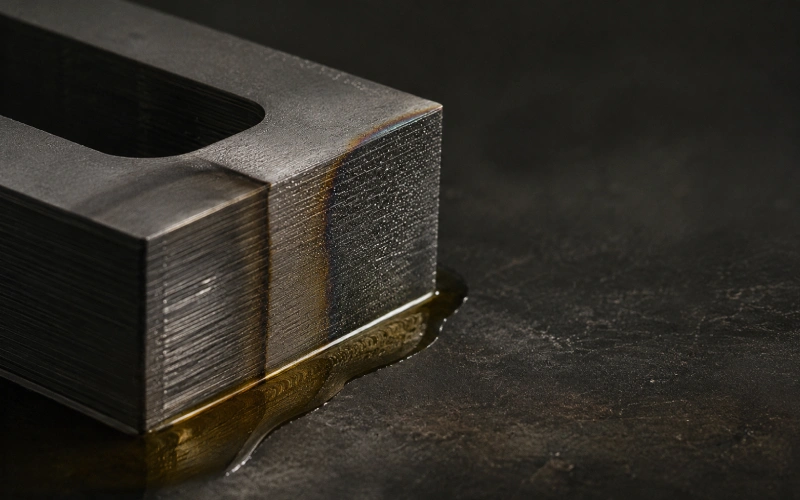
Most insulation-class arguments happen at the wrong level of the machine.
Someone asks for “Class H laminations.” What they usually mean is a Class H motor. Those are different purchases. A lamination stack carries a thin interlaminar coating measured in microns and an assembly method — weld, interlock, adhesive, rivet, cleat. The winding carries the thermal class that appears on the nameplate. The two interact, but neither one inherits the other’s rating, and the failures that follow from confusing them are slow, quiet, and expensive to diagnose in the field.
This piece separates the two systems, then walks through what actually changes when the stack lives in oil, in moisture, or above 180 °C.
The interlaminar coating exists to keep eddy currents from crossing sheet to sheet. It has to survive punching, any stress-relief anneal, joining, varnish or resin impregnation, and then decades of whatever fluid and temperature the machine offers. It is thin — 0.5 to 5 µm typically — and its rating is expressed in surface insulation resistance, anneal resistance, and chemical stability, not in a letter class.
The winding insulation system is what a thermal class describes: slot liner, phase and layer insulation, wire enamel, wedges, lead insulation, impregnating resin, all qualified together. The class is a property of the combination, aged as a system.
Where people get caught: the stack sits inside the winding system’s thermal envelope. If the slot liner shrinks, if the resin softens, if the varnish degrades chemically, the heat path from copper to core changes, and the stack starts running with less margin than the bench validation showed. The steel is fine. The magnetic properties are fine. The thermal picture underneath the machine has shifted.
The letter classes — B at 130 °C, F at 155 °C, H at 180 °C, 200, 220 — refer to the hottest-spot temperature the system can hold with acceptable endurance. Not the ambient. Not the housing. Not the oil sump average. The hottest point in the winding, usually mid-slot.
The arithmetic that follows is the part worth internalizing:
| Class | Hot-spot limit | Typical ambient assumption | Hot-spot allowance | Allowable rise (design) | Common practice |
|---|---|---|---|---|---|
| B | 130 °C | 40 °C | 10 K | 80 K | Appliance, general purpose |
| F | 155 °C | 40 °C | 10 K | 105 K | Very often built to an 80 K rise |
| H | 180 °C | 40 °C | 10–15 K | ~125 K | Often built to a 105 K rise |
| 200 / 220 | 200 / 220 °C | 40 °C or higher | 15 K | 145 K+ | Traction, aerospace, sealed compressors |
Run a system at its class limit and thermal endurance testing tends to land near 20,000 hours. Continuous duty makes that a little over two years. Fine for a power tool. Not fine for a pump that is supposed to run a decade. Which is why the widespread convention is to specify one class up from the temperature rise: Class F insulation, Class B rise. The rough guide — half the life for every 10 K above, roughly double for every 10 K below — is a decent planning tool for insulation aging, though bearing grease, thermal cycling, and drive-side voltage stress often decide reliability before the insulation does.
So the class question is really two questions stacked. What hot spot does the design actually produce, verified, not estimated? And what chemical environment does that hot spot exist inside?
Interlaminar coatings are classified into a C-series that runs from natural mill oxide through organic varnishes to fully inorganic phosphate and silicate systems, plus hybrids. Rather than reciting the whole list, here is the version that matters when you are choosing against an environment.
| Coating family | Composition | Anneal behaviour | Fluid/chemical stance | Where it fits |
|---|---|---|---|---|
| Natural or user-formed oxide | Inorganic, grown not applied | Survives normal stress relief | Stable, but low resistance | Small cores, low-loss-sensitivity parts |
| Mill glass film (grain-oriented base) | Magnesium silicate | Survives high-temperature anneal | Very good in transformer oils | Grain-oriented core foundation |
| Organic varnish / enamel (C-3 type) | Resin, cured | Burns off; not anneal-capable. Useful to roughly 180 °C | Solvent and oil resistance varies widely by resin | High-volume stamped motor laminations, good punchability |
| Chemically treated inorganic (C-4 type) | Phosphate | Survives stress relief, resistance may drop | Good | Moderate insulation plus heat tolerance |
| Inorganic with fillers (C-5 type) | Phosphate/silicate, filled | Anneal-resistant to roughly 800–850 °C under inert gas | Chemically stable; the default where oil immersion and heat both apply | Sheared laminations needing high surface resistivity; oil-immersed cores |
| Organic with inorganic filler (C-6 type) | Hybrid, filled resin | Generally not treated as anneal-capable; organics carbonize | Organic fraction is the exposure risk in hot fluids | Non-oriented motor steel where die life and high resistance both matter |
| Bond coat / self-bonding | Thermoset, activated by heat and pressure | Not anneal-capable | Bond line is the weak link, not the film | Thin-gauge, high-frequency, high-speed rotors |
Two things follow from this table that catalogue language tends to blur.
First, “higher class number” is not “better.” A filled inorganic coating is more abrasive to carbide tooling and can raise die maintenance noticeably against an organic system. If the part is a 0.25 mm stator lamination produced in the tens of millions, tool life is a real cost line, not a footnote.
Second, the anneal step is a gate, not a preference. If your magnetic targets require stress relief after punching — and for high-silicon thin gauge with small teeth, they often do — every organic-bearing coating either drops out or needs a documented post-anneal resistance value. Decide the manufacturing route before you shortlist coatings. Punch method, burr limit, joining method, anneal or no anneal, housing fit. Then pick a coating that still makes sense afterwards.
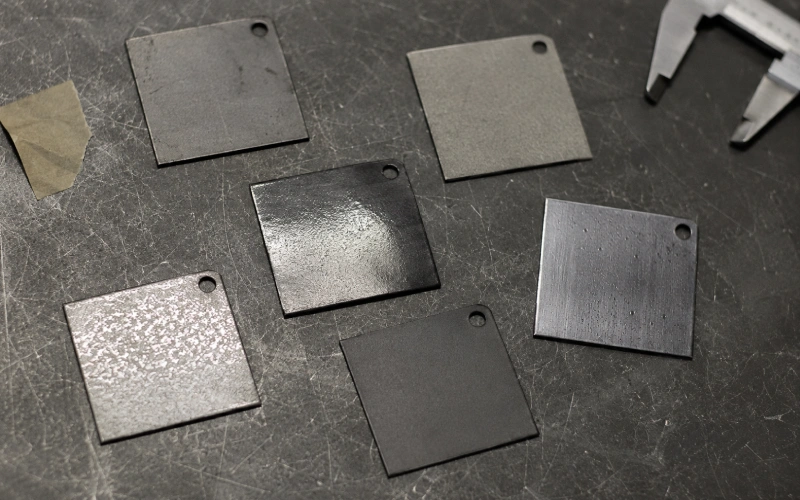
Oil cooling does not raise the class you need. It usually lowers the temperature the insulation sees, which is the point of it. What oil changes is which materials qualify inside that class.
Chemistry filter, applied on top of the thermal decision. A polymer film that swells or plasticizes in mineral oil is disqualified regardless of its temperature rating. Ester fluids behave differently from mineral oils, and automatic transmission fluid differs again — additive packages, water content, acidity over life. Aramid-based composites have a long record in oil-filled equipment because the chemistry is stable in both mineral and ester fluids. That record is worth more than a datasheet number generated in air.
The bond line is usually the real limit. This is the part most specifications miss. A stack can sit inside a Class H machine and still contain an adhesive layer whose glass transition falls in the 80–100 °C region. Published work on waterborne epoxy varnish systems for electrical steel found cured layers with glass-transition temperatures between roughly 81 °C and 102 °C, and roll-peel strength dropping around 50% at 100 °C and about 75% at 140 °C. The surrounding insulation system’s class did not protect the joint. Screen the adhesive against the lamination hot spot, not the class letter on the motor.
Oil is not necessarily the dominant aging driver. Fatigue and delamination testing on epoxy-bonded electrical steel laminates has shown crack-growth behaviour in hot air and in an oil-based cooling medium that was, under some conditions, broadly similar — with the crossover in fatigue threshold tracking the adhesive’s transition region rather than the fluid. Heat and viscoelastic softening can matter as much as fluid contact. Sometimes more.
Aging in oil follows different rules than aging in air. Immersion excludes oxygen, which slows oxidative degradation of organic components. Meanwhile heat, fluid, and vibration work on the adhesive bonds for decades. A Class F laminate that has been properly qualified in oil will typically outlast a nominally higher-class material whose adhesive was only ever validated dry. Ask for the aging basis. If the answer is “the film is rated 180 °C,” that is an answer about one layer.
Bond line thickness. Thicker is not stronger past a point. Peel strength in one study rose with adhesive thickness up to roughly 20 µm and then flattened. Extra adhesive costs stacking factor and buys nothing.
Practical qualification ask for oil-cooled stacks: peel or shear after oil aging at service temperature, not room-temperature immersion, and not a 48-hour dip. Plus cyclic loading in the same medium if the stack is structural.
Moisture attacks differently. It is a chemical mechanism, not a thermal one, and it can bring down a system that is nowhere near its class limit.
Polyester film — the low-cost workhorse behind most slot liners, rated Class E to B depending on grade — is vulnerable to hydrolysis. Hot, humid, sealed conditions reduce molecular weight and dielectric strength. The film embrittles. Composite papers with a polyester core inherit that weakness at the core layer even when the outer aramid layers are unbothered, which is why storage below about 60% relative humidity is a genuine specification for those materials, not warehouse fussiness. Hydrolytic stability, ranked loosely: polyphenylene sulfide and polyimide films hold up well, polyethylene naphthalate is intermediate, polyester is the weak entry.
Inside a sealed compressor the situation compounds. Moisture plus lubricant plus refrigerant, plus heat, can push toward acid formation. Once hydrolysis starts on a polyester component, the damage does not stay in that layer — it moves through the insulation package. Slot liner condition, varnish condition, lead insulation, all of it shifts, and thermal behaviour shifts with it.
For the stack itself, water raises two separate issues:
Anti-condensation heating, drainage, breathers, and enclosure rating are part of the insulation decision even though they appear on a different drawing. A machine that never gets cold enough to condense is running a milder insulation duty than its class implies.
Once the hot spot passes the Class H line, the material set narrows quickly and cost steps up rather than climbing smoothly.
Polyester-based films are gone. Aramid papers, polyimide films, polyphenylene sulfide films, mica composites, and high-temperature resins carry the load. Pure aramid paper is rated for continuous service around 220 °C and does not melt, though it absorbs more moisture than film-based options — a trade you make consciously rather than accidentally.
On the stack side, adhesive bonding gets harder to defend as the primary joining method above roughly 180 °C sustained, unless the adhesive system was specifically developed for it and you hold data at temperature. Welding and interlocking become more attractive structurally while costing interlaminar performance where the joint intrudes. Filled inorganic coatings survive burn-off repair and high-temperature process steps; some are quoted as thermally resistant to around 420 °C, which matters for rewind shops that burn out windings and reuse the core.
Watch the sequence too. Thin coatings chosen for their behaviour in welding or automatic stacking may not be the same coatings that keep electrical separation after a long thermal soak. Very few coatings are best at both.
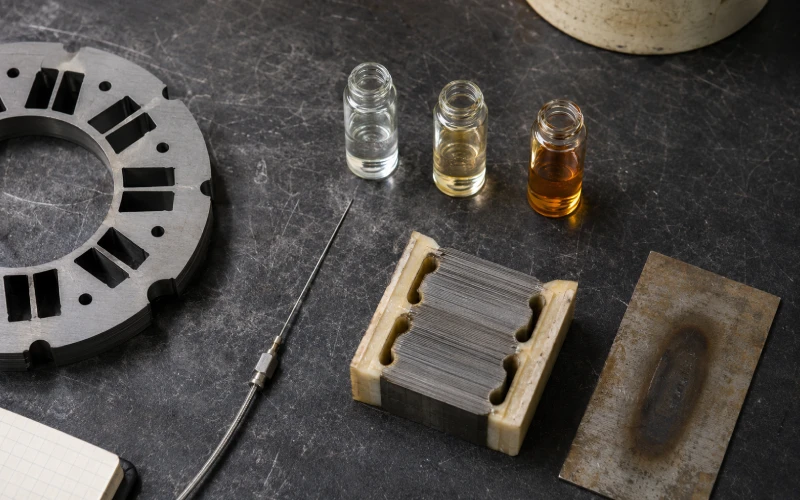
Step 6 is where programs are usually saved or lost. Fresh-sample lap-shear data at room temperature has almost no predictive value for a bonded stack in hot oil under cyclic load.
Does an oil-cooled motor need a higher insulation class? Usually the opposite. Effective liquid cooling lowers the hot spot, which can let you hold a lower class. What oil does is restrict which materials qualify inside whatever class you choose. State both the class and the exact fluid when you specify.
Can I use the motor’s nameplate class to select the stack’s adhesive? No. The class describes the winding insulation system aged as a combination. An adhesive layer inside the stack can have a glass transition 80–100 K below the class limit and still be sold into that machine. Screen adhesives against the lamination hot spot.
Is an organic-plus-filler coating acceptable in oil-immersed cores? Generally treated as the riskier choice. The organic fraction is what interacts with hot fluid over years. Fully or mostly inorganic filled coatings are the conventional answer for long-term oil immersion, and they also tolerate stress-relief anneal.
What breaks first in a humid environment? Polyester-based components, through hydrolysis, and punched edges, through corrosion. Neither failure requires the machine to be near its thermal limit.
How much thermal margin should a design carry? A 10 K increment roughly halves or doubles insulation thermal life, so most industrial designs target a rise one class below the insulation. Intermittent-duty machines sometimes run hotter on purpose to buy power density, accepting a shorter insulation life.
Does stress-relief annealing change the insulation decision? It gates it. Anneal-capable coatings survive roughly 800–850 °C under inert or slightly reducing atmosphere, though surface resistivity may drop afterwards. Organic-bearing systems either burn off or leave carbon residue that reduces resistance. Decide on the anneal before shortlisting coatings, not after.
What single piece of information most improves a quotation? The verified hot-spot temperature and the exact fluid, in the first message. Those two values eliminate most of the material set immediately and remove a week of back-and-forth.



 English
  German
  Spanish
  French
  Italian