Let Sino's Lamination Stacks Empower Your Project!
To speed up your project, you can label Lamination Stacks with details such as tolerance, material, surface finish, whether or not oxidized insulation is required, quantity, and more.
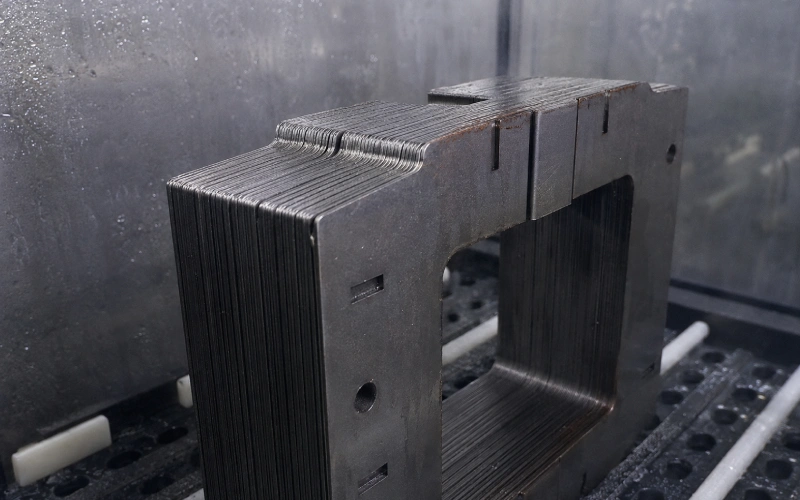
A lamination stack looks deceptively simple. Thin sheets of electrical steel, each wrapped in a coating a couple of microns thick, pressed or bonded into a core. That coating does a lot of quiet work. The interlaminar insulation on each lamination keeps them electrically separated, and it carries several jobs at once: limiting interlaminar currents, surviving punching, surviving annealing if any, resisting moisture and corrosion, and not eating up too much stacking factor.
So the question of corrosion testing is not really about steel rusting in a warehouse. It’s about whether the thing that keeps your stack quiet and efficient will still be doing its job in year eight. And that’s where salt fog testing enters the conversation—usually invited by a customer specification, sometimes shoved in without much thought about whether it fits.
This post is about the when. When you should require salt fog and corrosion testing on laminated components, when a lighter test will do, and when the whole exercise is theater.
Let’s be honest about the tool before we hand it out.
The salt spray test, also called the salt fog test, is a standardized corrosion method used to check the corrosion resistance of materials and surface coatings. The workhorse standard in North America is ASTM B117, with its international twin being ISO 9227 (the neutral variant abbreviated NSS). The conditions are straightforward: continuous atomized salt fog, a chamber temperature around 35 °C, a 5% sodium chloride solution at pH 6.5–7.2, and a fog collection rate of roughly 1–2 mL/hr.
The appeal is speed and repeatability. It doesn’t correlate cleanly with outdoor corrosion, but it produces results quickly and repeats better than almost any other method, which makes it useful for quality control.
Here’s the part people skip. ASTM B117 itself warns you not to over-read the results. Performance in natural environments has seldom been predicted from salt spray data used on its own, and correlation should only be trusted when backed by long-term atmospheric exposure. Read that twice. The document everyone cites as proof of corrosion resistance says, in its own text, that it mostly gives you relative answers. The intent is to compare specimens prepared the same way and run in the same chamber, together. It was never meant to compare different coatings tested in different chambers under different conditions.
That single fact reshapes how you write a spec. Salt fog is a comparison tool. It answers “is coating A tougher than coating B under identical, brutal conditions?” It does not answer “will this motor survive fifteen winters in Minnesota.” Treat the number as a ranking, not a prophecy.
Before requiring a test, picture the failure. A stack rarely dies from a dramatic sheet of rust. It degrades in ways that are more annoying and more expensive.
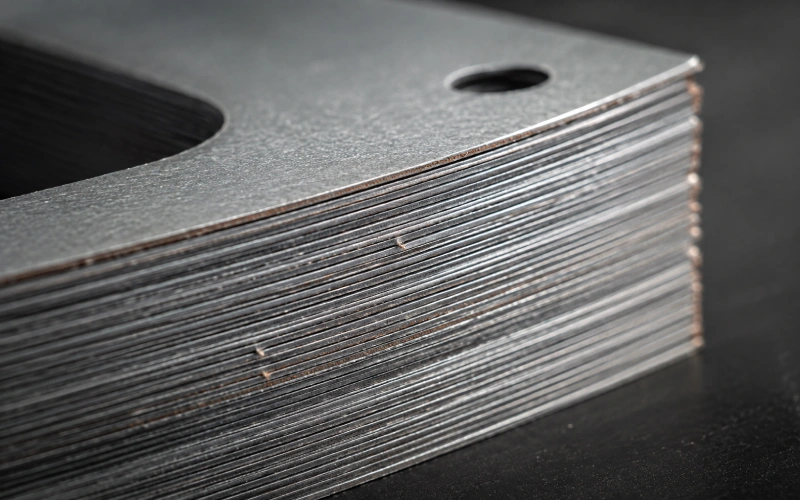
Moisture wicks into the stack edges, especially where punching burrs broke the coating. Rust forms at cut edges and, worse, bridges adjacent laminations. Degraded interlaminar insulation leads to local shorted turns through the stack, higher local loss, and hot spots. That’s the real damage: eddy-current losses climb, temperatures rise, efficiency slides.
The coating chemistry matters here. Interlaminar insulations get sorted by ASTM A976 into classes—roughly, C-0 for bare or natural oxide, C-3 for organic enamel/varnish, C-4 for a thin inorganic (often phosphate) layer, C-5 for inorganic with organic fill, C-6 for organic-with-inorganic-filler. The IEC 60404-1-1 / EN 10342 “EC” designations map onto similar territory. These respond very differently to chloride and humidity. An inorganic C-4 phosphate layer and a self-bonding organic layer are not interchangeable under salt fog, so a test built around one tells you little about the other.
And the coating is thin. Insulation layers commonly run from about 0.1 μm up to a few microns per side. Two microns doesn’t leave much margin. A scratch from a stamping die, a nick during stacking, a burr that never got deburred—any of those becomes the exact spot where salt fog starts eating.
There’s a second failure mode worth naming: the bond itself. Glue-dot and self-bonding (bond-varnish) stacks rely on an adhesive layer whose grip can weaken with moisture ingress. If humidity attacks the bond line, you lose mechanical integrity, not just insulation resistance. That’s a different question, and sometimes a humidity soak matters more than salt.
Skip the reflex of copying a competitor’s spec. Ask three questions instead.
First, where does the part live? A stack sealed inside a resin-overmolded housing in a climate-controlled cabinet has a different risk profile than a bare stator core in a coastal pump or an automotive traction motor eating road salt.
Second, what are you actually protecting—the steel, the coating, or the bond? The answer changes which test and which acceptance criterion make sense.
Third, do you need a pass/fail gate, a supplier comparison, or a life prediction? If it’s the last one, salt fog alone is the wrong tool, and no amount of chamber hours will fix that.
Here’s a working map.
| Application context | Corrosion exposure risk | Recommended approach | Typical rationale |
|---|---|---|---|
| Sealed / overmolded stack, indoor, climate-controlled | Low | Humidity screen (e.g. IEC 60068-2-78); salt fog only if customer-mandated | Coating rarely sees chloride; bond-line moisture is the real concern |
| General industrial motor, dry indoor | Low–moderate | Short ASTM B117 / ISO 9227 NSS as batch QC comparison | Ranking coatings and catching process drift, not predicting life |
| Automotive traction / e-mobility | High | Cyclic corrosion test (SAE J2334 or ISO 11997) + humidity, per OEM spec | Road salt plus wet/dry cycling; neutral fog alone under-represents it |
| Marine, coastal, offshore | High | Extended ISO 9227 NSS and/or acidified ASTM G85 + real exposure data | Continuous chloride and salinity; needs corroborating field data |
| Aerospace / defense airborne | High, specified | Salt fog per MIL-STD-810 (Method 509) or MIL-STD-202 | Compliance-driven; the spec dictates duration and criteria |
A few notes to go with that grid.
Neutral salt spray (ASTM B117 / ISO 9227 NSS) is the baseline everyone knows. But it isn’t the only option, and for many laminated parts it’s not the most honest one. A cyclic corrosion test alternates salt exposure with humidity and drying, so it simulates the wet-dry rhythm a motor actually lives through. Automotive programs tend to know this—which is why so many OEM specs reference SAE J2334 or ISO 11997 rather than a continuous fog. When a customer hands you an automotive-style limit, it usually reads like a scribe-creep number rather than a “no rust” wish: something like a capped millimeter of underfilm corrosion from a scribe after a defined number of cycles. That’s the kind of criterion worth negotiating into your spec—measurable, comparative, tied to a stated cycle count.
There’s no single right test. There’s a right test for a stated purpose.
ASTM B117 and ISO 9227 NSS are near-identical—same salt concentration, same temperature, same fog. The differences are in the details an auditor will flag: specimen orientation windows run 15°–30° in one and 15°–25° in the other, and the reporting requirements differ slightly. In Europe and for automotive and aerospace work, ISO 9227 tends to dominate; in North America ASTM B117 still prevails and gets referenced inside OEM specs. Pick one and cite it precisely, including which variant.
If you need something harsher for a durable coating, ISO 9227 also defines the acidified acetic-acid (AASS) and copper-accelerated (CASS) variants, and ASTM G85 covers a family of modified salt sprays through its annexes (acidified, cyclic acidified, dilute electrolyte). These bite harder and faster—but harder isn’t always more relevant. An aggressive acidified fog can fail a phosphate coating that would have lived happily for two decades. Match the aggression to the real environment, not to a wish for a scary number.
Duration is where specs go vague. Don’t. Tie the hours to the risk tier above and to the comparative baseline you’re using. A 24–96 hour screen catches gross coating defects and process drift. Hundreds of hours start to differentiate genuinely durable systems—but only relative to each other, in the same chamber, same run.
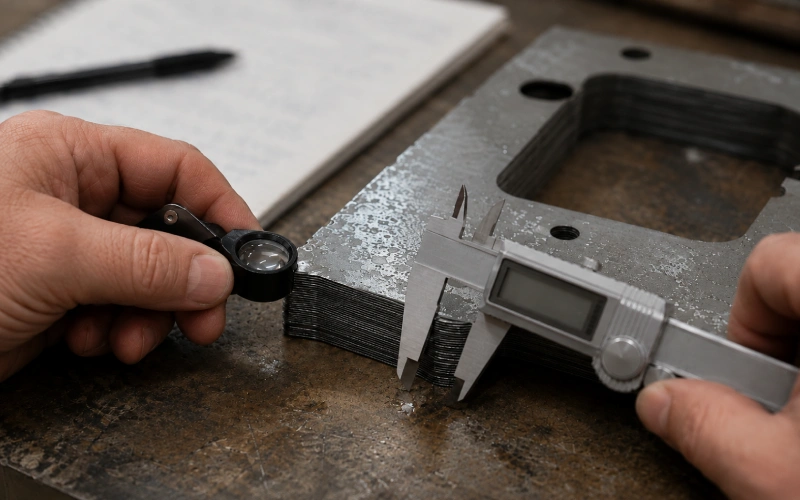
Borrow one discipline from coating work: scribe and inspect, don’t just stare. The standard practice cuts the coating to bare metal along a scribe line, and after exposure you measure how far corrosion has crept from that line in millimeters. For a lamination stack, the natural “scribe” is the cut edge and any handling damage. That’s where you look first.
A short list, from the recurring mistakes.
Requiring salt fog because the last spec did. If nobody can name the failure mode being screened, the test is decoration.
Reading a pass as a lifespan. It isn’t. End-use stresses differ from chamber stresses, so a B117 pass is not a service-life prediction or a valid stand-alone ranking of coating systems.
Comparing your supplier’s report against a different lab’s report. Different chamber, different run, meaningless comparison. If you want a real ranking, the samples go in together.
Ignoring the wet-dry reality. For anything that sees condensation cycles, continuous fog under-represents the actual attack. That’s what SAE J2334 and ISO 11997 exist for.
Testing the coupon and forgetting the assembly. A flat coated coupon and an assembled stack with burrs, bond lines, and exposed edges behave differently. Where the risk is real, test the stack, not a proxy panel.
A good requirement names the standard and variant, states specimen orientation, ties exposure hours to a risk tier, and sets a measurable acceptance criterion—edge corrosion extent, insulation-resistance retention, or scribe creep rather than a subjective “no rust.” It specifies that comparative claims come from a single co-run, adds a humidity or cyclic requirement when the part sees condensation, and writes down what the test is for.
Here’s a clause you can adapt straight into a drawing note or RFQ/SOW. Fill the brackets to match your part.
CORROSION QUALIFICATION — LAMINATED CORE

1. Coating class per ASTM A976 [C-4 / C-5]; report EN 10342 (IEC 60404-1-1)
   EC designation.
2. Test method: [ASTM B117 / ISO 9227 NSS]. Specimen orientation and
   chamber conditions per referenced standard.
   - For parts exposed to wet/dry cycling or road salt, substitute
     cyclic test per [SAE J2334 / ISO 11997], [N] cycles.
3. Test article: assembled stack including cut edges and bond lines
   (not flat coupon), unless otherwise agreed.
4. Duration: [__] hours, tied to risk tier; state QC-screen vs.
   qualification intent.
5. Acceptance criteria (measurable):
   a. Underfilm/scribe creep ≤ [1] mm from any cut edge or scribe.
   b. No interlaminar bridging corrosion between adjacent laminations.
   c. Interlaminar resistance retained ≥ [__]% of pre-test value
      (method per ASTM A717 / A937 as applicable).
   d. Bond-line integrity: no delamination on visual + peel check
      (bonded stacks only).
6. Comparative ranking valid only for specimens run together in a
   single chamber cycle.
7. Purpose of test (circle): batch QC screen / supplier ranking /
   design qualification gate.
Salt fog earns its place in that spec when there’s a real chloride or moisture threat and you want a repeatable gate or ranking. It does not earn its place as a stand-in for field data. Keep it in that lane and it’s genuinely useful.
Do all lamination stacks need salt fog testing? No. A stack that lives sealed and dry indoors gets little from it. The test earns its keep when the part faces chloride or repeated moisture—automotive, marine, outdoor, or coastal service—or when a customer spec mandates it as an acceptance gate.
Does passing an ASTM B117 salt fog test mean the part won’t corrode in service? No, and the standard says so itself. B117 performance rarely predicts natural-environment behavior on its own. Treat a pass as a comparative result, not a service-life guarantee.
ASTM B117 or ISO 9227—does it matter which I cite? The neutral tests are near-identical, so the ranking you get is similar. What matters is citing one precisely, including the variant (NSS, AASS, or CASS for ISO 9227), plus specimen orientation—because those details are what auditors and suppliers argue over.
Neutral salt spray or a cyclic test for a motor core? Depends on the environment. Neutral B117/ISO 9227 NSS is fine as a batch QC comparison. For parts seeing wet-dry cycling and road salt, a cyclic test like SAE J2334 or ISO 11997 represents reality better.
How long should the exposure run? Tie hours to risk, not habit. Short runs of 24–96 hours suit rapid screening; several hundred hours differentiate durable coatings relative to each other. Longer is not automatically more meaningful.
Should I test a coated coupon or the assembled stack? Where the risk is real, test the assembly. Cut edges, burrs, and bond lines are where corrosion starts, and a flat coupon hides all three.
Can I compare my supplier’s salt fog report to another vendor’s report? Not meaningfully. The method is built for specimens run together in one chamber. Reports from different labs and runs aren’t a valid head-to-head. If you need a real ranking, require a single co-run.
What acceptance criterion should I write? Something measurable—scribe creep in millimeters, absence of interlaminar bridging, or retained interlaminar resistance—beats a subjective “no visible rust.” An automotive-style capped underfilm distance after a set cycle count gives everyone the same yardstick.








 English
  German
  Spanish
  French
  Italian