Let Sino's Lamination Stacks Empower Your Project!
To speed up your project, you can label Lamination Stacks with details such as tolerance, material, surface finish, whether or not oxidized insulation is required, quantity, and more.
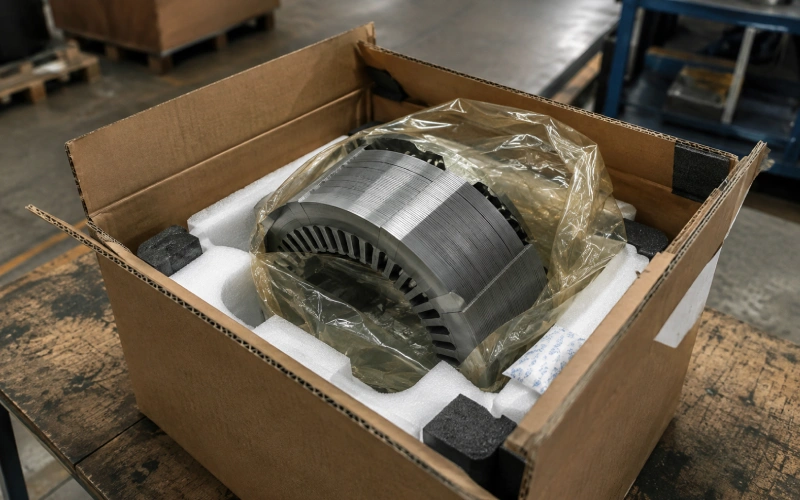
A lamination stack can pass every electrical test on the factory floor and still arrive at the customer’s dock as scrap. Bent teeth. A rusty bloom across the bore. A stack that shifted inside its carton and now rings with burrs on the outer laps. None of that showed up in your final inspection because the damage happened somewhere between your loading bay and theirs.
Packaging QC for laminations is the discipline that owns that gap: a set of pre-shipment checks that defend a stack against the three failures it actually suffers in transit—mechanical deformation, surface scratching, and corrosion—by controlling the two root causes behind them, movement and moisture.
That gap—the part of the process you don’t watch—is where most lamination losses occur. This article is about closing it. Not with “wrap it well,” but with the specific failure modes and the checks that catch them before a shipment leaves.
Most packaging guidance is written for boxes of consumer goods. Laminations don’t behave like that.
A stack is a column of thin electrical steel sheets—often 0.20 to 0.50 mm each, sometimes thinner, with common grades running 0.05, 0.10, 0.15, 0.20, 0.25, 0.35, and 0.50 mm. Individually those sheets are flimsy. Bonded or welded into a stack they’re stiffer, but the outer laps and the tooth tips stay vulnerable. A knock that wouldn’t dent a cast part will fold a tooth on a stator lamination.
Then there’s the electrical consequence, easy to forget when you’re staring at dents. Scratches aren’t cosmetic. If scratches occur on a sensor’s lamination rotor stack, rotating harmonics get created, picked up by the sensor, and they disturb the control of the associated electric machine. A scuff that looks trivial can quietly wreck performance.
And the steel wants to rust. Bare edges from stamping or cutting go first. Once corrosion sets in between laps, you can’t sand it out—it’s already living where you can’t reach.
So packaging QC here defends against three things at once: mechanical damage, surface scratching, and corrosion. Miss any one and the shipment can fail.
Before you inspect for damage, you need to know what you’re looking for.
| Failure mode | What it looks like | Root cause in transit | Where QC should catch it |
|---|---|---|---|
| Edge/tooth deformation | Bent tooth tips, splayed outer laps, out-of-round bore | Drops, impacts, poor corner support | Packaging design + pre-ship dimensional check |
| Surface scratching | Scuffs on lam faces, gouged edges | Parts rubbing each other or the carton wall during vibration | Interleaving check + fit check |
| Corrosion / rust | Orange bloom, spotting between laps, discolored edges | Humidity, condensation cycles, bare steel exposure | Moisture barrier + desiccant/VCI verification |
| Load shift & crush | Collapsed stack, crushed carton, loose parts | Vibration, compression from stacking, void space | Fill check + compression rating |
Notice how many trace back to the same two culprits: movement inside the package, and moisture inside the package. Control those and you’ve solved most of the problem.
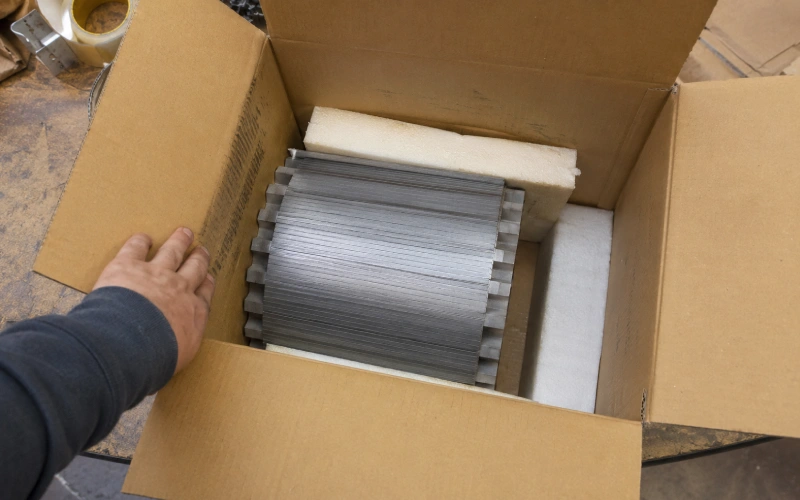
A carton on a truck vibrates for hours. Anything loose inside is being sanded, tapped, and worked the whole way. Void fill and cushioning keep parts from shifting inside cartons. That’s the whole game—if the stack can’t move, it can’t rub, and it can’t build momentum before hitting a wall.
The trouble is that void space hides. A package that looks snug when you seal it can develop slack as foam compresses or a stack settles. So the QC check isn’t “does it look full?” It’s “grab the sealed carton and shake it—do you hear or feel anything move?” If you do, it’s not ready.
Corner and edge protection matters here too. Edges and corners take the brunt of handling damage, and on a lamination stack that means the outer laps and the tooth tips. Those need a rigid buffer between the steel and whatever the carton might slam into.
Rust doesn’t need rain. It needs humid air and a temperature swing. Ocean freight exposes containers to humidity fluctuations that create condensation cycles, and the longer the transit, the more of them you rack up. A container that heats during the day and cools at night breathes moisture in and out, and every cool-down leaves condensation on cold steel.
Two tools handle this, and they work differently. Desiccants pull water out of the sealed air—silica gel is the common one, working by adsorption, where water molecules are held on the surface of the granules. VCI attacks the chemistry instead: vapor corrosion inhibitors form a molecular barrier on the metal surface.
For laminations you often want both. VCI alone is common and fine for shorter domestic trips. But for high-value parts, long transits, or ocean freight where humidity gets extreme, desiccant alongside VCI covers both moisture level and corrosion chemistry.
These tools have limits that QC has to respect—which is where most shippers get burned.
VCI bags fail more often than people expect, and usually not because the product is bad. It’s the packaging system around it that wasn’t verified.
First, desiccant runs out. It has a finite capacity; once saturated, it stops working. If you’re guessing the number of grams, you’re gambling on route and transit time. The quantity has to be matched to the package—box size, barrier material, humidity, temperature swings, and days in transit all move the number. There’s a recognized method for this: DIN 55474 defines how to calculate the number of desiccant units to enclose based on the packaging and the climatic load the goods will see. Cite that instead of guessing, and the calculation stops being a debate.
Second, the inhibitor expires. Most well-made VCI packaging is rated around two years under normal storage; beyond that the inhibitor concentration in the headspace may have dropped below effective levels. If parts sit in a warehouse before shipping, that clock is already running.
Third, none of it works without a seal. A humidity card only gives a useful reading when the package has a strong seal—a weak one lets humid air in. This is the single most common failure point, and it’s fully inside QC’s control. Inspect the seal for wrinkles, channels, contamination, or incomplete bonding along its full length.
The practical part: you can verify all of this without opening the bag. Drop a humidity indicator card inside before sealing—its treated spots change color at marked relative-humidity levels—and every inspection afterward is a glance through the barrier. One caution: the card isn’t a digital meter. Give a freshly sealed package time to equilibrate before you trust the reading, or you’ll reject good packages and pass bad ones. Treat the card as one signal in a complete process—right card, correct placement, good seal, stable reading, recorded result—not as the whole answer.
A stack going 40 minutes across town and a stack crossing an ocean are not the same shipment, even if they’re the same part. The packaging has to answer the route.
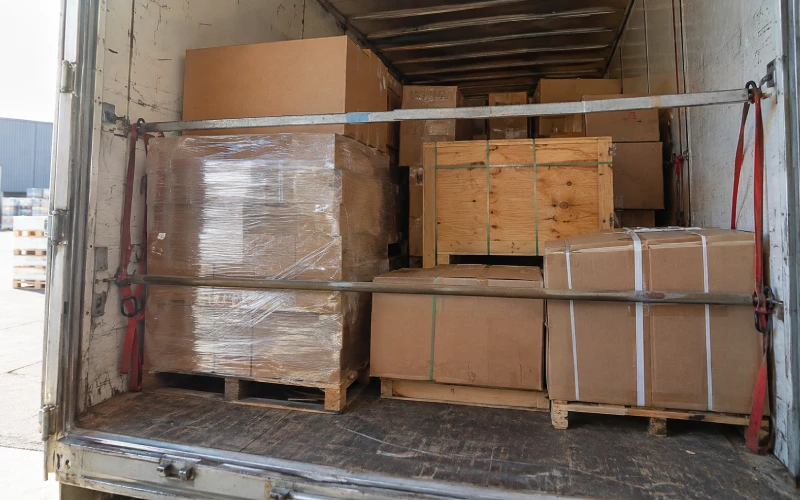
Choosing materials without considering the shipping environment leaves protection gaps, even when the box looks solid. Less-than-truckload freight is especially rough because your box isn’t traveling alone—it faces stacking, shifting, and compression over long distances.
That stacking point deserves attention. If your carton sits at the bottom of a mixed pallet, it needs to survive the weight above it for the whole trip, not just the moment it’s loaded. Compression is a slow-motion failure—the box holds, holds, holds, then folds hours later. Which is why compression testing exists as a separate discipline from drop testing.
There’s a materials point buried here too. Rigid support beats soft fill for parts that face pressure. For a heavy lamination stack, a bed of loose foam peanuts is the wrong answer; a fitted rigid cradle plus edge buffers is the right one.
You can argue about packaging design forever. Testing ends the argument. And this is where naming the right standard—by its actual code—turns a claim into evidence.
Two families cover most cases. One nonprofit transport-packaging body publishes a graded set of protocols; a materials-standards body publishes a risk-based method. They favor different philosophies, and the difference is worth knowing.
| Transport scenario | Standard to run | Why |
|---|---|---|
| Single parcel ≤ 68 kg | 1A (integrity) / 3A (simulation) | 1-series splits at 150 lb / 68 kg |
| Mixed LTL freight | 3B | Multi-shipper, multi-destination, mixed trailer |
| Unitized FTL load | 3E | Full trailer, identical product, single destination |
| Route-specific, risk-tuned | ASTM D4169 | Selectable distribution cycle by mode + product fragility |
| Desiccant quantity | DIN 55474 | Calculated desiccant units for the climatic load |
Whatever you run, the discipline is the same: inspect the package after each stage for damage to both the packaging and the product. That post-test teardown is the real deliverable. A package that “passed” but shows fresh scratches on the laminations didn’t pass—it just didn’t break the box.
Run this before a shipment is released, not after a complaint comes back.
Before packing
Sealing the moisture barrier
Building the outer package
Documentation
Do I still need desiccant if I’m already using VCI packaging? Sometimes not, sometimes yes. VCI alone often suffices for short domestic trips. For high-value parts, long transits, or ocean freight with extreme humidity, desiccant alongside VCI gives the most complete protection because it controls moisture level and corrosion chemistry separately. Transit time and humidity exposure decide it.
Why are my parts still rusting inside VCI bags? Usually one of three things: the desiccant saturated, the VCI aged past its service life, or the seal leaked. Check all three before blaming the bag.
How much desiccant do I actually need? Don’t guess. DIN 55474 gives a calculation method that factors package size, barrier material, and the climatic load over your transit time, and returns the number of desiccant units to enclose.
How do I check moisture inside a sealed package without breaking the seal? Put a humidity indicator card inside before sealing and read it through the barrier. Just let a freshly sealed package stabilize before you trust the color.
Are surface scratches really a problem if the stack still measures fine? For rotor and sensor stacks, yes. Scratches on a sensor’s rotor stack create rotating harmonics that get picked up and disturb machine control. A scratch that looks cosmetic can change how the part performs.
Which transit test should I run? Match it to weight and route. Single parcels under 68 kg fall under the 1-series (integrity) or 3A (simulation). Mixed LTL freight calls for 3B; unitized full-truckload calls for 3E. If you want the test tuned to your specific route and product fragility, ASTM D4169 lets you pick a distribution cycle.
Is edge protection really necessary, or is a strong box enough? The box protects the box. Edge and corner buffers protect the part—they stand between the outer laps and every impact the carton takes.
Packaging QC for laminations isn’t a step you bolt on at the end. It’s a defense against three specific failures—deformation, scratching, corrosion—that share two controllable root causes: movement and moisture.
Lock the stack so it can’t shift. Seal it against humidity and verify that seal instead of trusting it. Match the whole system to the route the shipment will really take, and prove it with the transit standard that fits that route before you commit a real order. Do that consistently, and the gap between your dock and the customer’s stops being the place your good parts go to die.







 English
  German
  Spanish
  French
  Italian