Let Sino's Lamination Stacks Empower Your Project!
To speed up your project, you can label Lamination Stacks with details such as tolerance, material, surface finish, whether or not oxidized insulation is required, quantity, and more.
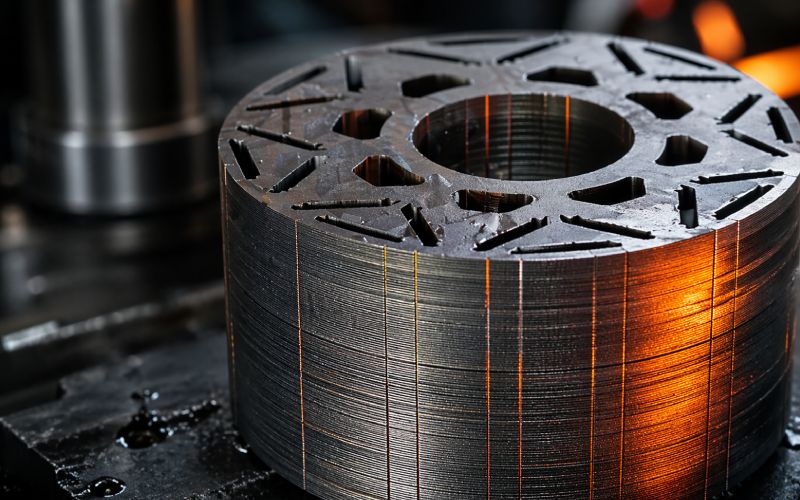
If a lamination stack will run hot, see oil, and live with cyclic load, the adhesive should be selected against the stack hot-spot temperature, oil exposure profile, and fatigue risk—not against room-temperature shear strength alone. In bonded electrical steel laminations, that distinction matters because the bond line is doing two jobs at once: it holds the stack together, and it helps preserve electrical separation between sheets. Published research also shows that adhesive joining can preserve magnetic performance better than welding because it avoids damaging the insulation coating in the same way.
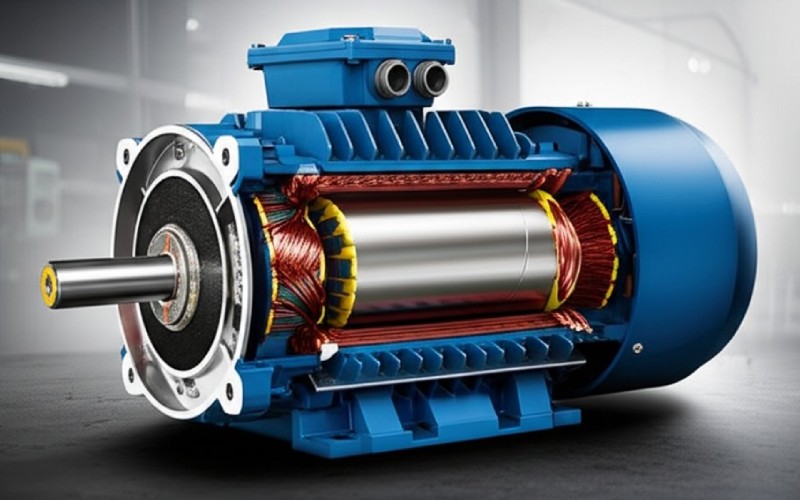
In motor stator and rotor laminations, adhesive bonding is used because it can hold a full stack together without cutting through or overheating the insulation coating on each electrical steel sheet. That is not a small detail. The insulation coating is there to reduce interlaminar eddy currents. The review literature on laminated electrical steels notes that adhesive joining did less damage to iron loss and exciting current than welding in reported motor-core evaluations, while welding and other joining processes can degrade magnetic properties through coating damage, microstructural change, and residual stress.
That is why adhesive selection for lamination stacks is not just a mechanical-strength exercise. It is a system decision. A bonded stack that tests well in static strength but weakens the electrical or magnetic function is not really a better stack. It is only easier to assemble.
Temperature is usually the first filter. It should be.
Many industrial motors are discussed in terms of insulation classes—Class B 130°C, Class F 155°C, and Class H 180°C—and those values are useful for framing the thermal environment. But an adhesive layer inside a lamination stack does not automatically inherit that temperature capability just because the surrounding motor insulation system carries a higher class. NEMA guidance describes those class temperatures at the insulation-system level; it does not say that every adhesive interface inside the machine will maintain the same mechanical behavior there.
Published work on waterborne epoxy varnishes for electrical steel laminates makes the gap plain enough. In that study, fully cured adhesive layers showed glass-transition temperatures in the range of 81°C to 102°C. The same paper also reported a strong loss in roll-peel strength at 100°C and 140°C, with strength dropping by roughly 50% at 100°C and 75% at 140°C for the investigated systems. So the selection problem is not abstract. A stack can operate in a machine built around higher thermal classes and still contain an adhesive layer whose mechanical response changes sharply much earlier.
That is the practical rule: screen the adhesive against the lamination hot spot, not the housing temperature, not the oil sump average, and not the marketing temperature on a generic datasheet. If the bond line lives near its transition region for long periods, the stack may pass fresh lab tests and still be the wrong design.
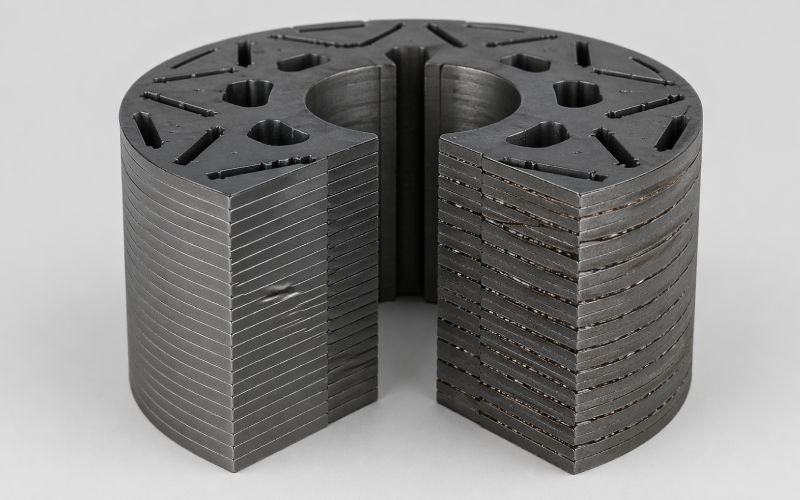
Oil changes the problem, but not always in the simple way people expect.
For oil-cooled motors, or any lamination stack exposed to splash, mist, or continuous oil contact, chemical resistance matters. Still, oil is only one part of the real service condition. A recent study on epoxy-based electrical steel laminates looked at delamination under elevated temperature, cyclic loading, and different environments. It found that the tested laminates showed similar crack-growth behavior in hot air and in an oil-based cooling agent, while the crossover in fatigue-threshold behavior tracked the adhesive transition region. That points to something useful: heat and viscoelastic change can be just as important as fluid contact, sometimes more so.
So the right question is not, “Is this adhesive oil resistant?” That is too thin. The better question is: Does this adhesive keep bond integrity after oil ageing at the actual service temperature and under the actual loading mode? A thin bonded stack under cyclic load fails differently from a thick structural bond line in a simple lap-shear coupon. It is the combination—temperature, interface, oil, fatigue—that decides the result.
Bond-line thickness deserves more attention than it usually gets in lamination stack discussions.
In a 2022 study on electrical steel laminates with epoxy layers from 7 to 48 μm, roll-peel strength increased up to about 20 μm and then leveled off. The same study reported that fracture-mechanics-based testing was more sensitive than monotonic roll-peel testing, and that temperature changed the ranking less at 60°C than at 23°C because the adhesive response shifted as the test moved closer to its transition regime. That is useful because it tells you two things at once: first, “more adhesive” is not a reliable strategy; second, a static peel number does not capture the whole failure picture.
Surface condition matters too. In the 2024 environmental-fatigue study, laminates produced with pre-treated sheets and catalyst achieved threshold strain-energy-release-rate values from 16 to 62 J/m² depending on configuration and environment, and the pre-treated versions showed enhanced threshold values and slower crack propagation in the stable-growth regime. That means adhesive selection is not only about resin chemistry. The steel surface, pretreatment route, and cure process are part of the adhesive system whether the specification admits it or not.
Below is a practical way to make the choice without drifting into generic adhesive language.
Use the worst-case stack temperature, including local hot spots and dwell time. Short spikes and long soaks are not equivalent. If your design lives near Class F or Class H operating territory, do not assume the bond line has comparable fracture resistance unless the adhesive data say so under comparable conditions.
Room-temperature strength is a screen, not a release criterion. For lamination stacks, elevated-temperature peel, delamination, or fracture data are more informative than a single room-temperature shear number.
If the stack will see oil, test after oil ageing at service temperature. Not just after immersion at room temperature. Not just after a short exposure. The approval condition should resemble the field condition.
A thin, uniform bond line is part of performance. Once thickness drifts upward, strength does not keep rising in a linear way, and fatigue behavior can shift with failure mode.
Pretreatment, partial cure, final lamination cure, and surface chemistry can change threshold behavior and crack growth. If these are unstable in production, the “same adhesive” may stop behaving like the same adhesive.
Table: A practical selection matrix for lamination stack adhesives under heat and oil exposure
| Lamination stack condition | What to prioritize | What to verify before release | Common mistake |
|---|---|---|---|
| Dry running, moderate thermal load | Electrical isolation, controlled thin bond line, stable peel strength | Elevated-temperature peel or delamination data, cure repeatability | Approving on room-temperature strength only |
| Oil mist or intermittent splash | Retention after oil ageing, interface stability, temperature margin | Oil-aged bond testing at service temperature, failure mode review | Treating “oil resistant” as a complete answer |
| Continuous hot-oil exposure | High-temperature bond retention, chemical stability, fatigue resistance | Oil-aged delamination or fracture data after long dwell | Using insulation class as a substitute for adhesive durability data |
| High cyclic load or vibration | Crack-growth resistance, surface preparation quality, cohesive vs. interfacial failure behavior | Fatigue crack-growth testing, threshold data, surface pretreatment control | Optimizing only static peel or shear |
| Tight dimensional control and thermal path requirements | Uniform bond-line thickness, full-surface bonding consistency | Bond-line thickness distribution, flatness, process capability | Letting adhesive thickness drift across the stack |
This table follows the same pattern seen in the published work: lamination stack durability depends less on one headline strength number and more on how the adhesive, substrate, and environment behave together over temperature and time.
A useful qualification plan for lamination stack adhesive bonding should include:
That last point gets missed. Mechanical retention is necessary, yes. But for electrical steel laminations it is not sufficient. A bond that survives mechanically while compromising interlaminar insulation or magnetic behavior is not a successful selection.
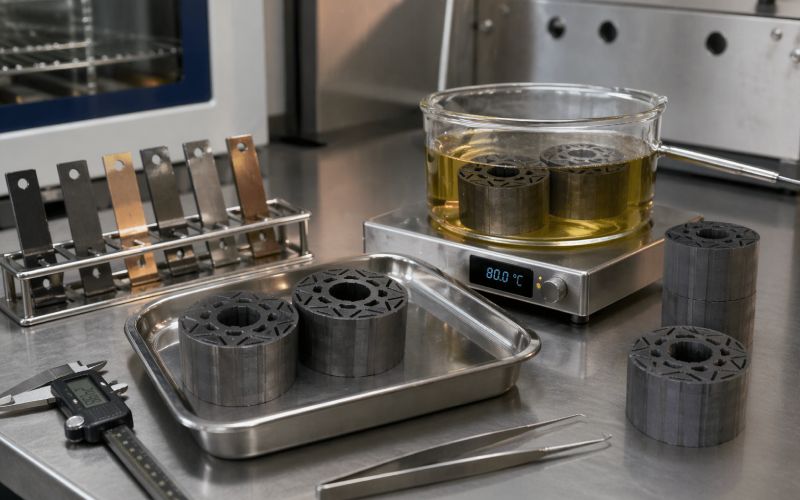
The best adhesive for lamination stacks is rarely the one with the highest published room-temperature strength. In practice, the better choice is usually the adhesive system that can deliver:
That may be an epoxy bonding varnish. Often it is. But the real answer depends on the thermal profile, oil contact mode, surface preparation route, and the way failure is most likely to start in the stack. Slightly awkward answer, maybe. Still the useful one.
There is no single best adhesive for every lamination stack. For electrical steel laminations, epoxy-based bonding varnishes are widely used because they support thin full-surface bonding and preserve insulation between sheets. The right choice depends on hot-spot temperature, oil exposure, bond-line thickness control, and fatigue risk.
Not by itself. Room-temperature strength is useful for screening, but published work on electrical steel laminates shows that temperature, bond-line thickness, and interface condition strongly affect peel and fatigue behavior.
A lot. In one study on electrical steel laminates, fully cured epoxy adhesive layers showed glass-transition temperatures of 81°C to 102°C, and roll-peel strength dropped sharply at 100°C and 140°C. That is why hot-spot temperature matters more than nominal ambient conditions.
Not always. A 2024 fatigue study found similar crack-growth behavior in hot air and an oil-based cooling agent for the investigated laminates, which suggests that temperature relative to the adhesive transition region and interface quality can be just as important as the fluid itself.
Not necessarily. A 2022 study found that roll-peel strength increased up to about 20 μm bond-line thickness and then leveled off. Beyond that point, more thickness did not keep improving joint performance.
Because adhesive bonding can keep the insulation coating intact and reduce the magnetic-property damage associated with welding. Review literature reports lower deterioration of iron loss and exciting current for adhesive joining than for welding in motor-core studies.
Validate performance after the actual cure cycle, at the real operating temperature, and after oil ageing if oil is present. Then check fatigue or delamination behavior, not just static strength. For lamination stacks, the approval plan should match the service environment closely.



 English
  German
  Spanish
  French
  Italian