Let Sino's Lamination Stacks Empower Your Project!
To speed up your project, you can label Lamination Stacks with details such as tolerance, material, surface finish, whether or not oxidized insulation is required, quantity, and more.
Before anything else — if you’re in a hurry, here’s the core decision map:
| Coating Class | Composition | Anneal-Safe? | Recommended Cleaning Method | What to Avoid |
|---|---|---|---|---|
| C-0 | Natural mill oxide | Yes | Mild alkaline or vapor degrease | Strong abrasives |
| C-1 | Steam blue / heat oxide | Limited | Mild alkaline aqueous (pH < 10) | Prolonged hot soak |
| C-2 | Magnesium silicate glass film | Yes | Most solvents and mild alkaline | Abrasion |
| C-3 | Organic enamel / varnish | No | Vapor degreasing; mild solvent | High-pH alkaline, hot soak |
| C-4 | Inorganic phosphate | Yes | Alkaline aqueous (pH < 12, < 70°C) | Prolonged high-pH immersion |
| C-5 | Inorganic + ceramic filler | Yes (up to ~815°C) | Alkaline aqueous or vapor degrease | Aggressive abrasion |
| C-6 | Organic + inorganic fillers | Some grades | Vapor degrease; mild alkaline (pH < 10) | High-pH alkaline |
The non-negotiable rule: identify your coating class first. Everything else — method, temperature, pH, contact time — follows from that single data point. If you don’t have that information, get it from your steel supplier before you design a cleaning process.
Stamping dies require lubrication. That’s not negotiable — without it, die wear accelerates, galling occurs, and dimensional accuracy degrades across a production run. The lubricant applied is typically a light mineral oil or a specific stamping fluid, introduced either to the strip before feeding into the press or sprayed directly at the die face.
After stamping, that oil doesn’t simply sit on exposed surfaces. It wicks into the interface gaps between stacked laminations by capillary action. In a pressed stack, those gaps — sometimes only a few tens of microns wide — act like reservoirs. Standard surface-cleaning methods don’t reach them.
The failure modes that follow are distinct and worth naming individually, because each one has a different timeline:
Knowing the oil type on your laminations shapes the method selection as much as knowing the coating class. These behave differently during cleaning, and some methods that work on one type fail on another.
Mineral oil-based cutting fluids are non-saponifiable — they don’t react with alkali to form soap. In aqueous systems, removal depends entirely on emulsification. Vapor degreasing removes them readily because most mineral oils dissolve in fluorinated or modified-alcohol solvents.
Sulfurized or chlorinated extreme-pressure (EP) stamping fluids are used on harder steels and tighter-tolerance dies. These are more difficult to remove and can leave residues that resist plain solvent washing. Alkaline systems with matched emulsifying packages perform better on these than solvent alone.
Rust-preventive oils applied after stamping for transit protection are typically thin-film and low-viscosity. They’re usually easier to remove than stamping fluids, but because they’re designed to adhere to metal surfaces, some formulations are more tenacious than their film thickness suggests.
If your laminations were stamped at one facility, shipped with a rust preventive applied, and cleaned at another facility before downstream processing — you may have two different oil types present simultaneously. Test your cleaning process against the actual combination, not individual oils in isolation.
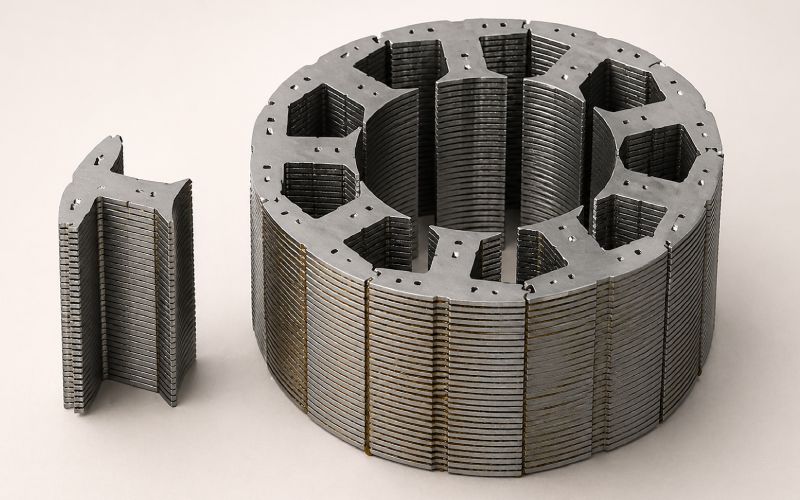
The ASTM A976 classification system defines interlaminar insulation coatings from C-0 through C-6. They don’t all tolerate the same cleaning chemistry, and the distinctions matter.
C-3 coatings are organic. The binder is a resin — an enamel or varnish. Strong alkaline solutions at elevated temperatures attack that binder the same way they attack any organic polymer. This is not a marginal degradation; it’s a systematic failure of the insulation layer. A C-3 coated lamination processed through a hot, high-pH spray wash will exit with measurably lower interlaminar resistance than it entered with.
C-4 and C-5 coatings are inorganic, based on phosphate chemistry. They tolerate moderate alkaline conditions far better than C-3. They’re not indestructible — prolonged exposure to high pH at elevated temperature degrades them too — but the working window is substantially wider.
C-2 glass film (magnesium silicate, used primarily on grain-oriented steel for wound cores) is essentially inert to aqueous chemistry. Its issue in production is mechanical — it’s abrasive and brittle, not chemically sensitive.
C-0 and C-1 are oxide-based, thin, and generally tolerant of mild aqueous cleaning. The exposure window matters more than the chemistry type for these.
Cleaning the outer surfaces of a lamination stack is straightforward. The hard part is oil trapped in the interlaminar gaps — whether it wicked in after stacking or was present on individual laminations before assembly.
Aqueous cleaning depends on surfactant penetration and hydraulic action. In tight interlaminar gaps — 0.3 mm to 0.5 mm is common for standard motor lamination thicknesses — water-based fluids resist full penetration. More critically, after the wash cycle, water that has entered those gaps doesn’t drain and dry quickly. Trapped moisture on bare silicon steel edges creates a corrosion risk that replaces the oil problem with a rust problem.
Solvent-based methods have the advantage here because modern cleaning solvents typically have lower surface tension than water. They penetrate fine gaps more effectively and, if chosen correctly, evaporate without leaving residue or promoting oxidation.
This is why vapor degreasing has been the preferred industrial method for fully assembled lamination stacks where interlaminar oil is the primary contamination.
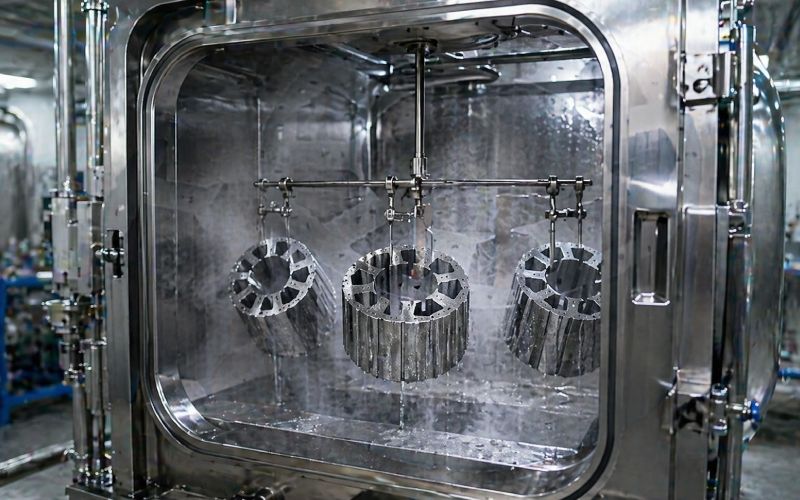
Vapor degreasing uses solvent vapor condensing onto a cooler workpiece to continuously rinse the part with fresh, uncontaminated solvent. Because the condensing vapor is always clean, it doesn’t redeposit contamination. The process self-limits once the part equilibrates to vapor temperature.
For lamination stacks, the decisive advantage is penetration. Solvent vapor condenses into interlaminar gaps and carries oil out by dissolution and gravity drainage. Mechanical rotation during the cycle improves coverage uniformly.
Modern closed-loop vapor degreasing systems use modified alcohol, hydrofluoroether (HFE), or similar formulations — not the legacy chlorinated solvents. These are compatible with all ASTM A976 coating classes. They don’t attack organic resins at operating temperatures, and they leave no aqueous residue.
Best suited for: Pre-assembled stacks with interlaminar oil; pre-EP-coat or pre-varnish cleaning; applications where zero moisture residue is required.
Practical constraint: Equipment cost is higher than spray wash. Throughput is batch-oriented. Regulatory compliance for solvent use applies.
Alkaline cleaning removes oils through two mechanisms: saponification (converting ester-based oils into water-soluble soaps) and emulsification (dispersing non-saponifiable oils into the aqueous phase). It’s compatible with conveyor-line production and cost-effective at scale.
The risk with coated laminations is chemistry aggressiveness. As a working framework:
The drying step is where many operations fail even when the wash chemistry is correct. Warm, wet lamination stacks left in a queue after washing will corrode at exposed steel edges. Inline forced-air drying or low-temperature oven drying must follow the rinse stage immediately — it’s not a separate process, it’s part of the cleaning cycle.
Best suited for: Individual laminations before stacking; C-4 and C-5 coated material; high-volume inline stamping and cleaning operations.
Practical constraint: Poor penetration into interlaminar gaps on assembled stacks. Drying must be immediate and controlled.
Ultrasonic cleaning drives cavitation — the formation and implosion of microscopic bubbles under high-frequency acoustic energy — to dislodge contamination from surfaces and, to a degree, from tight gaps. The cavitation energy propagates into the stack and provides mechanical assistance that passive immersion lacks.
Frequency and power selection matter significantly for coated laminations:
For coated laminations, the recommended configuration is higher-frequency ultrasonics at moderate power in a mild solvent or low-pH aqueous medium, with cycle times kept short.
Best suited for: Assembled stacks in batch processing; prototype or small-volume runs; when vapor degreasing equipment is unavailable.
Caution: Do not use high-power low-frequency ultrasonics on C-3 coated laminations in extended cycles.
Electrolytic degreasing places parts in an alkaline electrolyte and applies direct current. Electrolysis generates oxygen and hydrogen gas at the part surface, and the bubble action mechanically lifts oil films. It’s more aggressive at surface cleaning than passive alkaline soak.
For laminations, its limitations are specific. The alkaline bath chemistry carries the same coating risks as standard alkaline cleaning — and the electric current can preferentially conduct through metallic contact points between lamination layers, producing uneven treatment. Bubble generation is fundamentally a surface phenomenon and doesn’t assist in cleaning interlaminar gaps.
Best suited for: Pre-plating surface preparation on C-4 or C-5 coated material where surface oil films are the primary issue.
Not recommended for: C-3 coated laminations; assembled stacks with interlaminar oil contamination.
The cleanest technical solution to the interlaminar penetration problem is to clean individual laminations before they’re stacked. If stamped laminations are degreased before assembly, the stack starts without trapped contamination, and any subsequent surface cleaning is maintenance rather than remediation.
The practical obstacle is corrosion. Clean silicon steel oxidizes quickly in humid environments. If laminations are cleaned and then stored or shipped before stacking, they need a new protective treatment — a thin-film rust preventive applied at low volume after cleaning. That creates a controlled, light contamination problem rather than a heavy one, and the rust preventive can be selected for compatibility with the downstream process.
For facilities where stamping and stacking occur in the same building, pre-stack cleaning is often the most technically sound approach, even when it requires an additional process step.
If the process includes a stress-relief anneal — common with C-4 and C-5 coated silicon steel where punching has degraded magnetic properties — the cleaning sequence is not interchangeable with the anneal sequence.
Cleaning before the anneal removes oil that would otherwise carbonize in the furnace. Clean steel exposed to a controlled slightly-oxidizing anneal atmosphere can build or restore a natural oxide layer, adding baseline interlaminar insulation on surfaces where the original coating was thin.
Cleaning after the anneal is less effective: oil may have partially migrated or polymerized during heating, and post-anneal cleaning risks disturbing a freshly formed oxide surface. The accepted sequence is: clean first, then anneal.
| Mistake | Consequence | Corrective Action |
|---|---|---|
| High-pH alkaline wash on C-3 coated laminations | Organic binder degrades; interlaminar resistance drops; eddy current losses increase | Keep pH below 10 for C-3; use vapor degreasing or mild solvent |
| Skipping immediate drying after aqueous wash | Corrosion forms on bare steel edges and internal surfaces | Implement inline forced-air drying within 2–3 minutes of final rinse |
| Assembling stacks before cleaning when interlaminar oil is present | Gaps trap oil; surface methods can’t reach it | Clean individual laminations before stacking, or use vapor degreasing on assembled stack |
| Extended hot soak in alkaline bath | Even C-4 coatings soften or lose adhesion with prolonged exposure | Limit contact time; use mechanical agitation instead of longer soak |
| High-power low-frequency ultrasonics on thin organic coatings | Cavitation erosion damages coating surface | Use 80–120 kHz at reduced power; limit cycle time |
| No corrosion protection after cleaning | Silicon steel oxidizes; rust disrupts insulation and creates gap bridges | Apply thin-film rust preventive; move to downstream process promptly |
| Mineral-contaminated rinse water | Mineral deposits on surfaces interfere with coating adhesion downstream | Use deionized rinse water; replace wash bath on a defined schedule |
| Cleaning oil combination not tested together | One chemistry removes stamping oil but not rust preventive, or vice versa | Test cleaning process against the actual combined contamination, not isolated oils |
Surface wiping removes what you can reach. Oil that has wicked into interlaminar gaps doesn’t come out by wiping. If downstream processes — EP coating, varnish impregnation, annealing — require clean internal surfaces, and they do, surface wiping alone is not a complete solution for assembled stacks. Either clean laminations before stacking, or use vapor degreasing after assembly.
Vapor degreasing. Modern solvent formulations used in closed-loop systems don’t attack organic coatings at operating temperatures and leave no moisture residue. If aqueous cleaning is required for process or cost reasons: pH below 10, temperature below 50°C, contact time under two minutes, rinse with deionized water, dry immediately.
The severity depends on what follows. If laminations go into a stress-relief anneal, interlaminar oil carbonizes — that’s always a problem. If they go into varnish impregnation, residual oil reduces penetration and adhesion. If they go into final assembly without any of those steps, thin residual oil may not cause immediate failure, but it can migrate over time and contaminate winding insulation materials. The failure mode is just slower.
Apply a thin-film rust preventive immediately after cleaning, before exposure to ambient air. Select a formulation compatible with your downstream process — some are designed to be displaced by varnish, others to burn off cleanly during anneal. If storage time exceeds 24 to 48 hours in humid conditions, sealed packaging with desiccant is appropriate.
High-pressure spray is effective on flat surfaces and open geometries. In tight interlaminar gaps, the gap geometry resists hydraulic penetration — fluid entering from one side doesn’t reliably push oil out the other. More importantly, after high-pressure spray, water trapped in those same gaps resists drainage and drying, replacing an oil contamination problem with a corrosion risk. Vapor and solvent methods work in tight geometries because they don’t leave water behind.
Controlled cleaning — within the method parameters appropriate to the coating class — does not affect stacking factor. Aggressive alkaline cleaning that softens or swells an organic coating can cause the insulation layer to become uneven, slightly increasing non-magnetic layer thickness and reducing the active steel cross-section. For applications where stacking factor is tightly specified, verify coating integrity after cleaning before final assembly.
Measure interlaminar resistance with a megohmmeter between adjacent lamination layers. The acceptable minimum varies by coating class, but values below 1 MΩ per lamination pair generally indicate insulation degradation. Visually, damaged phosphate coatings lose their characteristic matte gray texture; damaged organic coatings may show hazing, blistering, or delamination at edges.
Clean individual laminations after stamping and before stacking. Apply a thin-film, process-compatible rust preventive immediately after cleaning. Stack within the same shift if possible, or within 24 hours in controlled humidity. This avoids the interlaminar penetration problem entirely and gives downstream processes the clean surface they need without requiring vapor degreasing equipment on assembled stacks.


 English
  German
  Spanish
  French
  Italian