Let Sino's Lamination Stacks Empower Your Project!
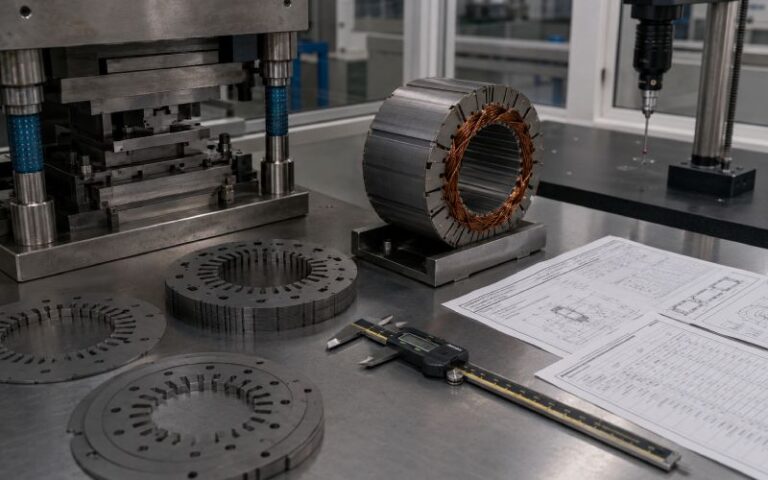
To speed up your project, you can label Lamination Stacks with details such as tolerance, material, surface finish, whether or not oxidized insulation is required, quantity, and more.
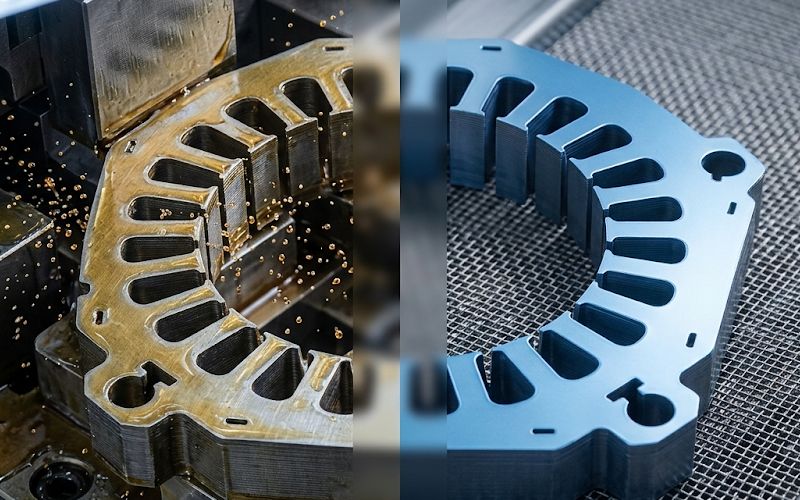
Electrical steel isn’t regular carbon steel. It carries an insulation coating — sometimes organic, sometimes inorganic, sometimes a hybrid — that is supposed to survive stamping and end up between laminations in the finished stack, doing real electrical work. That coating interacts with whatever lubricant you put on the strip. Sometimes helpfully. Often not.
The coatings on non-oriented electrical steel are thin. Typically a few microns. They’re there to limit eddy currents between laminations in the assembled core. Damage them during stamping, contaminate them with residue afterward, or strip them unevenly during cleaning, and the stack pays a price in core loss that may not show up until testing — or worse, until field operation.
So you’re not just lubricating a stamping operation. You’re lubricating a stamping operation on a coated substrate where the coating has a job to do later. That constraint changes everything about how you pick, apply, and remove the lubricant.
There’s also the metallurgy to consider. Higher silicon content grades — 2.5% Si and above, which are common in premium motor laminations — are harder and more brittle than mild steel. They abrade tooling faster. They crack at the sheared edge more readily if conditions aren’t right. The lubricant has to manage friction and heat at the punch-die interface while dealing with a workpiece material that is less forgiving than what most stamping engineers trained on.
It’s worth being specific, because vague talk about “reducing friction” doesn’t capture the full job description. In a progressive die stamping laminations, the lubricant is working at several locations simultaneously:
Each of those zones has a slightly different pressure, temperature, and surface-speed condition. The lubricant doesn’t get to choose which zone it serves. It has to work across all of them, with whatever film thickness managed to survive the feed system and whatever the coating on the steel left behind in terms of surface energy and wettability.
And then, after doing all that, it has to come off.
In many stamping applications, a little residual oil on the part is tolerable or even protective during storage. Lamination stacks don’t work that way.
Lubricant residue trapped between laminations in a stack can:
None of these are hypothetical. They happen. The question is always how much residue is too much, and the answer depends on the downstream process.
A stack that gets welded on the OD and never sees a furnace has different cleanliness requirements than a stack that goes through a full stress-relief anneal at 750°C or higher. A stack that uses self-bonding laminations with heat-activated adhesive coatings is particularly sensitive — any contamination on the bonding surface directly weakens the mechanical integrity of the core.
The cleanliness specification should be set before the lubricant is selected. Not the other way around. This ordering mistake is common.
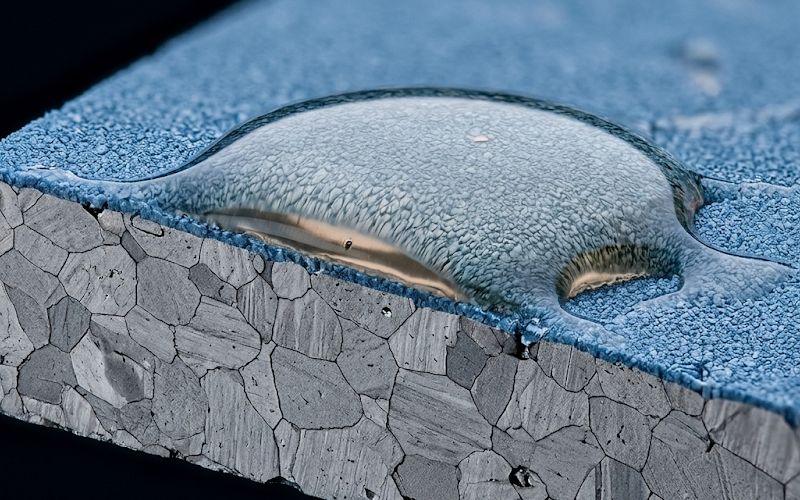
There’s no universal winner. The right choice depends on production speed, die complexity, steel grade, coating type, cleaning capability, and what happens to the lamination after stamping. Here’s a practical comparison:
| Lubricant Type | Film Strength | Cleanliness After Stamping | Coating Compatibility | Typical Application Method | Removal Difficulty | Best Fit |
|---|---|---|---|---|---|---|
| Vanishing oils (light petroleum-based) | Low to moderate | Good — evaporates partially | Generally safe with most coatings | Roller or drip | Low — may self-evaporate | Low-to-moderate tonnage, thinner gauges |
| Synthetic fluids (water-based) | Moderate | Good if dried properly | Varies — some attack organic coatings | Spray or roller | Low to moderate | Medium-speed progressive dies |
| Straight stamping oils (mineral-based) | High | Poor — requires active cleaning | Risk of coating softening with some organics | Flood or roller | High — needs solvent or aqueous wash | Heavy draws, thick gauges, high-tonnage operations |
| Dry film lubricants (pre-applied) | Moderate to high | Excellent — nothing to remove | Must be matched to coating chemistry | Pre-coated on strip by supplier | None needed | High-volume, high-cleanliness requirements |
| Chlorinated EP oils | Very high | Poor — residues are aggressive | Can damage some insulation coatings | Drip or brush | High — environmental and coating concerns | Rarely appropriate for lamination work |
A few things stand out from this table. Dry film lubricants eliminate the post-stamping cleaning problem entirely, but they require coordination with the steel supplier and add cost per kilogram of strip. They also don’t suit every die geometry equally well — complex progressive dies with many stations and tight carrier bridges may need supplemental lubrication even when the strip arrives pre-coated.
Vanishing oils are popular because they simplify the process. But “vanishing” is a relative term. These oils volatilize under heat and time. Whether they’re actually gone before stacking depends on ambient temperature, air circulation, time between stamping and assembly, and how much oil was applied in the first place. In a fast-running line where laminations go from die to stack in seconds, “vanishing” hasn’t happened yet.
The connection between lubrication and die life is well understood in general stamping. What’s less appreciated is how die wear feedback loops into lamination quality.
As a punch wears, the effective clearance between punch and die increases. That clearance change affects:
Burr growth is the visible symptom. But the invisible ones matter more for motor performance. Increased work hardening at the cut edge degrades magnetic permeability locally. Coating damage at the sheared edge can create electrical bridges between laminations when stacked under compression.
So lubrication that extends punch life by even 15–20% before regrind isn’t just a tooling cost story. It’s a lamination quality story. Less wear means more stable burr height, more consistent edge condition, longer runs between maintenance interruptions, and — this is the part that gets missed — more uniform magnetic behavior across a production batch.
The flip side: if you chase maximum die life by using a heavier, more aggressive lubricant, you may win on tooling but lose on cleanliness, coating compatibility, or post-stamping handling. That’s the balance in the title of this article, and it doesn’t resolve itself. You have to manage it run by run.
There’s a temptation to treat lubrication as the answer to all stamping problems on electrical steel. It isn’t.
If punch-to-die clearance is wrong for the material grade and thickness, no amount of lubricant will produce a clean edge. If the press speed exceeds what the feed system can track accurately, the strip arrives at the station in a slightly wrong position and the lubricant has nothing useful to contribute to that problem. If the die design crowds too many stations into too short a strip progression and the carrier is mechanically unstable, the lubrication system can’t stabilize it.
Lubrication is a process variable. A significant one. But it works inside a system, and that system includes clearance design, strip layout, press dynamics, die maintenance schedules, and stack preparation practices. When teams treat lubrication as the knob to turn when things go wrong, they often end up over-lubricating — which trades one problem for another.
Application method and uniformity deserve more conversation than they usually get.
Roller application gives reasonable control over film thickness and is common in coil-fed progressive die operations. But roller condition degrades. The roller surface picks up fines from the strip coating. Film thickness drifts as roller pressure changes or as lubricant viscosity shifts with shop temperature. Without periodic verification, what was a well-controlled film becomes an uncontrolled variable.
Spray application can achieve thinner, more uniform films if the nozzle geometry and pressure are maintained. It also wastes more lubricant to overspray and mist, which creates housekeeping and environmental control issues in enclosed press areas.
Drip systems are simple and cheap. They’re also inconsistent. On a fast-running progressive die, drip lubrication is often a legacy setup that nobody has revisited because it “works.” It does work — in the sense that the die doesn’t seize. Whether it works in the sense of optimizing the balance between tool protection and cleanliness is a different question entirely.
Pre-applied dry films bypass all of this. The film is there, it’s uniform, and it was applied under controlled conditions at the steel processing facility. The stamping operation doesn’t need to apply anything. The trade-off is cost, lead time, and reduced flexibility to adjust lubrication mid-run.
If the lubricant isn’t a vanishing type and the downstream process demands a clean surface, somebody has to clean the laminations. That step costs money, time, floor space, and environmental compliance effort.
Common cleaning approaches include:
The choice depends on volume, the specific lubricant used, the joining method for the stack, and whether the stack gets annealed. For interlocked stacks that go straight to a winding operation without any heat treatment, residue tolerance is often relatively high. For bonded stacks or annealed stacks, it’s much tighter.
Stress-relief annealing is common for lamination stacks that need to recover magnetic properties degraded by the stamping process. The anneal is typically done at 700–800°C in a controlled atmosphere — often dry nitrogen, nitrogen-hydrogen blends, or in some cases a light exothermic atmosphere.
At those temperatures, organic lubricant residues decompose. What they decompose into depends on the lubricant chemistry, the atmosphere, and the temperature profile. Best case: they volatilize cleanly and the atmosphere carries them away. Worst case: they carbonize on the lamination surface, react with the insulation coating, or produce enough decomposition products to overwhelm the furnace atmosphere and create locally reducing or carburizing conditions.
The problem is amplified in a stack because the residue is trapped between laminations. There’s no free surface for easy volatilization. The decomposition products have to migrate out through the edges of the stack, which in a tall, tightly compressed stack can be a genuinely slow diffusion path. So the laminations in the center of the stack may be exposed to decomposition products for longer than the laminations at the edges.
This is one of those issues that doesn’t show up in a test on a single lamination coupon. It only shows up in a production stack in a production furnace. And by then, people are usually looking for the problem somewhere else.
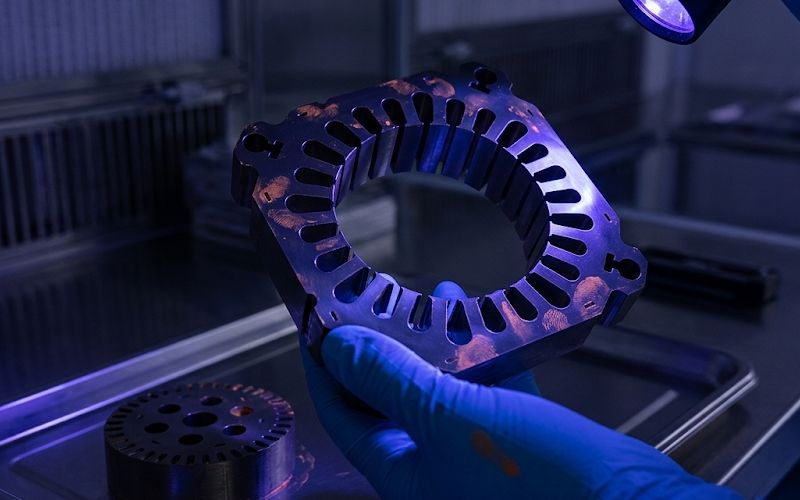
There’s no formula that spits out the perfect lubricant choice. But there are decision principles that tend to produce better outcomes:
Start from the cleanliness requirement, not the tooling requirement. Figure out what the downstream process can tolerate, then find a lubricant that meets that constraint while still protecting the die. Going the other direction — picking the best tooling lubricant and then trying to clean it off — usually costs more total.
Match the lubricant to the insulation coating. Not all coatings react the same way to all lubricants. Organic coatings can soften or dissolve in certain petroleum-based products. Inorganic coatings (phosphate-based or oxide-based types) are generally tougher chemically but can be mechanically damaged if the lubricant film isn’t thick enough to cushion the stamping forces. Get compatibility data before committing to a production lubricant.
Monitor film thickness, not just application rate. Knowing how many milliliters per minute your roller applies tells you what the system is doing. Knowing what’s actually on the strip tells you what the part is experiencing. Those are different numbers, and they drift apart over time.
Track burr trend and correlate it to lubrication changes. Burr height responds to clearance, speed, and lubricant film condition simultaneously. When burr height changes and nothing else moved, the lubricant is usually part of the story.
Don’t skip the cleaning validation. If your process includes a cleaning step, verify that it’s actually working. Not once during commissioning, but periodically during production. Residue testing on lamination surfaces — even something as simple as a water-break test or a contact-angle measurement — catches drift before it becomes a stack performance problem.
Keep the stamping lubricant discussion connected to the stack discussion. These are not separate engineering problems. A decision made at the press affects what happens at stacking, bonding, welding, annealing, and final assembly. Treating lubrication as an island is how teams end up with great die life and bad motors.
Some coatings do contribute a modest reduction in friction during stamping. Certain organic-inorganic hybrid coatings are specifically formulated to offer a degree of die protection in addition to their electrical function. But relying on the coating alone for lubrication is generally not viable for high-speed progressive die work, especially at high tonnage or with complex die geometries. The coating is too thin and too variable in friction performance to replace a dedicated lubricant in most production scenarios. It can, however, influence how much supplemental lubricant you need.
Sometimes, but it’s not a safe assumption. The insulation coating on electrical steel introduces compatibility concerns that plain carbon steel doesn’t have. Chlorinated extreme-pressure additives, for example, may be perfectly acceptable on uncoated carbon steel but can attack certain lamination coatings. The cleanliness requirement is also typically much tighter for lamination stacks than for general stamped parts. The lubricant that works fine on brackets and housings may be entirely wrong for motor laminations.
Directly, the lubricant doesn’t change core loss — it’s not in the magnetic circuit during operation (or shouldn’t be). Indirectly, the effects can be meaningful. Lubricant that fails to protect the tooling leads to faster burr growth and worse cut-edge condition, both of which increase iron loss. Lubricant residue that damages or contaminates the insulation coating between laminations can increase eddy-current losses. And lubricant that contaminates a stress-relief annealing cycle can prevent the full recovery of magnetic properties that the anneal was supposed to provide. The chain of effects is indirect but real.
It eliminates the cleaning problem and provides consistent film thickness, which are significant advantages. But it’s not always practical. Dry films add cost to the strip, require agreement with the material supplier, reduce your ability to adjust lubrication mid-run, and may not provide sufficient protection for the most demanding die geometries or heaviest tonnage operations. For high-volume production of a stable design with tight cleanliness requirements, dry films are often the strongest option. For lower volumes, frequent design changes, or very aggressive die conditions, a well-managed wet lubricant may still be the better path.
There’s no universal interval, but once per shift is a reasonable starting point for high-volume production. The actual frequency should be driven by how fast your application system drifts. Roller-applied lubricants tend to drift faster than spray systems because of roller wear and contamination buildup. If you’re seeing unexplained burr-height variation or intermittent die galling between maintenance intervals, inadequate or inconsistent lubricant film is one of the first things to investigate.
Higher press speeds generally increase the thermal load at the punch-die interface and reduce the time available for lubricant to redistribute between strokes. Both effects push toward needing a more robust lubricant film or a lubricant with better high-temperature stability. But the relationship isn’t strictly linear — die geometry, clearance, material grade, and strip thickness all interact with speed to determine how much lubrication is actually needed. Increasing lubricant application rate to match a speed increase is a common reaction, but it’s a crude one. The better approach is to understand where in the die the lubrication is actually marginal and address that zone specifically.
Outright electrical failure from lubricant residue alone is rare. What’s more common is a measurable degradation in interlaminar resistance — the ability of the lamination stack to resist eddy-current flow between individual sheets. If residue partially compromises the insulation coating or creates conductive carbonized deposits during annealing, the stack’s effective resistance drops. This won’t cause a short circuit in most cases, but it will increase eddy-current losses, reduce efficiency, and in some operating conditions contribute to localized heating that shortens insulation system life over time. The damage is chronic, not acute.




 English
  German
  Spanish
  French
  Italian