Let Sino's Lamination Stacks Empower Your Project!
To speed up your project, you can label Lamination Stacks with details such as tolerance, material, surface finish, whether or not oxidized insulation is required, quantity, and more.
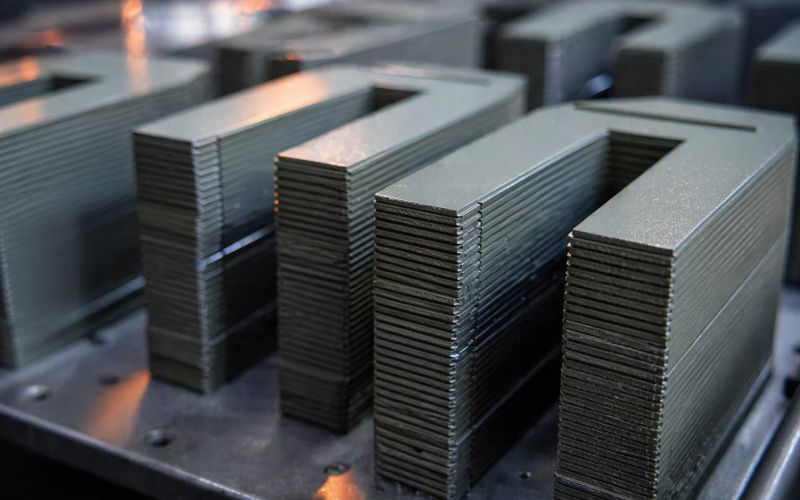
Epoxy powder coating on laminations can work well when the job is simple in one specific way: the stack needs reliable sheet-to-sheet insulation, decent handling durability, and no later heat step that asks the coating to survive normal stress-relief annealing. That last part changes everything. In common coating classifications for electrical steel, some inorganic systems are rated for stress-relief annealing up to about 845 °C, while organic-rich insulating systems can handle burn-off or moderate high-temperature exposure yet are not meant for normal stress-relief annealing. Some thin organic coating systems also show short-term temperature capability around 0.5 h at 500 °C and continuous temperature resistance around 180 °C, but that is not the same thing as saying they are safe for every post-stack heat cycle.
So the real question is not “Does epoxy insulate well?” Usually, yes. The harder question is this: what happens after coating—punching, stacking pressure, welding nearby, bonding, rework burn-off, or anneal. That is where lamination stacks stop being tidy lab samples and start behaving like production parts. Standards for thermal endurance of electrical-steel coatings focus on the change in adhesion, surface insulation resistance, and stacking factor after heat exposure for exactly that reason.
In plain terms, epoxy powder coating is a dry epoxy film applied to metal and then cured by heat into a continuous insulating layer. On laminations, that layer is there to interrupt sheet-to-sheet current paths. If adjacent sheets make too much electrical contact, interlaminar currents rise, local heating follows, and the whole point of laminating the core starts to erode.
That is why good lamination coatings are judged by more than one property. You care about insulation, yes, but also adhesion, pressure resistance, thermal stability, and stack factor. A coating can score well in a simple resistance check and still disappoint in the finished stack because the film cracks at edges, creeps under compression, or loses margin after the hottest process step. Thermal-endurance test methods for these coatings explicitly track changes in adhesion, insulation resistance, and stacking factor after heat treatment.
Epoxy powder coating is usually strongest in a process route that stays below the line where organic insulation systems begin to become the weak link. That means stamped laminations, moderate thermal exposure, and no later stress-relief anneal. In that window, organic insulating systems are valued for high surface resistivity and good punchability, and some thin-film variants are used specifically where good insulation and punching performance are both needed.
It also makes sense when the plant wants a post-applied insulating film rather than relying only on a mill-applied coating. There is a practical reason for that. Factory-applied electrical-steel films are very thin—often about 1.0, 2.25, or 3.25 µm per side in representative coating systems, with some C-6 style systems available around 3–8 µm per side. Thin is good for stack factor. Thin is also less forgiving if the rest of the route is rough. A tougher post-applied epoxy layer may buy handling margin, but it also moves you away from the thinnest possible build. That trade is real.
This is the mistake that costs the most and hides the longest.
If the laminations will later go through normal stress-relief annealing, an organic epoxy-rich insulation system may simply be the wrong family. Standard coating classifications separate these cases clearly: some inorganic systems are intended to survive stress-relief annealing, while organic-rich systems may withstand burn-off treatments or moderate elevated-temperature exposure but are not suitable for normal stress-relief annealing. That distinction is not academic. It should sit near the top of the drawing, the process sheet, and the purchase spec.
A related trap is confusing short-term temperature tolerance with full process compatibility. A coating may tolerate a brief hot event and still lose too much insulation, adhesion, or stack-factor margin after a longer or less uniform cycle. Thermal-endurance methods exist because “survives heat” is too vague to be useful in lamination work.
People do this all the time. Insulation looks marginal, so they ask for more coating. It feels sensible. Sometimes it is. Then stack factor starts drifting the wrong way.
Representative electrical-steel coating data puts very thin mill-applied films in the roughly 1–3.25 µm per-side range, while some higher-insulation thin-film systems are offered around 3–8 µm per side. Bonding-varnish systems commonly sit around 4.5–8 µm in example supplier data. None of those numbers is huge. Still, across a tall stack, every added micron occupies space that used to be steel. The geometry is boring, but it wins every argument. If your design lives or dies by active steel fraction, film build has to be controlled as tightly as resistivity.
There is a second issue. More thickness does not automatically mean more usable insulation inside the finished stack. Under pressure, with real cut edges, local contact points can still form. So the right target is not “maximum coating thickness.” It is the thinnest film that still holds electrical separation after cutting, compression, and the hottest downstream step.
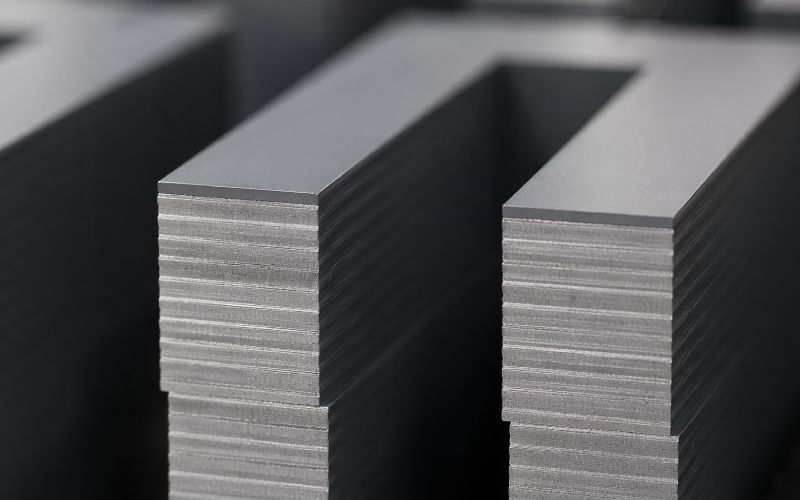
The face of the lamination gets attention. The edge deserves more.
Punching and cutting can create burrs that short adjacent laminations. The mechanism is straightforward: when edge contact closes a conductive path between sheets, interlaminar eddy currents can rise, local power loss increases, and the damaged area can run hot enough to trigger further insulation failure. One widely cited engineering paper on burr-affected laminations notes practical edge limits around 0.05 mm over a 10 mm strip length, allows punctual edges up to 0.1 mm, and then spends the rest of the paper showing why these details matter.
This is why a lamination stack can pass a coating check on flat sheet and still underperform in service. The coating on the face may be fine. The problem may live at the punched slot, the tooth tip, or the sheared edge where the film is most likely to be thinned, cracked, or bridged by burrs. In other words, edge quality is not a side issue. It is part of insulation performance.
Epoxy systems are cure-sensitive. Not a little. A lot.
Example process data for epoxy bonding-varnish systems shows crosslinking becoming significant around 140–150 °C, with workable cure windows as wide as 2 hours at 140 °C or 2 minutes at 200 °C, while degradation may begin around 2 hours at 200 °C or 2 minutes at 230 °C. Those are object temperatures, not just oven setpoints, and the coldest part of the stack still has to complete the cure while the hottest part stays below damage limits. Small parts often tolerate fast, hot cycles. Larger stacks usually do not.
That same logic carries over to epoxy powder coating on laminations. If cure is uneven, you can end up with a film that looks continuous but behaves inconsistently under compression or heat. Too little cure leaves a weak network. Too much cure, or too much local heat later, can embrittle or degrade the film. The stack does not care what the oven recipe said. It cares what temperature the steel actually reached.
Most engineers are not really choosing “epoxy” or “not epoxy.” They are choosing among process routes.
| Route | Best fit | What you gain | What usually bites back |
|---|---|---|---|
| Epoxy powder coating on laminations | Post-applied insulation when you need a durable film and do not plan to run normal stress-relief annealing later | Robust insulating layer, dry application route, useful when a tougher post-coat matters more than the thinnest possible build | Film-build creep into stack factor, cure-window sensitivity, edge damage after punching, trouble if later heat exposure exceeds what an organic film can tolerate |
| Liquid or self-bonding epoxy varnish | Bonded stacks, damping, or routes that want insulation plus adhesion between sheets | Bonding and insulation in one system; example process data shows common coating levels around 4.5–8 µm, recommended bonding pressure around 150–300 N/cm², and workable cure windows from roughly 140–200 °C depending on time | Cure history becomes critical; overbake risk is real; direct metal contact can still occur under pressure if the process is loose |
| Pre-coated electrical steel | High-volume work where thin, repeatable film build and stack factor matter most | Very thin, consistent coating systems; representative average film values often sit around 1.0, 2.25, or 3.25 µm per side, with some higher-insulation systems around 3–8 µm | Less forgiveness after edge damage, limited recovery if the downstream route is rough, coating choice must match the later thermal path from day one |
The numbers and process notes in that comparison come from standard coating-class references, electrical-steel product data, and epoxy bonding-varnish process data. The broad pattern is stable: pre-coated steel wins on thinness, bonding varnish wins on adhesion, powder coating can win on post-applied film robustness, and heat history decides whether any of them stay valid in the actual route.
Write the spec backward. Start with the hottest step, then work toward the coating.
Choose epoxy powder coating on laminations when you want a durable insulating film on stamped parts, you are not planning a later stress-relief anneal, and you can control cure history tightly enough that the whole stack sees the intended temperature window. Use it carefully, not casually. The coating itself is only one variable. Edge quality, pressure, heat, and film build do just as much work.
Avoid it, or at least stop and re-check the route, when someone says any of the following: “We may anneal later,” “welds are close to the teeth,” “we can always add a little more coating,” or “the sheet resistance looked fine before stamping.” Those are not minor details. That is the stack telling you where the risk sits.
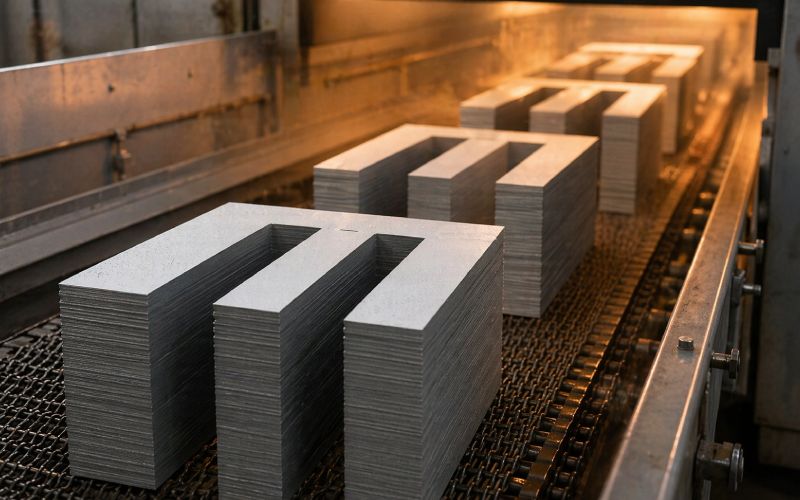
Not across the board. Powder coating is attractive when you want a durable post-applied insulating film and do not need the sheets to bond together. Liquid or self-bonding epoxy varnish is usually stronger when the stack needs both insulation and adhesion, or when the process is built around heat-and-pressure bonding. Example bonding-varnish data shows coating levels around 4.5–8 µm and recommended bonding pressure around 150–300 N/cm², which is a different job from a simple insulating overcoat.
You should not assume so. Standard coating classifications separate inorganic systems that can survive stress-relief annealing from organic-rich systems that can handle burn-off or moderate hot exposure but are not intended for normal stress-relief annealing. If a later anneal is in the route, this question has to be closed before the coating is chosen.
There is no universal best number. Thin pre-coated electrical-steel systems commonly sit around 1.0 to 3.25 µm per side, while some higher-insulation thin films are offered around 3–8 µm and epoxy bonding-varnish systems are often around 4.5–8 µm. The right target is the thinnest film that still keeps adjacent sheets electrically separated after cutting, compression, and the hottest planned thermal cycle.
Not by itself. If higher resistance comes from a thicker film that cuts too much steel out of the stack, you may solve one issue while creating another. Thermal-endurance methods for these coatings treat stacking factor as a first-class property for a reason. High resistance on paper is not the whole answer.
Yes. Punching and cutting can create burrs that short adjacent laminations. Once a conductive path is closed between sheets, interlaminar currents and local heating can rise sharply, and the damaged region can trigger additional insulation failure. Edge condition is part of the insulation system, not a separate machining note.
At minimum, test the finished film after the real manufacturing steps that matter: after cutting, after stack compression, and after the hottest expected heat cycle. For coating systems on electrical steel, the most useful property set is adhesion, insulation resistance, and stack factor before and after heat exposure. That is much closer to production reality than a room-temperature check on flat sheet alone.



 English
  German
  Spanish
  French
  Italian